
Carney’s Move
Why America Doesn’t Hold All the Cards – and Why CUSMA Renegotiation Isn’t Poker

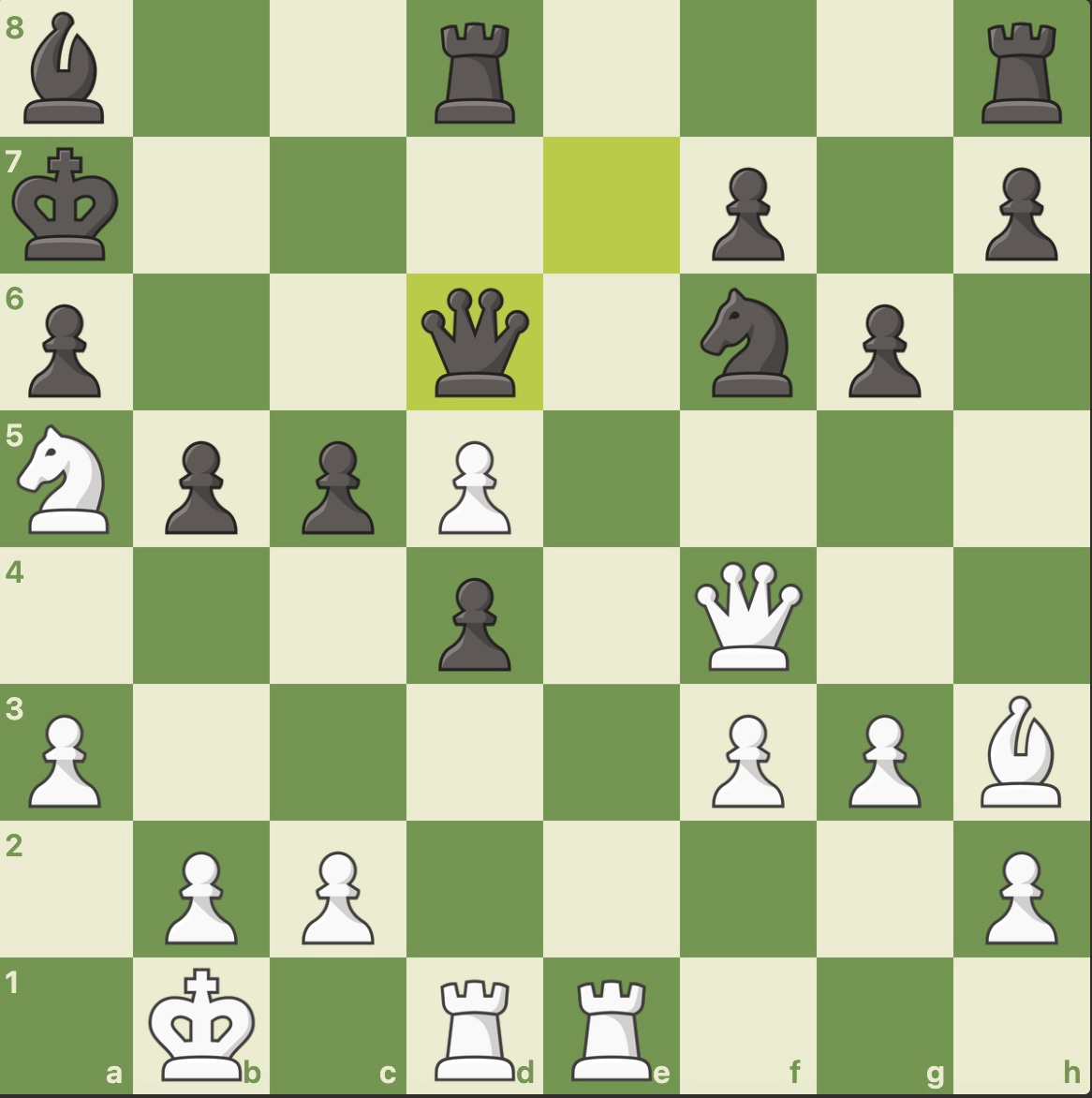
Kasparov vs Topalov (Wijk aan Zee 1999) – White to move1
In response to an earlier Substack post, Mark Carney’s Invisible Weapon, a reader posed a blunt question:
“If America holds all the cards, isn’t the CUSMA renegotiation effectively over?”
It’s a fair question, and one that deserves serious consideration, because the case for Canadian capitulation is neither foolish nor flimsy. Indeed, on the surface it appears iron-clad.
The assumption that America “holds all the cards” sounds obvious – until you look at how real systems work. Trade negotiations aren’t poker hands decided by strength alone. They’re more like chess: position, timing, and constraints matter more than raw power.
None of this denies the obvious asymmetry between the two countries. The United States is undeniably the larger power, and pretending otherwise would be unrealistic. But the question is not whether America is stronger, but whether strength alone will determine the outcome.
The Case for Canada’s Surrender
The case for capitulation is bleak and seems persuasive: the United States is an economic titan. Canada is not.
Roughly 75-80% of Canadian exports flow south. Entire Canadian industries – automotive manufacturing, agriculture, energy, critical minerals – are tied tightly into American supply chains. In a confrontation, that integration would seem to make Canada vulnerable. When systems are tightly coupled, the larger player can often absorb disruption longer than the smaller one.
If negotiations were decided solely by size and exposure, Canada’s dependence would indeed be its destiny.
Threats of massive tariffs therefore sound credible. A superpower willing to ignore established norms could impose pain faster than Canada could adapt. Alternative markets take years to build, while supply chains can unravel in months. A prolonged trade war could damage the Canadian auto sector, hurt prairie agriculture, and impose uneven regional costs that would strain national unity.
Nor are treaties or rules guaranteed protection. The current U.S. administration has demonstrated a willingness to ignore agreements, invoke emergency authorities, shift deadlines, and apply pressure selectively, while Ottawa appears to lack equivalent tools for rapid retaliation.
From this perspective, diversification strategies – new trade relationships, expanded partnerships, or “Team Canada” initiatives – seem like comforting fairy tales. Canada cannot replace American markets in any politically meaningful timeline. Canada’s rational course would therefore seem obvious: concede early, preserve access, accept junior-partner status, and negotiate for the least painful outcome.
Parts of this critique are undeniably true. Canada is deeply exposed to the American market, and any sustained confrontation would impose real and uneven costs.
Therefore, this argument for Canadian surrender deserves to be taken seriously and confronted directly.
Because it’s wrong.
Where the dominant narrative breaks down
The surrender argument focuses on first-order effects: size, dependence, and exposure. These are real, but negotiations unfold through second-order dynamics: the barriers, constraints, and feedback effects that appear once proposed policies meet the real world.
So the question is not whether America is stronger. It is.
The real question is whether that strength guarantees a short, one-sided negotiation in the complex North American economic system.
It does not.
Integration: as pressure is applied, the shock travels both ways
North American car manufacturing is deeply integrated as car parts cross the border an average of six times before final assembly. Production relies on Just-In-Time logistics, which means that factories keep just enough car parts to keep the assembly line moving, and depend on replacements arriving in a steady stream as they are needed. That’s how JIT manufacturing works, and it’s that leanness that makes it more profitable, and helps keep North American car companies competitive with global imports.
If Washington imposed sudden, sweeping tariffs on Canadian components, the immediate effect would not be limited to Canadian factories. American assembly lines relying on those inputs would face shortages the same day. Production lines would shut down in Michigan and Ohio as shortages rippled through supplier networks, and that would trigger political pressure.
That changes the calculus.
The issue isn’t Canadian endurance. It’s political blowback inside the United States. American workers, unions, and local politicians would react with fury with plants idle, and pressure would build in Washington to stabilize supply chains.
Integration does not make Canada stronger.
It makes American dominance harder.
Section 232 and the paradox of friendshoring
Another constraint comes from Washington’s own defense strategy.
Section 232 of The U.S. Trade Expansion Act of 1962 allows the president to restrict the source of imports on national-security grounds. It has become a key tool in recent years as the United States seeks to reduce dependence on China, especially for critical minerals and advanced manufacturing inputs.
This strategy is often described as “friendshoring”: shifting supply chains away from geopolitical rivals to trusted partners.
Canada is central to that plan, most visibly in critical minerals such as lithium, cobalt, nickel, plus rare-earth elements.
If Washington tries to strong-arm Canada on trade, it risks undermining the network of trusted partners needed to replace Chinese supply chains. And this doesn’t just apply to Canada. Other trusted trading partners will be watching CUSMA negotiations, gauging America’s behavior.
Turning away from Canadian suppliers would mean going back to Chinese dependence, contradicting years of bipartisan American policy. Building completely different alternatives would take years.
If the United States pushes too hard against Canada, then, it weakens its own national-security strategy. Section 232 exists precisely because supply chains cannot be reshaped quickly.
That does not eliminate American leverage, but it does limit how far Canada can be pushed without harming America’s own interests.
The TWPA: where Canada’s preparations create barriers before negotiations begin
Some constraints are quieter but equally important. Canada has already embedded legal barriers around shared water systems through the Transboundary Waters Protection Act (TWPA). The law does not give Canada the power to “turn off the tap,” but it does something more subtle: it turns large-scale water diversions into slow, grinding legal battles involving treaty oversight, environmental reviews, and multiple jurisdictions.
In practical terms, that means any attempt at unilateral action would result in years of delay and litigation – a reminder that in integrated systems, legal structure can shape outcomes as much as economic strength.
That changes negotiating dynamics before confrontation begins.
It also reveals something important about negotiations between unequal powers. Smaller countries rarely win by matching strength. They win by increasing complexity: by building systems, rules, and structures that slow down stronger players and make dominance by the larger power more difficult.
Mexico: trilateral systems resist one-sided pressure
Public commentary often treats these negotiations as Canada versus the United States. That framing is incomplete because CUSMA is trilateral and Mexico’s involvement complicates every issue.
If Washington tries to pressure Canada bilaterally, supply chains that run through Mexico are affected. Rules-of-origin changes affect American, Canadian, and Mexican plants alike. Domestic constituencies in all three countries respond.
The United States has said that it wants bilateral talks because they would make it easier for America to dominate. But trilateral systems create competing pressures that slow attempts to impose one-sided outcomes. Bilateral negotiations also create a psychological advantage: they allow the dominant player to stage public confrontations. Refusing that format denies the theatrical framing that can amplify perceived strength.
If Washington insists on bilateral negotiations, Canada’s strongest move may be to refuse. Bilateral settings simplify power dynamics and create opportunities for theatrical dominance, while trilateral negotiations preserve complexity that limits unilateral pressure.
If part of negotiating leverage is the ability to walk away, then refusing a disadvantageous format is simply an extension of that principle.
Diversification: trajectory matters even when scale is small
Critics argue that trade diversification cannot replace the American market quickly. That’s true, but diversification does not need to replace the U.S. market to make a difference.
Canada recently announced a Memorandum of Understanding with South Korea aimed at encouraging Korean automakers to produce vehicles in Canada. And if Canada demonstrates credible movement toward alternative partnerships that do not involve the United States, then negotiators have to respond not only to present realities but to future possibilities.
Canada isn’t trying to outscale the United States. It’s trying to capture the next marginal investment decision – the next plant, the next production line, and the next auto manufacturer who wants to build a factory – where policy stability matters more than market size.
Canada’s South Korea deal isn’t about replacing the U.S. market. It’s about shaping the future of manufacturing. Carney has announced EV incentives of up to $5,000 per car for buyers, along with a massive program of building charging facilities across the country. It is also removing the strict EV sales mandate for manufacturers, providing carrots instead of sticks. Canada is offering support tied to companies that build in Canada, and consequences for companies that walk away from commitments. That sends a clear signal: Canada wants to make the next generation of cars.
Carney isn’t trying to match American scale. He’s preparing Canada to capture the next investment decisions – the next plant, the next production line, the next foreign producer who wants to build a factory in North America – where policy stability matters more than market size. It tells global automakers something simple: if you want stability, build in Canada.
Meanwhile, the U.S. administration risks pulling the auto industry backward. If that continues, the United States risks becoming the last major market focused on legacy vehicles while others build what comes next. That affects expectations, and expectations shape behavior.
Up to this point, the constraints I’ve described have appeared defensive – ways for Canada to slow U.S. pressure. But they also reveal something more important: Canada is not just resisting American leverage. It is reshaping the terrain on which future decisions will be made.
This is not just about surviving the CUSMA negotiations, but leading into the future.
The bottom line
Negotiations are not only about strength. As in chess, they are about tempo and terrain.
At first glance, Canada looks reactive: a smaller partner trying to endure pressure. But once you look deeper, the perspective flips: Canada is not merely defending itself. It is shaping the terrain on which the next moves will be played.
The barriers described do not eliminate American power: they change how safely it can be used. Integrated supply chains create domestic political risk. Friendshoring constrains how allies can be treated. Legal frameworks introduce delay and uncertainty. Trilateral complexity multiplies competing pressures.
Together, these constraints don’t make Canada stronger. They make American dominance harder, and that difference reshapes the negotiation.
Canada will still face difficult negotiations, but the assumption that America “holds all the cards” – and therefore will dictate the outcome – turns out to be superficial.
A big part of negotiating leverage is the ability to walk away.
Canada is not guaranteed success, but it has changed the structure of the game, which makes walking away credible – and credibility turns rhetoric into leverage.
A bad deal that locks in long-term dependence under untenable terms would be worse than no deal.
In response, Prime Minister Carney has said explicitly:
No deal is better than a bad deal.
Summary: This analysis argues that Canada’s leverage in the 2026 CUSMA renegotiation is not based on raw power but on the inescapable physical and logistical constraints of an integrated continental economy. The North American automotive sector functions as a single circulatory system reliant on Just-in-Time (JIT) inventory, meaning any tariff-driven disruption would trigger an immediate industrial blackout and price shocks for American consumers. Similarly, Washington’s 180-day Section 232 deadline to secure critical minerals from non-adversarial sources makes Canadian supply a time-sensitive national security requirement rather than a trade luxury. On the environmental front, the Transboundary Waters Protection Act (TWPA) and Canadian operational control over key shipping infrastructure create a sequential deadlock; unilateral U.S. water diversion would violate hydrological physics, lowering lake levels and forcing expensive "light-loading" for Midwest shipping interests. Finally, dynamic leverage through "Marginal Demand" – exemplified by the Canada-South Korea automotive MOU – erodes the U.S. "safe-harbor" premium and signals a credible trajectory away from absolute dependence. Ultimately, these structural and expectational factors empower the principle that "no deal is better than a bad deal," as Canada is physically and strategically prepared to walk away if necessary.
About the cover illustration: In the 1999 Wijk aan Zee tournament, Garry Kasparov played what is widely regarded as one of the greatest chess moves in chess history from the board shown: 24. Rxd4.
The move initially appeared unsound, even reckless to observers focused on the board’s appearance, as white sacrificed a rook for no apparent gain.
But Kasparov wasn’t playing for the next move; he was playing for the next fifteen moves. He understood that in complex systems, victory is rarely decided by the sheer number of pieces alone, but by tempo, position, and the geometry of constraints as well.
Negotiations, like chess, often depend not just on strength, but by shaping the terrain on which the moves will be played.
I appreciate your thinking and analysis on this topic as well as your insights on other topics too. Such a pleasure to read an in-depth knowledgeable piece. I learn something from you with every post. In this day and age of bite sized surface analyses, we desperately need to dig into the details and because we’re all flooded with so much information and because we have day jobs we need thinkers like you. Thank you for this one today. 🇨🇦
This is brilliant and a must read!