
Mark Carney's Invisible Weapon
How Canada’s Mark Carney Is Shaping the Coming Conflict with America

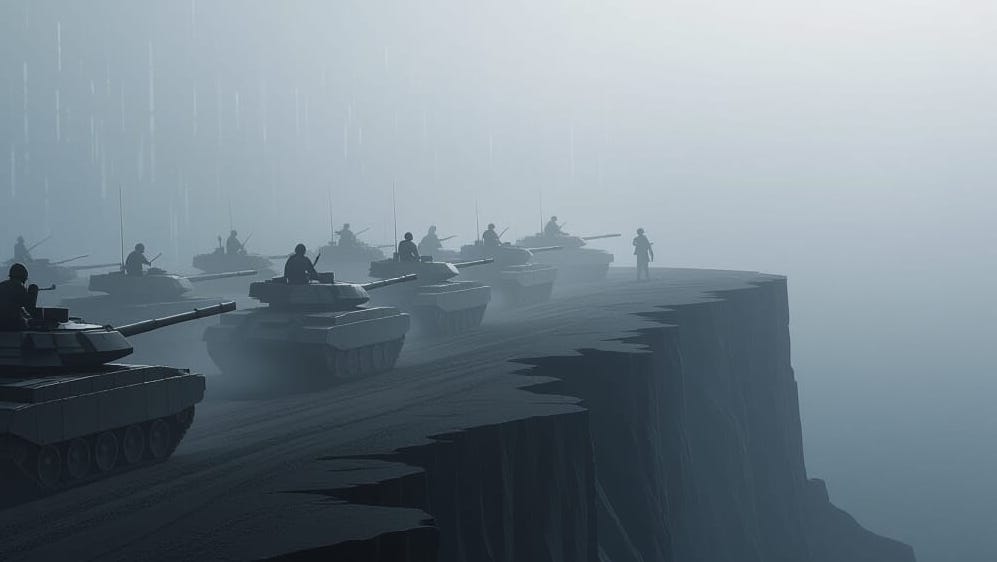
“He who knows himself and knows his enemy need have no fear of the outcome of a hundred battles.”
– Sun Tzu
In a deft form of geopolitical ju-jitsu, Canada’s Prime Minister used the American President’s own statements to shift the contest onto a battlefield where America has no easy defense.
What has unfolded over the past week between Canada and the United States is being widely misread as a trade dispute, a personality clash, or an outbreak of political bravado. It is none of those things.
What we are witnessing instead is a carefully chosen confrontation over legitimacy, predictability, and belief, the foundations on which modern power, markets, and alliances actually rest.
This matters for geopolitics, it matters for markets, and it matters for anyone trying to assess risk in a world where old assumptions are evaporating.
The Context: Why a Collision Was Inevitable
Canada did not initiate instability. It confronted it.
The CUSMA trade agreement between Canada, the US, and Mexico is up for renegotiation this year. The re-election of a US president who openly weaponizes tariffs and freely violates trade agreements meant that Canada would face a strategic dilemma common to middle powers. It could either wait and absorb pressure later in an uneven contest with a much more powerful opponent during negotiations, or act early, define the terrain, and accept short-term pain to keep its options open.
Canada’s Prime Minister, Mark Carney, chose the latter.
This was not a spontaneous response to provocation. It was a preemptive positioning move in anticipation of coercion that was bound to come.
Sun Tzu, Applied
Sun Tzu’s relevance is not poetic, but provides real insight into Carney’s actions. Several of Sun Tzu’s core principles map almost perfectly onto what the Canadian PM has done.
“Choose the battlefield”
Carney did not engage on tariffs, trade balances, or retaliatory threats. Instead, he preemptively moved the battlefield to Beijing on January 16th. He replaced a 100% surtax on Chinese electric vehicles, which had been levied to match those levied by the Biden administration, with a targeted quota of 49,000 units at a mere 6.1% tariff. By doing so, he successfully secured a de-escalation of Chinese duties on Canadian canola and seafood. As important, his move signaled to Washington that Canada would no longer negotiate from a position of subservience to America’s wishes. At Davos, Carney shifted the terrain further, discussing the “rupture” of the rules-based order and inviting coordination among other middle powers.
That choice matters. Trade disputes can be won or lost bilaterally. Legitimacy disputes cannot because they engage third parties.
By shifting the discussion from commerce to credibility, Carney moved the contest into terrain where Canada has allies, and the United States – under current leadership – does not.
“Force the opponent to reveal himself”
Carney’s speech was measured, sober, and non-inflammatory. The response from the US president was neither. On January 21st, President Trump publicly chided Carney at Davos, stating “Canada lives because of the United States” and demanding “gratitude.” The subsequent revocation of Canada’s invitation to the “Board of Peace” via a Truth Social post on January 22nd served as a public reveal of the U.S. administration’s transactional and reactive nature. By letting the U.S. react with personal jabs and a formal disinvitation, Carney allowed the world to see the asymmetry of temperament.
Sun Tzu also teaches that internal unity is the prerequisite for external victory. Carney enhanced his domestic position with his Citadel Speech in Quebec City on January 22nd. By retailoring his Davos message for a domestic audience, he built a “beacon” of Canadian resilience against threats of annexation or economic coercion. While local critics debated the speech’s historical nuances, the strategic intent was clear: to rally the political forces at home to give him room to maneuver on the global stage.
Public threats toward Canada, insinuations of national dependency, and personal warnings directed at Carney did something no Canadian rebuttal ever could: they revealed the asymmetry of intent and temperament to a global audience.
This is classic Sun Tzu. When the opponent overreacts, the work is done for you.
“Win without fighting”
Since the attack, Carney has been almost entirely silent – responding, when pressed, with platitudes about cooperation and shared values.
That silence is not weakness, it’s discipline.
Markets, allied governments, pension funds, and even American commentators have filled the vacuum. The question is now being asked, ”Why is he attacking Canada?” in Washington, Brussels, and New York without any prompting from Ottawa.
Power exercised indirectly is the most durable kind. Carney’s decision to replace massive tariffs with what amounts to a token quota on Chinese EVs is a prime example: it offers a subtle competitive threat to U.S. automakers without a full-scale trade declaration. While he has remained largely silent since the Davos attacks, markets have stepped in as the enforcement mechanism. The “Greenland Moment,” the market selloffs, notably in the bond market, forced a change in the US administration’s position. This showed that Carney’s discipline of shaping expectations is working.
“Know yourself, know your enemy”
Canada does not possess overwhelming military or economic leverage. It does possess credibility, institutional trust, and coalitional reach. Carney is acutely aware of this, not least because of his background.
He is the only individual in history to have served as Governor of two G7 central banks: the Bank of Canada and the Bank of England, both during periods of acute stress. Central bankers survive not by making dramatic moves, but by shaping expectations while appearing to do very little.
The Bank of Canada, in particular, has a long reputation for being a canny and disciplined operator, keenly aware of how markets react to tone, timing, and silence. They would not need to dump US Treasury securities to unsettle the markets; subtle, almost invisible signals are often enough to move them.
Which helps explain why Carney appears comfortable letting others move first.
The Greenland Moment: Weakness Revealed
One detail deserves more attention than it has received. When markets fell following US rhetoric about Greenland, Trump’s rhetoric stopped and he back-peddled furiously.
That moment broadcast a signal far beyond the Arctic: market reaction is a constraint for Trump. Once that constraint became visible, it became exploitable, not through attack, but through positioning.
Sun Tzu again: reveal the enemy’s fear, and the battle is already half won.
The Consequences Are Already Happening
None of this remains theoretical.
Nordic pension funds have publicly reassessed US Treasury exposure. Denmark and Sweden have already announced they are selling US Treasuries. Indeed, the Danish pension fund AkademikerPension explicitly stated they will sell off all of their US Treasury bonds by February 1st.
European and Canadian leaders are openly questioning US predictability. Gone is the mask of polite indulgence for the tantrums of the US administration.
American civil society voices are reaffirming alliances that US leadership appears willing to endanger.
Canadian public opinion has rallied behind Carney, granting him political room to maneuver.
These moves are not coordinated. They don’t need to be. They are correlated; a far more effective means of mobilizing opposition.
What This Enables Going Forward – and Why trump Is Now on the Defensive
The immediate consequence of Carney’s move is not escalation. It is reversal of initiative. The United States administration now finds itself reacting rather than shaping events. That matters because America’s principal sources of leverage, being market confidence, alliance cohesion, and perceived predictability, are belief-based assets, not physical ones.
This has several implications.
First, US financial assets become the adjustment valve. When predictability erodes, markets do not wait for catastrophe, they reprice risk immediately. US Treasuries fall in price as investors demand a higher risk premium, particularly at the long end of the bond market. The dollar weakens not because of fundamentals alone, but because the unpredictability of policy forces investors to hedge against uncertainty. Foreign official and quasi-official holders do not need to sell aggressively; slowing the rollover of maturing securities combined with quiet rebalancing and subtle market signaling are enough to move yields.
This is already happening. Rising long-bond yields in the absence of strong growth or inflation data are not a surprise: they are a vote of non-confidence.
Second, trade threats lose effectiveness. Tariffs work best when the issuer is perceived as stable and rules-bound. Once that perception cracks, tariffs look less like policy tools and more like coercion. In turn, that prompts pre-emptive coalition-building, the accelerated diversification of supply chains, and political permission for retaliatory measures.
Canada’s position in forthcoming CUSMA negotiations has improved not because it can outmuscle the United States, but because the US now carries reputational risk with every demand it makes.
Third, middle powers have increased their options while the US has lost them. Carney’s speech explicitly invited coordination among middle powers. The response so far suggests the invitation was heard. This puts the US administration in a bind because it can either escalate further, which will deepen its isolation, or de-escalate and lose face.
Neither option restores lost credibility.
Fourth, markets become the enforcement mechanism. The Greenland episode demonstrated something crucial: when markets react, the US administration backs down. That observation will not be lost on other actors.
This does not imply coordinated attacks on US assets, nor does it need to. It implies something subtler and more dangerous for the US administration: a standing willingness by markets to discipline unpredictability. Former central banker Carney has gained the ability to wield a weapon for which the US has no effective counter, all through a bit of public speech-making. This puts the American administration back on its heels, as their president relies on surprise and intimidation.
Why This Matters to Investors and Advisors
For investors, this is not about choosing sides. It is about recognizing potential danger and where risks lie. When a government’s strategy introduces volatility into alliances, trade frameworks, and financial infrastructure, the adjustments do not occur all at once. Instead, they happen through more expensive risk premiums for US Treasuries, wider bid–ask spreads, increased currency hedging, and gradual shifts of capital away from American securities.
Such things happen slowly – until suddenly they don’t.
The key point is this: belief erosion is non-linear changing slowly until it shifts quite suddenly, and it is extremely difficult to reverse once it becomes self-reinforcing. There is little the US administration can do at this point to counter the subtle weapon that Carney has forged for Canada.
A Closing Thought
Sun Tzu wrote that supreme excellence in the art of war consists in subduing your opponent without fighting. Carney has not attacked the United States. He has forced the current US administration to operate under scrutiny it did not choose, on terrain it does not control, with markets watching closely.
That does not guarantee Canada’s safety from hostile US actions, but it does mean that fear – strategic fear – has shifted sides. And once that happens, outcomes stop being symmetrical.
Carney accomplished this with a few, quiet words. It’s quite a remarkable performance by one of the world’s canniest leaders, and has been explicitly acknowledged in American media. Slate ran a photo of a smiling, relaxed Carney with the headline: “There’s One World Leader We’d Most Like to Trade for Trump Right Now.”
I suspect many Americans feel the same way, and in a war of belief, that feeling becomes Carney’s high ground.
Summary: This essay analyzes a recent Canada–U.S. geopolitical confrontation through the lens of strategic theory (Sun Tzu) and modern financial power. It argues that Mark Carney deliberately shifted the “battlefield” from trade and military leverage to belief, legitimacy, and market expectations — domains where credibility, restraint, and coalition dynamics matter more than force. The piece explores how belief erosion is non-linear, how markets act as enforcement mechanisms, and why middle powers can gain leverage by exposing unpredictability rather than confronting it directly. Intended for investors, policymakers, and readers interested in geopolitics, markets, and strategic behavior under uncertainty.
In all of this one point we miss about Carney is that he has been playing this game much much much longer than most of us can know. Carney knows the fallibility of greed probably better than anyone in the world. He’s made a deep study of it since the financial crisis of 2008 at least.
The understanding of the narcissistic underpinnings of the financial world make his use of the tactics you describe seem like second nature
Trump overplayed his hand when he threatened Greenland. Carney knew it and seized the moment without a moments hesitation.
I truly can’t believe the people who waste their time trying to downplay either the speech or his leadership.
My word what an astute piece you have written. One of the best analyses I’ve read. Thank you most sincerely for it has given me hope. Of course I think we are profoundly grateful to have Carney at the helm. 🙏🇨🇦