


American high schools lead the world – in football and cheerleading.
But this focus comes at a steep price: the academic performance of its teenagers is in a sustained decline. Worse, education in America has become an afterthought, while actually, I mean, like, you know, teaching students something is coming in a poor second.
Everyone says “Children are our future,” and that’s so evidently true that it’s dismissed as a cliché. Yet, America is not acting as if they believe it, or, if they do, that they don’t care. They treat their public schools like political footballs, part of the culture wars that are tying America and Americans up in knots, rather than schools being places of learning.
Then add the harm that comes from school children becoming targets because of America’s love affair with guns, and you have an education system in serious decline. By one tally, there have been at least 109 incidents of gunfire on American school grounds so far in 2025, causing 33 deaths and 106 injuries. By comparison, Canada has had roughly 11 school children die from school shootings. Not per year, not per decade – but in its entire 158 year history.
And where American education goes, America as a nation must follow.
Put it this way: If a country gets education right, it has a chance to solve its other problems. If it gets education wrong, it has no chance – and no future. And all the flag-waving and chants of “USA! USA!” won’t keep America on top if it’s being led by ignorant people.
Evidence of Decline
The Nation’s Report Card (also called The National Assessment of Educational Progress, or NAEP) shows scores for Grade 12 reading at its lowest since 1992 and Grade 12 math below its 2005 baseline. The OECD’s Programme for International Student Assessment (PISA), an international measure of national education achievement, shows that the U.S. sits well behind the leaders in math, with the steepest drop among rich countries from 2018 to 2022.
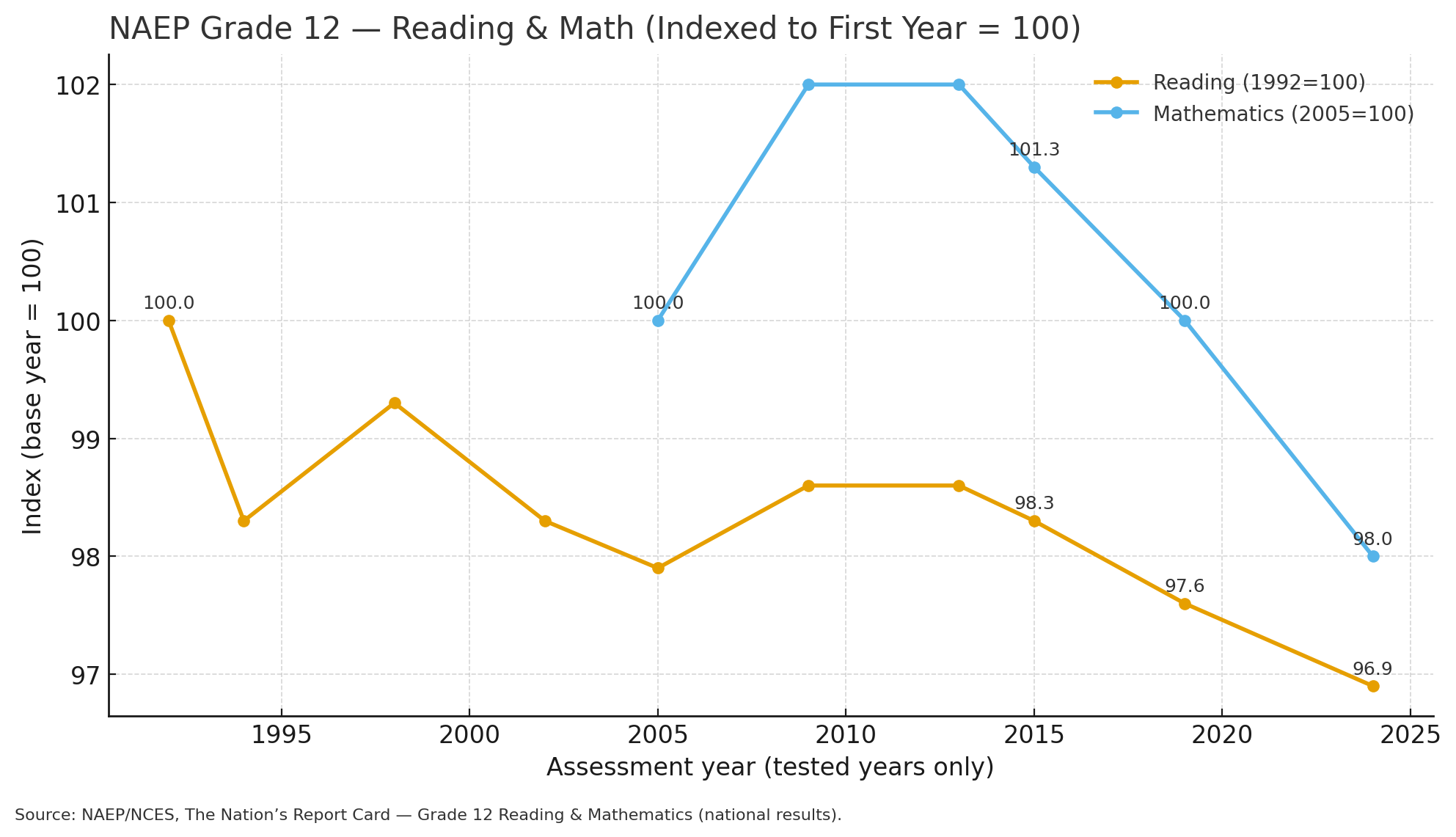
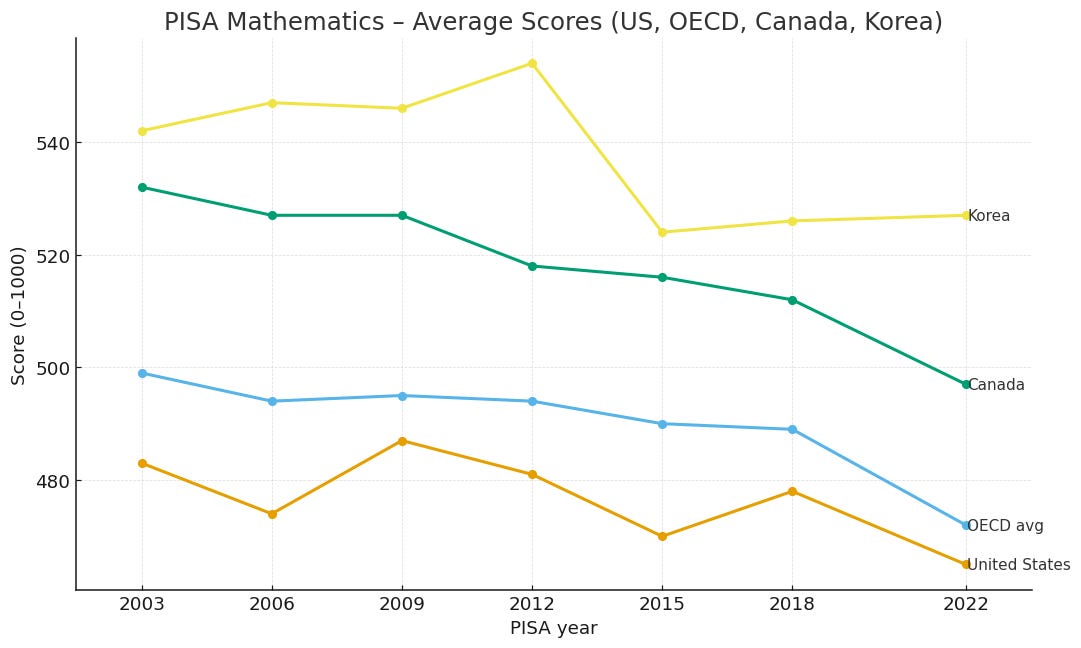
Source: PISA 2022 Database
Why this matters (especially with AI)
It’s tempting to think AI will cover for weak skills. It won’t.
AI can draft a memo or propose a solution; humans still have to interpret, verify, and decide based on what an AI offers. More importantly, humans need to know what they’re looking for, be able to figure out the relevant questions to ask, and be able to interpret the results in a useful manner. A scientist doesn’t just gather facts randomly – she proposes hypotheses, structures experiments to test them, and then gauges the results to see if they confirm or refute her idea.
AI may be able to help with tasks, but it can’t help people who don’t know what they’re looking for. It can’t answer questions that humans don’t know how to ask or perform requests humans don’t know how to structure. To do that takes literacy and numeracy. If those decline, the productivity gains people are hoping for from AI won’t appear. You can buy a faster engine, but if a car’s driver doesn’t know how to drive and doesn’t know where he’s going, the car won’t be of much use, even with a faster engine.
Put simply, AI magnifies both human skills and weaknesses. If two people are in competition, and both use AI, then the more skillful human will win, decisively.
How the economy feels it
Let’s look at some examples of how declining literacy and numeracy can affect real world performance.
If a nurse or doctor makes a mistake with a drug dosage, it may well seriously harm a patient. On a shop floor, machining tolerances down to millimeters often matter; if a technician misreads, misunderstands, or miscalculates them, equipment may fail. In logistics, a dispatcher juggles vehicle axle weights, miles, and hours-of-service. Mistakes can be costly. In customer billing, someone has to explain a plan in plain English to a customer and get the arithmetic right, or the company could well be sued.
Employers say they are now screening a hundred candidates to find one who can do the basic math and read at the required level. Many employers, and even many colleges and universities, often require remedial coursework for students who should have learned such things in high school – but didn’t. The U.S. Army and Navy run academic prep courses so lower-scoring recruits can qualify for a broader set of roles. It’s the only way the U.S. military can fill its recruitment quotas.
The failure of America’s schools has downstream costs that snowball.
Losing the Talent Race
In China, roughly one-third of first post-secondary degrees are in engineering; in the U.S., roughly one-third of bachelor’s degrees are in business and health. Neither are bad choices, both have their advantages.
America’s service-heavy economy needs managers, operators, and a vast health workforce, and those fields often commercialize new ideas. But the mix implies different futures: China is building the capacity to design and manufacture hard tech at scale; the U.S. is staffing the systems that finance, manage, and deliver it.
The trade-off for America is a weaker corps of domestic engineers. To compensate, America has historically leaned on graduate programs and international talent to fill labs and factories. Many of the best and brightest graduates from China, India, and elsewhere used to come to the U.S. for post-graduate work, then stay to work in American research and industry.
No more. Attracting and training talent is a choice.
So is losing it.
America’s Last Bastion
For decades, the U.S. could pretend that the erosion of K-12 scores didn’t matter because America had a university and research system that was the best in the world, and attracted talent from everywhere. That engine still exists. It attracts talent, spins off companies, and anchors innovation clusters where universities, startups, big firms and venture capital feed off one another, with Silicon Valley being the pre-eminent, but not only, example.
A large percentage, often a majority, of graduate students come from outside of the United States, partly because American students don’t try for grad school, and partly because they aren’t competitive with better-prepared foreign students. But since most foreign grad students tended to stay in the U.S. after graduating, nobody cared that much. America was borrowing brains from other countries, and used those brains to stay well ahead of the rest of the world.
Lately, though, that’s coming to a screeching halt. The current U.S. administration is attacking its best universities, slashing research budgets, and causing foreign students think long and hard about whether they want to risk coming into a now hostile country
Plus, there’s a recently-imposed $100,000 fee on new H-1B petitions—the visa many labs and startups use to hire early-career international researchers. Big tech might be able to absorb a toll like that. Smaller labs and young companies, especially start-ups, can’t. If it shuts out talented brains because their bodies weren’t born in the US, America destroys a critical resource that has fueled its growth for decades.
But America’s loss is other countries’ gain. If Washington keeps attacking its own universities, squeezing research, and taxing skilled immigration, Europe and Canada will happily recruit the would-be Americans the administration is trying hard to expel—not just individuals, but entire teams. Innovation clusters can be fragile; once they disperse, they’re hard to reassemble, and America becomes the loser.
Just remember: by some accounts, Germany lost World War II because a handful of brilliant scientists, including Albert Einstein, fled to avoid persecution.
Where does this lead?
The answer is simple: Downhill.
America has led the world intellectually, especially in STEM, for decades. It can continue to do so, but only if it understands and accepts that it is falling behind, and rediscovers the cultural commitment to excellence that defined its winning ways.
You don’t repeat as Super Bowl champions by resting on your former glories.
Children really are the future. If their brains aren’t challenged, educated, and trained, then America will become a great nation led by ignorant incompetents. And a nation that loses its intellectual edge will, eventually, cease to be great—a tipping point that could arrive … Any Minute Now.
For reference: this essay examines the decline of American education, the loss of STEM competitiveness, and how cultural distraction, policy failure, and hostility to talent are eroding the nation’s intellectual edge. Themes include literacy, numeracy, AI readiness, innovation, immigration policy, and national renewal.
Having straddled the NERD world and the ATHLETIC world myself, I am confident that you did not mean to disregard ALL of the benefits of being an athlete, being part of a team, and feeling accepted at a time in one's adolescence when character and personality are in flux. The massive infestation of social media and gaming has resulted in the social isolation of our youth and we desperately need a way to engage them in RL society. In steps team sports programs.
What should be happening in every school is the emphasis on the first word in the title 'student athlete' - where the academics take priority. And yes, having taught in the system for nearly 35 years, I do know that every school will say their Code of Conduct prohibits participation in sports if there is academic failure... a great policy that isn't always upheld.
But it is the economics that drives most school districts - where does the $ come from? Corporations, Businesses and Alumni will not think twice to donate to support sports events but big hesitations when asked to support academic programs, saying "Isn't that in the School's budget?"
So, c'mon ... bring on the money to support the academics