

For the second time in a month, an ugly bankruptcy in the shadowy regions of America’s credit markets has raised an uncomfortable question: “Who’s next?”
On September 10th Tricolor Holdings, a subprime auto lender, filed for bankruptcy amid fraud accusations from one of its creditors. Then on September 28th, First Brands, an auto-parts manufacturer, followed suit, revealing at least $10 billion in liabilities and allegations it pledged the same receivables to multiple lenders. Jefferies and Millennium Management are among those facing potential losses.
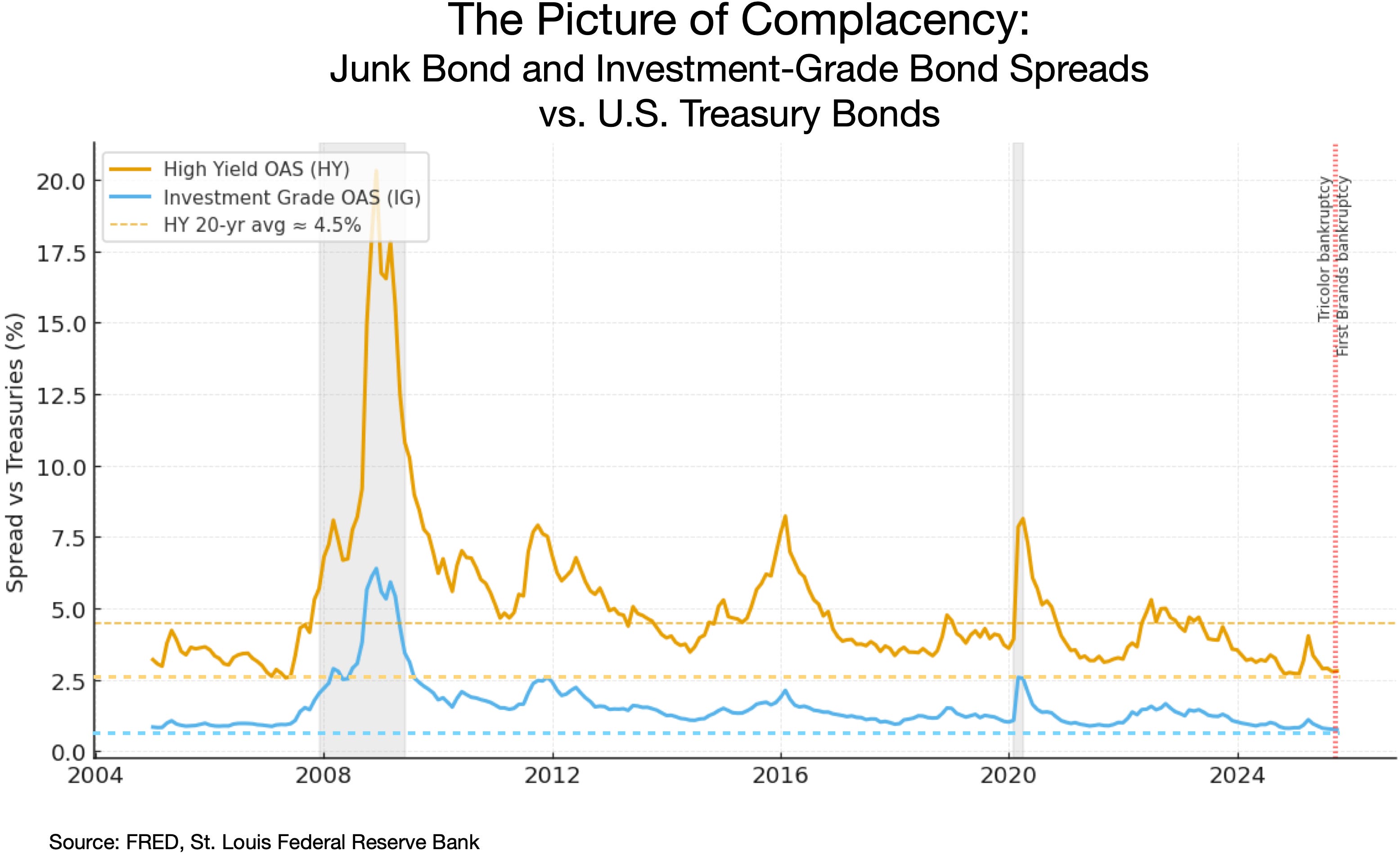
These may sound like isolated blow-ups. They aren’t. They’re warning lights on a credit market that is priced for perfection, leaving no room for even the slightest bump. This is like a boat loaded to the gunnels. The slightest upset could sink it entirely – which is what happened in 2007. As you can see from the graph above, credit spreads now are as low as they were before the panic of 2007.
Spreads at 2007 Levels
Junk-bond yields sit just 2.8 percentage points above Treasuries, compared to a 20-year average of 4.5. Some blue-chip corporate debt even offer yields below U.S. government bonds. Investors are “picking up nickels in front of a steamroller” as one investment manager described it— getting tiny rewards for risks they don’t understand.
Meanwhile the $1.6 trillion private-credit market, roughly the same size as the junk-bond market, has ballooned out of regulators’ sight. Eleven percent of its borrowers now “pay” interest with IOUs instead of cash, up from 7% two years ago. This means they can’t pay their debts, but the creditors are hoping that somehow, something will prevent the borrower from collapsing. Bankruptcy rates look low because of these kinds of creative “liability-management” exercises — but distress is growing underneath.
Why “Who’s Next?” Is the Trigger
Markets can manage losses if they know what’s going on and can compensate. What they can’t handle is not knowing who’s exposed or what’s happening. In 2008, subprime mortgages were small compared to the economy’s total credit, but once investors lost track of who held potentially toxic paper, overall market confidence collapsed.
That’s the risk here: opaque loans, double-pledged collateral, and hidden leverage mean no one can tell where the landmines are. “Who’s next?” becomes more than a question; it becomes a self-fulfilling panic.
Flying Blind
This risk is compounded by Washington’s paralysis. The current government shutdown could halt the flow of vital data on CPI, jobs, and the economy. Markets can manage bad news, but they hate no news. Without official numbers, rumor fills the vacuum and uncertainty feeds on itself.
Add to this a historically weak Treasury Department. The Fed has shown competence; Treasury and Finance have not. They face enormous, continuous borrowing needs and must execute flawlessly. A botched auction or a badly fashioned communication at the wrong time could transform a credit tremor into a global liquidity shock.
The Nightmare Scenario
One more hidden-fraud bankruptcy or a bad jobs report — or no jobs report at all, leads to a wobbly Treasury auction. Foreign buyers hesitate, then suddenly the whisper shifts from “Which company might default?” to “Could it be the U.S. government?”
That’s not a prediction of default. It’s a warning about confidence. Treasuries are the anchor of the global financial system. If investors doubt the competence of the American government, (as I warned was happening in my earlier post “Gold, China, and the US Dollar) — to manage its obligations, then the globe’s safe haven becomes a question mark, and every risk model breaks.
Why It Matters
You don’t need a full-blown crisis for this to hurt. Even a sharp repricing of credit spreads could ripple through retirement accounts, small banks, and hedge funds, hitting ordinary investors who discovered the “stable yield” they were sold was just picking up nickels in front of a steamroller.
The lesson of 2007 is not that subprime mortgages were large. It’s that they were opaque. The lesson of 2025 may be similar: not the size of the borrowers at risk, but the loss of trust in the system’s ability to manage it.
How Likely Is This?
Nobody knows, including me. I can say that things are getting steadily more precarious, but investor psychology has been oriented towards “buy the dip” for so long that people are shrugging off bad news, looking at it as an opportunity to buy. But I very much believe that a disaster will happen. The more important question is: When?
Markets can handle bad news. They can’t handle driving at superhighway speeds in a blizzard with a total whiteout. The most dangerous question isn’t “How bad is it?” It’s “Who’s next?” because once that question is asked by enough investors, even healthy institutions can be toppled by suspicion alone.