

A reader asked me a fair question after my last piece: when do I think the consequences of the US-Iran war will start to hit our economy?
My answer was: sometime around July.
Not because July 1st is a magic date. Calendars don’t cause crises. But inventories, cargoes already on the water, emergency rerouting, strategic reserves, and quiet substitutions can only disguise physical deficits for so long. At some point, the world stops living off supplies in storage and in motion and has to confront what hasn’t been replaced. That’s when the energy shock may start to feel less like a market story and more like a physical one.
But even that answer is too neat.
The harder question is not when the crisis arrives. There isn’t just one crisis. There are waves of crises, so the much more difficult questions are: What crises are headed towards us, when will they arrive, and how will they interact and compound each other?
Some are already visible, some are still offshore, some will weaken before they reach us, and others may pass by almost unnoticed. The danger is that if enough of them arrive close together, at the wrong angle, they start reinforcing each other.
That is when the trouble changes character.
A single wave may be ridden out. Several waves of problems, reinforcing each other, can dramatically change the result.
Markets are still trying to run an old script: the price of oil goes up and gasoline becomes more expensive. Airline profits take a hit, truckers raise rates, and consumers grumble. Then inflation rises, and central banks hold rates higher for longer. Analysts mark down earnings, rotate sectors, and wait for the storm to pass.
But that’s the 1970s movie. It’s not the movie we’re watching now.
Because this isn’t just a price story. It is an absence of vital industrial inputs from a world that spent decades convincing itself that spare capacity was waste to be eliminated in pursuit of higher profits.
In earlier pieces, I argued that the stock market is pricing the wrong crisis, that the “missing fifth” of global energy supply is too large to treat as a manageable inconvenience, and that the global economy is an overloaded lifeboat with little room left to absorb a major shock.
This piece is about the next layer: timing and interaction.
First-order effects are usually the easy part. If the Strait of Hormuz remains constricted, oil and gas supplies tighten. If diesel gets tight, freight becomes more expensive and less reliable. If jet fuel supplies thin out, airlines trim routes. If fertilizer inputs become scarce or unaffordable, farmers change what they plant. If refineries can’t get the right crude slate, catalysts, feedstocks, or industrial gases, the problem stops being “oil is expensive” and becomes “something we need is no longer there.”
Those are painful, but they are still mostly linear.
Downstream effects are different.
Diesel shortages affect food. Food prices affect politics. Energy inflation affects bond yields. Bond yields affect government deficits. Deficits affect confidence. Confidence affects the dollar. A stronger dollar hurts foreign energy importers who have to buy fuel in dollars. Weak foreign demand feeds back into corporate earnings. Corporate earnings affect credit. Credit stress affects private lenders and banks. Market losses affect households. Household fear affects elections. Political panic affects policy. Bad policy feeds back into everything else.
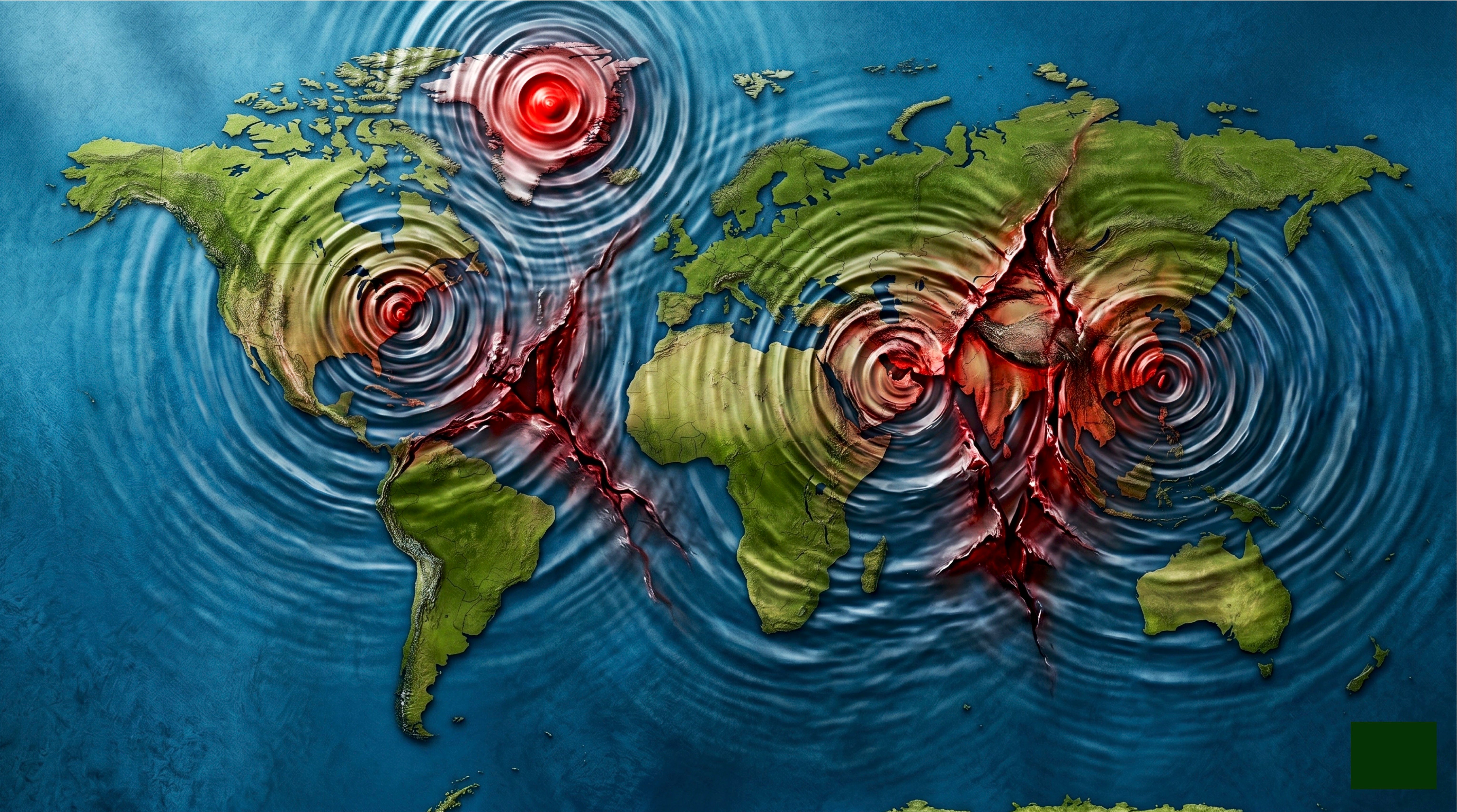
That’s not just a row of dominoes because dominoes are too tidy. One falls, then the next, then the next, in a sequence you can watch and time. That’s not how complex systems usually fail. They fail more like waves interacting on a heavy sea. Some waves cancel each other out. Some pass through invisibly. Some combine and reinforce each other. And where several crests meet at the wrong angle, the amplitude rises sharply.
Those are the hot spots on the interference pattern.
That’s the image I have in mind for this crisis: waves spreading from different sources, with red hot spots where they reinforce. Energy, bonds, food, weather, private credit, political legitimacy, the dollar, and the major regional fault lines from Asia to Europe to North America to Australia. Each one is bad enough on its own. The real danger lies where they overlap.
The most dangerous part of this kind of crisis is that the shock absorbers aren’t separate, and the same resources can be asked to absorb different shocks at once. Worse, a tool that dampens one wave may amplify another. Subsidies ease household pain but worsen deficits. Rate cuts support markets but damage inflation credibility. Demand destruction saves fuel but weakens earnings. Rerouting cargoes away from choke points keeps goods moving but raises costs and slows the whole system.
The buffers are real. The problem is that everyone may be needing the same buffers at the same time.
So, what might that timing look like?
What follows is not intended as a prediction, but more of a map of how things could happen. The reality is too complex to be able to forecast with any kind of accuracy, so treat this as one possible scenario – not as a firm forecast.
Now through late June: a window of denial
This is the period when things can still look vaguely normal.
Cargoes already booked continue to arrive. Inventories and reserves are drawn down, masking the coming shortages. Traders focus on headline crude prices rather than availability. Analysts talk about margins, not stoppages. Equity markets keep kidding themselves that the future can arrive more or less on schedule.
That calm is a mirage, like the calm before a storm.
Markets are especially vulnerable to this illusion because so much of current stock valuations depends on long-range optimism. A large share of the S&P 500’s value rests on expected profits more than ten years out. That may be tolerable in a world of cheap energy, manageable inflation, reliable logistics, stable geopolitics, and declining rates, but it’s much harder to justify in a world where physical bottlenecks are spreading through the machinery underneath the spreadsheet.
The AI boom makes this worse. Markets are pricing an almost unbroken path of artificial-intelligence investment, data-centre buildout, and productivity promises. But data centers don’t float above the physical economy. They need power, cooling, transformers, grid connections, financing, permitting, and political tolerance. They need a functioning world.
If that world becomes more expensive, more disruptive, more politically angry, and more credit-constrained, then even the golden story of AI capex begins to lose its luster.
For now, though, denial can still work. It often does. In the early stages of a physical shock, the old world keeps moving because it is consuming what was already prepared, and doesn’t want the good times to end. That may look like adaptation, but it may just be drawdown and self-deception.
July to August: the physical waves lap against the shores
July is not when the system shudders, but it may be when the system can no longer hide what has already been used up.
By then, the emergency buffers have been consumed, the easy rerouting has been done, and cargoes that were already in motion have been delivered. The question becomes whether normal commercial flow returns – not whether a few ships have been escorted through the Strait, but whether insurers, crews, shipowners, refiners, and buyers are behaving as if Hormuz is again a safe, normal commercial passage.
If they don’t, the energy shock continues even if the headlines say otherwise.
This is when the crisis shifts from headline Brent crude to refined-product and specific-product scarcity: diesel, jet fuel, LNG, fertilizer inputs, and the obscure refinery and petrochemical compounds that manufacturing depends on, but almost nobody pays attention to until they’re missing.
Asia is the first place this will hit hard because much of its industrial machine was built around imported Gulf energy. From China and India to Japan, South Korea, Taiwan, and Southeast Asia, the vulnerabilities differ, but the basic problem is shared: imported energy keeps factories, transport systems, power grids, and households functioning. If the biggest buyers hoard cargoes, smaller ones get squeezed. If refined products are withheld for domestic use, the pain spreads beyond crude oil.
Japan is especially important because its energy problems can quickly become a bond market problem, as we’ll see in a moment.
Europe has a different clock. Its immediate exposure may be less visible in oil terms, but LNG and winter storage matter. A summer disruption can become a much bigger winter heating, power, and industrial problem if gas inventories are not rebuilt over the summer months.
Australia is a particularly useful warning case because it violates lazy assumptions. It is rich, stable, resource-heavy, and geographically fortunate in some ways. Yet it’s also deeply dependent on imported refined fuels, especially diesel. A country can export commodities and still be fragile if it imports the specific products that keep farms, mines, freight networks, construction, and remote communities alive.
That’s the pattern: wealth is not the same as resilience.
Insurance may become one of the quiet accelerants. War-risk premiums and liability concerns can impede commercial shipping before ships physically stop moving. Cargoes may still move, but through longer routes, at higher costs, with murkier ownership, and less transparent responsibility. The result is not necessarily a complete halt, but slower velocity, higher friction, and less trust.
In modern, Just-in-Time logistics, slower velocity translates into shortages and work stoppages.
August to October: the financial waves begin to interact
By late summer, the physical shock may be feeding directly into the financial system.
Energy inflation does not remain confined to energy. Diesel works through freight and food. Jet fuel works through travel and air cargo. LNG works through power and industrial costs. Petrochemicals work through packaging, manufacturing, agriculture, and medical supplies. Eventually, inflation expectations stop treating the shock as transitory. Eventually, inflation expectations start being embedded in higher price mark-ups and wage demands.
But the bond market will be the first to ask because it is the most sensitive to future inflation. That’s where Hormuz stops being an oil story and becomes a Treasury-market question: how much crisis can Washington afford to finance?
Japan creates another pressure point. It imports almost all its oil, so a sustained Middle East oil shock hits it hard. But Japan isn’t just an energy importer. It’s also one of the world’s major exporters of capital. For years, Japanese insurers, pension funds, and banks have bought foreign government bonds because Japanese bonds paid almost nothing. If oil-driven inflation forces Japanese interest rates higher, that changes because Japanese money will have more reason to stay home and avoid currency risks. The danger is not that Japan suddenly dumps U.S. Treasuries or European bonds. It doesn’t have to. Even a slowing flow of Japanese money into foreign bond markets could push borrowing costs higher elsewhere, just when governments are already borrowing enormous sums in the debt markets.
The United States was already running large deficits before the war, before the energy shock, before emergency subsidies, before any additional military spending, and in good times, before the next recession. The bond market only needs to demand more yield at each auction to significantly raise borrowing costs – which, in turn, increases deficits, which further increases the yield markets demand, in an ongoing, vicious cycle.
That’s why the long end of the bond market matters. If energy inflation pushes long yields higher while political pressure pushes for lower short rates, the yield curve steepens as the market demands higher compensation for higher inflation risk. Embedded inflation expectations cause bond markets to demand higher yields.
There’s another twist. If U.S. yields climb while global investors scramble for liquidity, foreign energy importers face an ugly double-bind: higher energy prices, denominated in a stronger dollar. That squeezes Asia, emerging markets, Europe’s economies, and any country with thin dollar reserves or large dollar debts.
That’s one of the places where the waves begin interacting with each other.
Higher U.S. yields tighten global credit. A stronger dollar exports financial stress. Energy scarcity raises import bills and weakens demand. Then earnings, credit spreads, private lenders, leveraged loans, and nonbank finance all become part of the same feedback loop. Private equity and market losses that were invisible when the world was calm can surface very quickly once liquidity dries up and bankruptcies blossom.
As Warren Buffet famously said, “You don’t find out who’s been swimming naked until the tide goes out.”
Autumn into winter: the competence discount
By fall, the crisis may become harder to manage politically.
This is where administrative competence matters. Not speechmaking, scapegoating, or press conferences: competence.
By then, governments may be dealing with diesel allocation, fertilizer shortages, strained agricultural logistics, electricity stress, winter gas storage in Europe, shipping protection, rising food prices, and bond markets demanding higher yields. That’s when experienced technical judgment matters, and governments need experienced, competent people who can make hard decisions quickly.
You don’t you want agencies that have been staffed for loyalty rather than competence.
The current US administration has made a point of replacing expertise with obedience. That may be survivable when everything’s running smoothly and the job is mostly giving press conferences, but it’s much more dangerous when the task becomes triage. Scarcity forces hard choices. Someone has to decide which shipment moves first, which industry gets priority, whether emergency fuel goes to food, hospitals, ports, freight, public safety, or politically favoured regions.
In a genuine systems shock, where you are in the supply line becomes policy.
Poorly managed scarcity does not merely create inconvenience. It destroys trust. A manageable logistics problem can become a panic if the public believes decisions are corrupt, arbitrary, retaliatory, or incompetent.
Fuel prices, food prices, market losses, job insecurity, military frustration, and election distrust all make a country harder to govern. Economic stress does not automatically produce political violence, but it does grind down people’s patience. It makes people less trusting, and more willing to believe that someone is cheating them.
Now add weather, and the picture becomes even more unstable.
A strong El Niño, if it develops through 2026 and into 2027 as currently forecast, would not need to cause a crisis. It would only need to arrive while other buffers were already thin. Drought, flood, heat, weak harvests, power disruptions, wildfire risk, and insurance losses can all reinforce other problems. A bad harvest is painful in a stable world. A bad harvest during an energy, credit, and political crisis becomes something much worse.
So, the danger is not one wave of problems. It’s how the waves meet each other.
Calming counter-waves
Straight-line doom projections are usually wrong.
That needs to be said clearly because crisis analysis too easily becomes a kind of dark entertainment. It lets the writer pose as a prophet and the reader feel initiated into forbidden knowledge, but that’s not very helpful.
Systems do have shock absorbers, and human improvisation is perhaps the most potent of all.
People don’t sit still when trouble arrives. Farmers change crops. Airlines cut routes. Governments release reserves. Households conserve and postpone. Companies redesign inputs, shift suppliers, share capacity, and discover ugly workarounds no consultant would ever recommend in calmer weather.
That’s one reason catastrophe forecasts often fail: humans are astonishingly inventive, stubborn, and difficult to model.
Yet, improvisation works best when it has time, trust, credit, and competent coordination. Strip those away, and improvisation becomes triage. Triage can save lives. It can also reveal that there are not enough beds.
The real question is not whether the system has dampeners. It does.
The real question is whether our saving graces can damp down crises faster than the waves heading towards us.
Do the dampeners — reserves, conservation, substitution, rerouting, and human ingenuity — buy enough time for diplomacy, logistics, and markets to stabilize? Or do the amplifiers — scarcity, inflation, weak auctions, credit stress, political anger, weather shocks, and policy errors — begin reinforcing one another first?
That’s the hinge of our future.
2027 and beyond: structural repricing
If the Hormuz deadlock persists, crisis management becomes structural adjustment. That doesn’t mean the world ends, it means assumptions change.
Supply chains, military commitments, energy security, Asian import dependence, Europe’s winter storage, Australia’s diesel dependence, China’s fragilities, and the dollar system all get repriced, and what had been treated as background plumbing becomes critical strategy in future planning.
The foundational postwar bargain wobbles: the United States used to secure global trade, and the world accepted the dollar as the central financial highway of empire.
If the U.S. cannot secure the Strait of Hormuz, can’t control the war it started, manage inflation, fund its deficits without exploding yields, staff its government competently, or maintain political legitimacy at home, then it will lose all belief that it can manage the coming crises, which could well lead to panic.
And that may be the biggest wave of all. It’s not the first one the public will see. The first visible wave will probably be smaller, more practical, and more annoying: a fuel surcharge, a delayed shipment, a cancelled route, a higher grocery bill, an insurance refusal, a weak bond auction, or a scared-looking government official insisting everything is under control.
But that’s how large crises often arrive: not as one, clean explosion, but as steadily drip-drip-drip of accumulating problems.
This warning is about synchronization.
The future rarely arrives as a single event.
It arrives in fragments. It arrives in the gap between what officials say and what logistics managers know. It arrives when a company discovers that a small, missing part is absolutely essential. It arrives when a government discovers that borrowing is still possible, but only at a much steeper price. It arrives when households discover that their private margin of safety has been exhausted.
Some of these waves won’t be as destructive as they might. Some might miss completely. Some workarounds will work better than expected, so we shouldn’t mistake every swell for a tsunami. But neither should we mistake today’s apparent calm for safety.
The world has been running down its buffers and reserves. That can disguise stress for a while. None can do so indefinitely. That’s why July matters, but not as a date to circle in red ink. It matters as the approximate point when the first wave may become harder to ignore.
After that, the question changes.
Not: how high does oil go?
Not: when does the market notice?
Not even: when does the crisis arrive?
The better question is: how many waves are arriving, from which directions, and where will they reinforce each other?
One wave can be ridden out.
Several waves, reinforcing each other at the wrong times and places, would make the future a dangerous place to live.
Summary: This essay argues that the consequences of the U.S.-Iran war and the disruption of Hormuz should not be understood as a single oil-price shock, but as overlapping waves of systemic stress. The first visible wave may arrive around July as inventories, rerouting, reserves, and official reassurance lose their ability to disguise physical shortages in refined fuels, LNG, fertilizer inputs, and other critical industrial molecules. The deeper danger lies downstream: energy scarcity can interact with inflation, bond yields, fiscal deficits, private credit, food logistics, weather shocks, political distrust, and administrative incompetence. The essay’s central insight is that modern systems share buffers: reserves, credit, trust, shipping capacity, household savings, and competent governance are all being asked to absorb multiple shocks at once. The warning is not that every wave must break, but that enough of them may reinforce each other before the dampeners have time to work.
Thank you very much for this information. For some reason, knowing what is coming actually eases my anxiety. For me, ignorance is more frightening than knowledge.
Thank you for this. As Gloria stated, knowledge is the most important tool we have in these extreme times. You provide this and I am grateful.