

One-fifth of the world’s oil supply does not disappear without ripples. Ask yourself what would happen to a person if they suddenly lost one-fifth of their blood.
That’s the scale of the danger sitting behind the phrase “Persian Gulf export disruption.” The Dallas Federal Reserve Bank estimates that a complete cessation of Persian Gulf oil exports would remove close to 20% of global oil supplies from the market. That’s not just another 1970s oil shock. By supply-shortfall arithmetic, it is several 1970s-scale shocks piled on top of one another.
Indeed, the Dallas Fed describes the 2026 Iran War as the largest geopolitical oil supply disruption in history, larger than the great shocks of 1973 and 1990.
That matters because many investors still seem to be thinking about the wrong things, like how high will prices go.
A better question is: how much of the world’s energy system is now missing, and how long can reserves mask the growing problem?
The 1973 Arab oil embargo was traumatic enough to change the direction of politics, inflation, transportation, housing, foreign policy, and monetary policy for a generation. But today’s disruption is occurring in a much more tightly coupled world, where shocks are transmitted farther and faster.
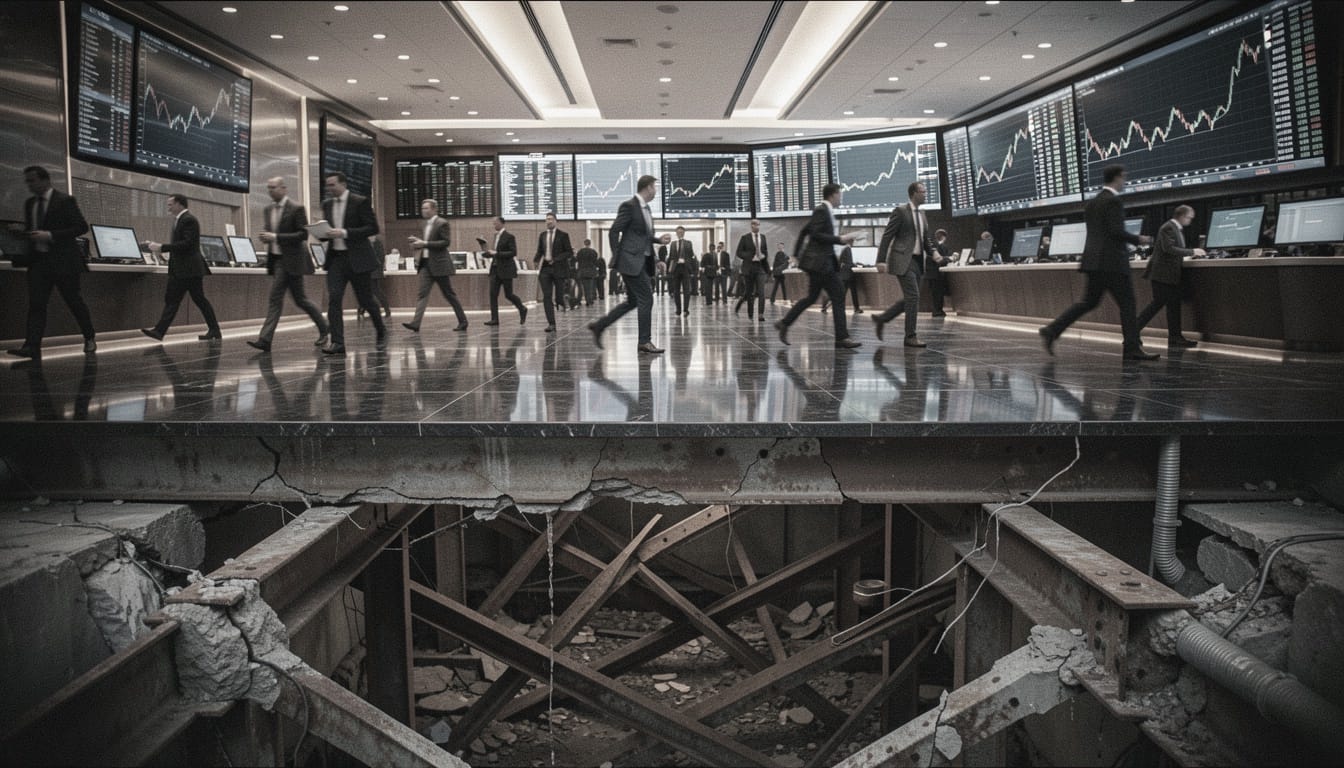
And yet the economy is priced as if the next ten years will arrive more or less on schedule, with AI capex, corporate margins, and consumer spending all somehow gliding through unscathed. So many forecasters are assuming that this is just a bump in the road to prosperity instead of a sinkhole that could swallow the future.
That assumption is looking more dangerous by the day.
Reuters reports that even if the war ended quickly, oil supplies would continue tightening for weeks because shipments have to load, sail, arrive, refine, and distribute before tanks can even start to refill. In other words, peace would stop things from getting words, but it would not instantly refill the bloodstream. (Reuters) The International Energy Agency has warned that global oil supply is now falling short of demand because of the Iran war, with shut-in Gulf output and record inventory drawdowns turning buffers into borrowed time.
That’s the point I keep coming back to: buffers are not solutions. They’re supplies we’ve borrowed from our future.
The world can run for a while on stored crude, floating tankers, strategic reserves, rerouted cargoes, emergency substitutions, and demand destruction, but those aren’t signs of recovery; they’re signs that the system is eating through its shock absorbers.
And once the buffers get thin enough, the problem changes character and the real shocks begin.
At first, prices rise. Then particular kinds of fuels get scarce. Next, diesel gets rationed by price or availability. Jet fuel becomes a route-planning problem. Fertilizer decisions change planting decisions. Shipping and insurance costs rise. Refineries struggle to get the right crude slate, the right catalysts, or the right intermediate products. Consumers see gasoline prices jump at first, but the economy feels the shortages of diesel, jet fuel, fertilizer, chemicals, and plastics like a gut-punch.
That’s when the shock stops being financial and becomes physical.
This is what the Dallas Fed comparison really means: a 20% Gulf export disruption is not like adding a little more inflation to the forecast. It’s like removing one-fifth of the world’s critical energy system from the world economy and asking the remaining four-fifths to pretend nothing important has happened.
Markets can price expensive oil. They are much worse at pricing supplies that are just not there.
That’s why the continuing calm in equities looks so dangerous to me. A market complacent about long-term earnings and priced to perfection is not prepared for a world in which energy, transport, fertilizer, and industrial feedstocks become unstable – or unavailable.
Meanwhile, the AI capex boom may still be carrying parts of the economy, but AI data centers don’t float above the physical world. They need electricity, transformers, metals, cooling, financing, and political permission. An energy shock that weakens consumers and raises infrastructure costs hits both sides of that story.
The longer this continues, the damage does not simply add up one day at a time. It compounds, with interest.
A one-week disruption draws down inventories. A one-month disruption changes purchasing behavior. A two-month disruption changes shipping routes, planting decisions, airline schedules, contracts, insurance assumptions, and credit risk. By the time the original cause is resolved, the consequences have already crashed into the broader system. And that’s the part markets are still getting wrong.
They are waiting for the headline that says Hormuz has reopened, or negotiations have resumed, or oil has come off the highs. But the question isn’t whether a few more tankers move. The real question is whether normal commercial confidence has returned: insurers, crews, shippers, refiners, and buyers all willing to behave as if the system is safe again.
Until that happens, this is not a restored market. It is a damaged market limping along on temporary workarounds.
The 1970s taught investors to fear expensive oil. This shock may teach them to fear something worse: not expensive oil, but oil you can’t get. Diesel too scarce to move trucks. Jet fuel scarcity that grounds planes. Fertilizer that’s unobtainable or arrives too late for planting. Small industrial inputs missing when the JIT process downstream depends on them.
The world is not adapting. Worse, the U.S. administration is displaying a profound lack of foresight in understanding of how massive, and how long-lasting, this crisis could become.
Remember: every extra day does not merely increase the cost.
It compounds it.
I've read that rationing of gasoline will hit around July 4th. Does that seem right? What will it take for the markets to price in the reality of the situation?
It is submitted the effects (as implied) are non-linear, and for that reason unforeseeable in detail. Accordingly, planning by government and non-government alike becomes impossible under current economic/political regimes. While structural change thus becomes inevitable, strictly speaking this will eventuate by way of revolution rather than evolution.