

Markets seem to think all is well. The reality is more disturbing.
Markets are cheering the two-week ceasefire between the United States and Iran as if the hard part is over. It isn’t. The immediate long-tail risk is lower this morning – we might have avoided a nuclear war started by the United States. That matters. But a pause in the shooting is not the same thing as a commercial reopening, and it is certainly not the same thing as repairing the damage that has been done.
To see why, let’s start with the simplest question:
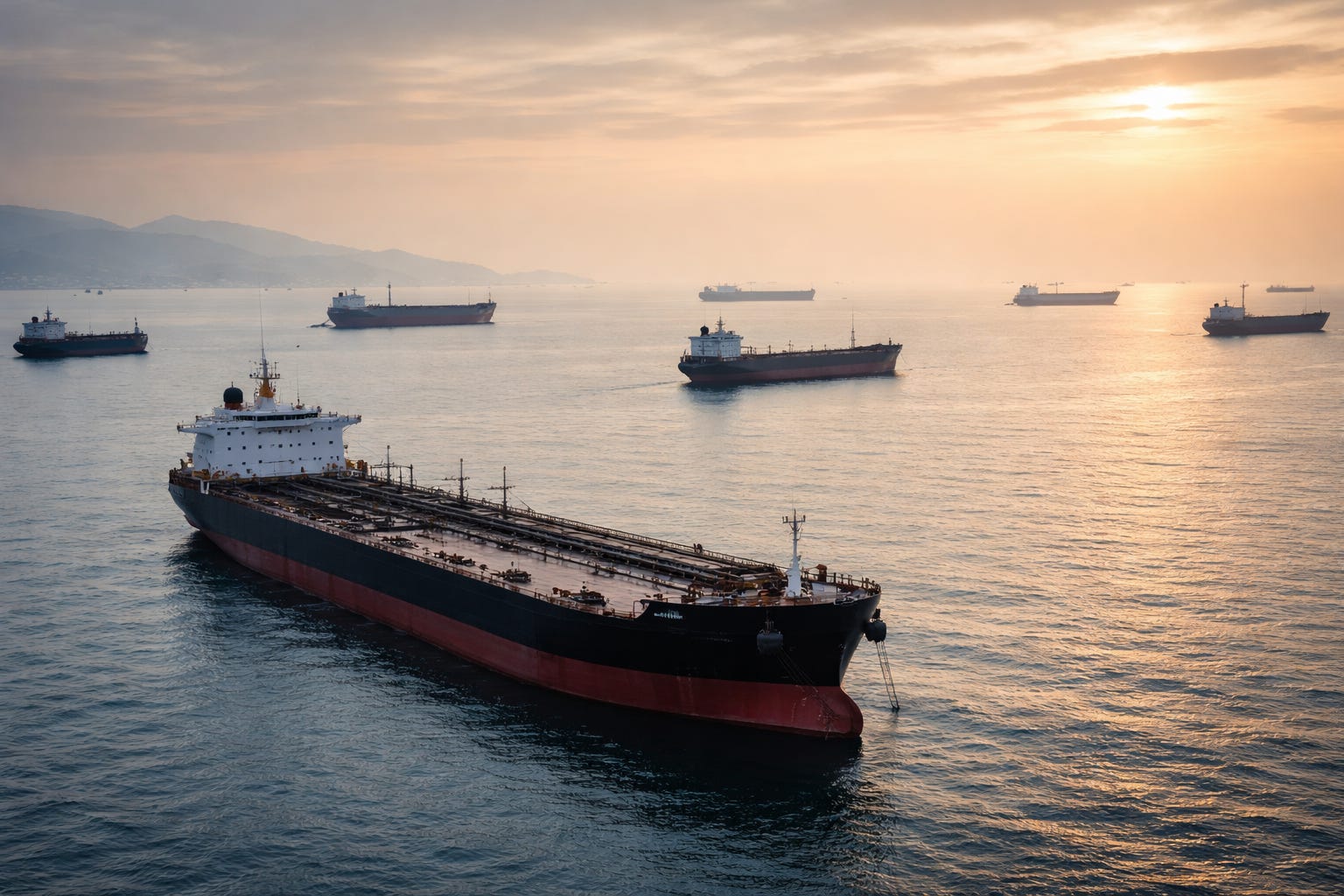
Will the ceasefire get the ships moving again?
There are plenty of cargoes afloat, waiting to move and fulfill contracts. Reuters reports that a reopening of Hormuz could release around 130 million barrels of crude, along with large volumes of refined fuels and LNG that have been stranded by the closure.
But ships do not move because politicians declare victory. They move when shipowners, crews, charterers, and underwriters decide that the route is tolerably safe. Maersk’s response was telling. The company said the ceasefire may create opportunities, but it still does not provide “full maritime certainty.” That is not a technicality. It is the entire point. Commerce runs on confidence long before it runs on headlines.
That is why the plunge in oil prices, while understandable, may be telling us less than many investors think. Brent fell sharply, into the low- to mid-$90s, because the market removed the panic premium. Fair enough. But physical oil markets remain badly stressed, Saudi Aramco has lifted its May selling prices to record levels, and even in a best-case peace scenario global oil supply may still run 3 to 5 million barrels per day below earlier expectations in the years ahead. So while the market is celebrating the end of the immediate emergency, it may be underestimating the aftershocks.
But this isn’t just an oil story.
Commentators have focused on the price of crude because it’s the headline commodity. A much deeper problem is the supply web attached to the Gulf. Qatar’s gas and LNG system has taken real damage that could take 3-5 years to repair. Shell has already cut its outlook for gas production because of those disruptions, and Reuters reports that production restarts across the region are likely to be slow even if the ceasefire holds because infrastructure was damaged and labor and logistics have both been scrambled. A truce can reduce fear quickly. It cannot rebuild an export system overnight.
Then there is helium, the sort of bottleneck most macro models barely notice until it bites. Qatar accounts for nearly one-third of global helium supply. Reuters reported in March that helium spot prices had doubled after Qatar’s LNG halt, and later reported that the shortage was already starting to hit technology supply chains. Helium is not a just birthday-party-balloon novelty; it’s essential to semiconductor manufacturing, medical imaging, aerospace, and other high-value processes. If this war taught us anything, it is that the world runs on more than barrels of oil. It runs on hidden industrial commodities that have very few substitutes.
Fertilizer may prove even more consequential. About one-third of global fertilizer trade moves through Hormuz. Urea prices in the Middle East surged more than 40% as the war disrupted flows, and the FAO has already warned that higher energy costs and fertilizer scarcity could lead farmers to slash fertilizer use, reduce plantings, or switch to less input-intensive crops. That matters right now, not in the abstract sweet by-and-by. Spring planting doesn’t wait for diplomacy. Even if the ceasefire survives, some of the damage to this season’s agricultural decisions has already been done.
This is where the American story begins to look darker than the stock market seems willing to understand.
It has been such a lovely, upbeat run that stocks do not want to admit that perhaps the party is finally over – even though no bull market gallops forever.
The United States entered this crisis with a K-shaped economy. Reuters reported in February that the top 10% of U.S. households now account for nearly half of all consumer spending. That’s not normal; it’s a sign of how narrow the support for growth has become. At the lowest income levels, many households were already stretched before the war. Higher up, even better-off shoppers have started to trade down. Reports in February indicated that Walmart was attracting shoppers across income brackets, including higher-income households, as consumers looked for cheaper options. That’s not what healthy demand looks like. It’s what stress looks like in its early stages.
Fuel prices will keep the financial pressure on household budgets. The U.S. Energy Information Administration has warned that gasoline and diesel prices could remain elevated for months even after Hormuz reopens. Diesel matters especially because it pervades the entire economy: trucking, farming, shipping, construction, warehousing, and more. Higher diesel is not just bad news for drivers. It’s a tax on moving everything. If gasoline hurts households directly, diesel does the same thing indirectly through freight bills, food prices, and margin pressure across the economy.
This is where inflation becomes dangerous again. The New York Fed’s latest survey showed one-year inflation expectations rising to 3.4%, with expected gasoline-price inflation surging to its highest level since the energy shock of 2022, yet workers have very little leverage to negotiate higher pay packets. Wage growth has slowed, average weekly hours have dipped, and the labor market is showing “low hiring, low firing” behavior. That’s a nasty combination for workers. Prices rise, but pay doesn’t keep up, and household budgets get squeezed. That’s not the recipe for a classic wage-price spiral. It’s the recipe for something much nastier: stagflation coupled with weak bargaining power.
And hanging over all of this is the market’s other great article of faith: that artificial intelligence spending will solve all problems and keep carrying the economy forward. Some analysts estimate that AI-related capital investment accounted for more than a third of U.S. GDP growth in mid-2025. Market valuations seem to expect that to continue, that the AI bubble will continue to expand.
Perhaps. But that story is starting to look less like salvation and more like concentration risk. Reuters Breakingviews noted this week that the AI data-center boom was already running into constraints in power, water, copper, labor, and above all money before the Iran war. If the stock market weakens enough to hit the wealth effect at the top while investors also begin to question hyperscaler spending, one of the few remaining pillars of U.S. growth will start to wobble at exactly the wrong moment.
Meanwhile, the Federal Reserve is trapped in the middle.
It cannot print fertilizer. It cannot produce helium. It cannot restore Qatari LNG trains, lower marine insurance premia, or reassure shipowners about Hormuz again. What it can do is react to the consequences. But that reaction is ugly whichever direction it turns. If it cuts rates too early, it risks validating an inflation rebound driven by energy and supply shortages. If it holds rates too high, it deepens the squeeze on already weakening demand by reducing the purchasing power of household wages. That’s what makes this moment so uncomfortable – and dangerous. The old policy tools were built for problems of demand. This is increasingly a problem of damaged supply colliding with crumbling demand.
Some commentators are describing this two-week ceasefire as the beginning of the end of the crisis. That strikes me as Pollyannaish. Reuters has already reported that Iran wants the right to charge ships transiting Hormuz, and that Tehran continues to insist on recognition of its right to enrich uranium, presumably for nuclear weapons, while seeking sanctions relief from America and others. If those are part of the real starting point for negotiations, then at least some of the supposedly “workable” terms now in circulation are likely non-starters in Washington. The gap between tactical pause and strategic settlement seems to me to be impossibly wide.
So yes, things look better this morning. They should. The worst immediate war scenario has receded, including the rumors of America’s possible use of nuclear weapons.
But the shortages, the cost pressures, the inflation impulse, and the economic strain have not disappeared because the price of oil fell twenty dollars in a day. The missiles may pause more quickly than the damage they caused.
This is a lull, not the end of the storm.
Summary: This essay argues that the two-week U.S.-Iran ceasefire has lowered the immediate risk of a wider war, but hasn’t repaired the deeper economic damage already done. Shipping, insurance, LNG, helium, fertilizer, fuel costs, and consumer strain all suggest that markets may be mistaking a tactical pause for a true normalization, leaving the U.S. economy and financial markets exposed to stagflation, weakening demand, and a possible reassessment of the AI-driven growth story.
Thank you for the informative article. I suspect this sordid story created by the US and Israel is just the prologue to the developing nightmare.
Another enlightening article. Thank you!