

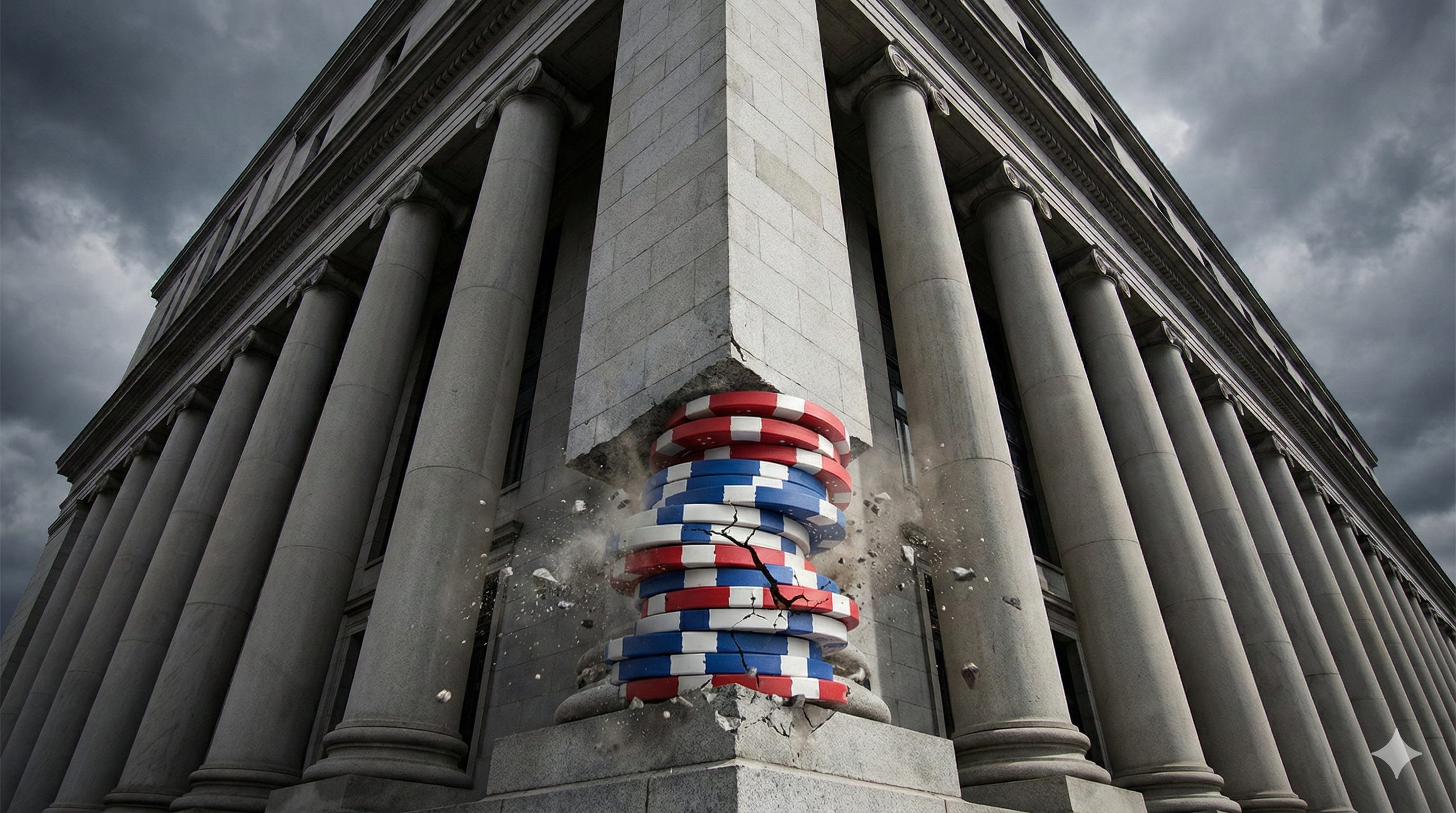
Most people assume the next financial crisis will begin in a familiar place: a Wall Street meltdown, a run on a major bank, a hedge-fund flameout, or a misstep inside the Fed’s marble fortress in Washington.
These are all reasonable guesses, and historically accurate but this time the real danger may come from a place you couldn’t find on a map, run by people you’ve never heard of, inside a company with no branches, minimal regulatory oversight, and no meaningful accountability.
Its name is Tether, a shadow bank headquartered in El Salvador that recently announced that it owns more U.S. government debt than Germany. S&P has openly questioned its financial soundness, yet this quasi-bank that lives in the shadows has become important to America’s ability to borrow. Most Americans have never heard of Tether – and that’s part of the problem.
Think back to 2008. Subprime mortgages were a quirky, little-known corner of the housing market, barely worth a footnote – right up until their collapse shook the foundations of the global economy. Tether is today’s version of that rickety financial structure, but updated for the 21st century: unregulated, offshore, opaque, politically protected, yet quietly woven into the financial support structure of the U.S. government.
It is as if a critical support of the U.S. financial system has been outsourced to a lightly regulated private firm operating offshore, not because it was designed that way, but because no one stopped it.
The Company That Shouldn’t Matter – But Does
Tether was supposed to be boring.
To understand what it is, and why people might use it, think of a stablecoin like a poker chip at a casino. When you walk into a casino, you hand the cashier $100 in real cash, and they give you a $100 plastic chip. Inside the casino, that chip is “money.” It’s easier to handle, easier to bet with, and if you trust the casino, you know you can always swap it back for cash at the exit.
Now, imagine if you could take that chip outside the casino and use it to buy a house in London, settle a debt in Dubai, or pay a supplier in Shenzhen—instantly, without a bank, and without anyone asking for your ID. That’s Tether. It’s a digital poker chip that moves at the speed of the Internet.
So, why would anyone swap real dollars for these digital chips that are transmitted and accessible by Internet? Two reasons: Speed and Secrecy.
If you try to wire $1 million from New York to Hong Kong through a regular bank, it takes days, costs fees, and requires endless paperwork to satisfy anti-money laundering laws. If you are a crypto trader, a citizen in a failing economy (like Argentina), or a sanctioned entity (like Iran or Russia), the traditional banking system either works too slowly or refuses to serve you entirely.
With Tether, you can send that $1 million to the other side of the world in seconds, with the click of a mouse, bypassing the entire global banking system.
But here’s the magic trick for Tether: When someone hands Tether that $1 million in cash to get an equivalent amount of stablecoins, Tether doesn’t just put the cash in a vault. They invest it, using that customer’s money to buy safe assets, like US Treasury bonds, which currently pay about 5% interest.
The customer gets no interest, but gains the ability to move money fast and anonymously while Tether gets the interest earned on the bonds.
On the $1 million in my example, that is a risk-free profit of $50,000 a year. Multiply that by the $130 billion in stablecoins they have issued, and you understand why Tether may be the most profitable company per employee on earth.
This is not hyperbole. Tether now holds more US Treasuries than many G20 nations. It also holds an astonishing hoard of gold, roughly 116 tonnes of it, supposedly tucked away in a Swiss vault somewhere that no regulator has inspected or audited. It behaves like the world’s largest unregulated money-market fund, proclaiming that it was the seventh largest buyer of US debt in 2024, and is reputed to be used in transactions involving countries hostile to America.
So Tether isn’t just a utility to enable people, organizations, and nation states that want to avoid US control or scrutiny. It’s also one of the most profitable companies in the world. In the first six months of 2024 alone, Tether reported a record $5.2 billion in profit. That is pure profit, retaining the interest on the US debt they hold which would otherwise go to the investors who bought USDT stablecoins instead of Treasury bills and bonds.
And who holds the keys to this vault? Not an august board of directors or a celebrated former commercial bank chairman. No, this operation is headed up by one Giancarlo Devasini, a former plastic surgeon who faced a software-piracy fine early in his career. Today, he is estimated to be worth over $20 billion, making him one of the richest – and most invisible – men in the world. This is the man who has become a significant buyer of US government debt.
In any sane world, this would have elicited global concern. Instead, the reaction has been a mixture of indifference, denial, and, in the case of some Washington officials, something that looks suspiciously like regulatory capture.
The Iron Triangle Nobody Wants to Talk About
You’d think Washington would be leery of an offshore shadow bank that holds tens of billions of dollars in US debt while amassing more gold than many national governments. Oddly, the opposite seems to be true: Washington appears increasingly dependent on Tether’s money.
Since America’s federal government deficits have exploded and traditional buyers of US Treasuries are retreating, with China being the most notable example, the US needs new buyers to step up. Enter Tether. Treasury officials understand that if large, price-insensitive buyers of U.S. debt withdraw simultaneously, borrowing costs would rise and fiscal flexibility would narrow – and Tether has quietly become one of those buyers.
Meanwhile, Cantor Fitzgerald, a private Wall Street investment banker, quietly earns fat fees as custodian of Tether’s treasure pile. And as it happens, the family of the US Commerce Secretary Howard Lutnick owns a controlling interest in Cantor Fitzgerald. This arrangement creates overlapping incentives that could help explain Washington’s reluctance to act, and risks creating the appearance – fair or not – of political leniency.
The structural risk is not necessarily that the founders are planning a heist, but that if their business model fails, there is no legal mechanism to stop them from simply walking away. In a regulated bank, the FDIC would seize the assets. Because Tether operates outside conventional resolution frameworks, a severe liquidity crisis would leave regulators with few tools to enforce orderly redemptions, increasing the risk of market turmoil.
And that is the kind of institutional denial that has precipitated past financial crises.
The Fragile Equilibrium
Unlike a gold ETF, which stores metal in regulated and audited bank vaults, Tether CEO Paolo Ardoino admitted they keep their gold in their own private vault in Switzerland to avoid fees. That means there is no third-party oversight, no independent auditor, no regulator ensuring they live up to their promises of backing their fiat money with hard assets. There is just Tether’s word, gold in some secret vault, and a back door exit.
The stability of this arrangement is theatrical: a balancing act, not a foundation. Tether’s business model depends on the illusion that its tokens are as solid and secure as dollars. But if Tether investors lose confidence and redemption requests surge, it would have to dump assets on the open market to buy US dollars. There is no regulator watching to make sure their behavior is prudent, or that their cash reserves are adequate.
The assets they would be forced to sell include long-dated Treasuries and that mountain of gold. If Tether were to face a run, it would be forced to fire-sale tens of billions in Treasuries into a market that is already fragile. While $100 billion is a fraction of the total market, a forced sale of that magnitude during a liquidity crunch could well be enough to break the price mechanism, triggering algorithmic panic and freezing the credit markets.
There is no gradual adjustment from that. Such forced liquidation would create a vacuum in the gold market, as other buyers stepped back to wait for the bottom. This volatility would spill over, tightening dollar funding conditions and amplifying stress across already-fragile balance sheets. Interbank lending – a major source of liquidity – stalls because banks don’t trust each other’s balance sheets. Yields spike. Credit tightens. Systems stay online, but personal and business account withdrawals could be restricted and limits imposed.
A Gift to America’s Competitors
While American regulators sleepwalk through this arrangement, others are alert to its usefulness. Entities operating under sanctions, such as Russia, Iran, have increasingly used dollar-linked stablecoins, such as Tether, as as a tool to avoid American-influenced banking channels. China has banned crypto at home, but offshore entities connected to China continue to participate in the ecosystem – something Beijing appears content to tolerate. Beijing understands that anything which erodes confidence in the US dollar is a strategic advantage to them.
The beauty for America’s opponents is that the United States is doing this to itself. There is no need for cyberattacks or covert financial warfare. Just let American greed and complacency build a towering vulnerability, then wait. As Napolean is reputed to have said, “When your enemy is making a mistake, don’t interrupt him.”
That brings us to the endgame: if the music stops, if regulators finally move, or if a crisis begins to strangle Tether’s balance sheet, U.S. regulators could well be helpless to stop the resulting market turmoil.
It wouldn’t resemble a normal bankruptcy. A disorderly liquidation could move enormous pools of capital outside Western regulatory reach.
Building a Personal Firewall
I get asked: “Okay, this sounds terrifying, but what can I actually do about it?”
Let me start with a disclaimer: Every crisis is different. History doesn’t repeat, it rhymes, and what follows are not predictions. They are safeguards against low-probability, high-impact events.
We cannot know the exact day, the specific trigger, or the precise hour the systems might freeze. Therefore, it is impossible to construct a perfect defense. That said, while we cannot predict the event, we can predict many of the likely consequences.
If Tether collapses, the immediate consequence is a liquidity freeze. This means the “plumbing” of the world’s financial system stops working. Based on that, you don’t need to be a survivalist in a bunker; you just need to build a bridge to get you across a 2-to-4-week period of banking dysfunction.
Here is a practical checklist to harden your personal finances against a systemic shock:
1. A “Blackout” Buffer (physical cash) – In a digital world, we assume access to money is guaranteed. It isn’t. If the bond and money markets seize up, electronic payment networks like Visa, Interac, and electronic or wire transfers can fail or be paused by banks struggling to preserve capital. To prepare for that, keep one month of essential living expenses like groceries, fuel, medicine in small denominations ($5s, $10s, and $20s) of physical cash at home in a fireproof box. In a cash crunch, no one will have change for a $100 bill. This is your “survival liquidity.”
2. Create a “Paper Mirror” – If banking websites go dark or suffer outages due to a cyber-event or liquidity panic, you will need proof of what you own, so once a month, download and print PDF statements for your bank accounts, investment portfolios, and insurance policies. If the digital record is temporarily inaccessible, a physical paper trail may become the only way to prove what you own.
3. Audit Your Savings (The “Bail-In” Check) Not all “savings accounts” are legally savings accounts so investigate your “High Interest Savings.” If you are holding cash in a stock-market ETF, you are not covered by deposit insurance. In a market freeze, these funds can freeze up, so spread your funds among institutions to ensure that no single account exceeds the federal insurance limit of $100,000.
4. A “Strong Hands” Strategy for Gold – Hold physical gold in a secure location as insurance against a dollar crisis. But there’s a psychological trap: In the first days of a crash, gold prices often drop as big funds sell everything to raise cash. Decide now to not to sell your gold during the initial panic. If you see gold drop 10% or more while the news is screaming about a crisis, that’s the market clearing its throat. Real wealth preservation happens on the other side of that dip.
5. Know Your Bank’s Hierarchy – If you own shares in a bank, understand that you are the “crumple zone.” In modern banking (post-2018 “Bail-In” laws), regulators will wipe out shareholders to save depositors. If you are relying on bank stocks for safety, you are holding the wrong asset. Be a depositor, not an owner.
In a genuine liquidity shock, banks can stay solvent by becoming exceptionally cautious. They restrict withdrawals, impose temporary limits, and ration cash – not because the system is collapsing, but because confidence is. Most people have no idea any of this might happen, so may suffer if the banking system is caught in a panic. In a severe liquidity shock, cash access can be temporarily restricted – not because the systems fail, but because banks ration physical currency. ATMs could run dry, and banks could impose limits on cash withdrawals, even when core systems remain functional.
What Tether has exposed is not just a financial vulnerability but a psychological one: the belief that the system will hold because it has always held in the past. That assumption is the weakest point, especially with a US administration that appears to prize loyalty to the president over competence.
Where This Leaves Us
I don’t believe Tether will crash the global financial system tomorrow. Systems this large don’t collapse on a timetable; they collapse when enough people stop believing that everything is hunky-dory. Much of the information here comes from reporting by the Financial Times, S&P Global Ratings, the IMF’s 2024 working papers on stablecoins, and Tether’s own published attestations, which is what I’ve based my comments on.
And there are those who argue that Tether’s growth simply reflects market demand, and that fears of systemic risk are overstated. Perhaps. But systemic crises rarely emerge from the places policy makers expect.
What concerns me is that Tether has become a critical player in global finance without any regulatory oversight or operational transparency. Plus it does so in a manner that maximizes profit for its management without regard to the risks involved, while appearing to allow them to escape without personal loss if things go wrong.
Heads they win, tails you lose.
And the US government seems content to leave things that way. They have traded short-term convenience for long-term system stability.
History tells us that superpowers rarely collapse because of a single dramatic act. They drift into instability through a thousand small concessions to convenience. America has permitted Tether to exist and grow to enormous size because it was convenient for crypto traders, for Cantor Fitzgerald, and for the US Treasury. They let it continue even though it’s a shaky, unreliable support because it helps finance the America’s skyrocketing federal deficit.
America has encouraged a structural vulnerability at the center of its funding process, not because it was coerced into doing so by outside forces, but simply because it was easier to do that than come up with a better solution.
So, if America’s financial system crashes, the cause won’t be a shadow bank in El Salvador. It will be the risks America chose to ignore.
As with all dangers one can never know them all but we would be utter fools not to identify as many as possible. Thanks once again for the work you are doing to educate us on complex issues. One risk I see is that the psychopaths in power will protect themselves first so we depend on ourselves and you are doing a great service by suggesting a plan. 🇨🇦
Tether is a Ponzi, but it does not pose systemic risk because its liabilities are held by retail suckers, not by banks. When it blows, the victims will be people not institutions.