

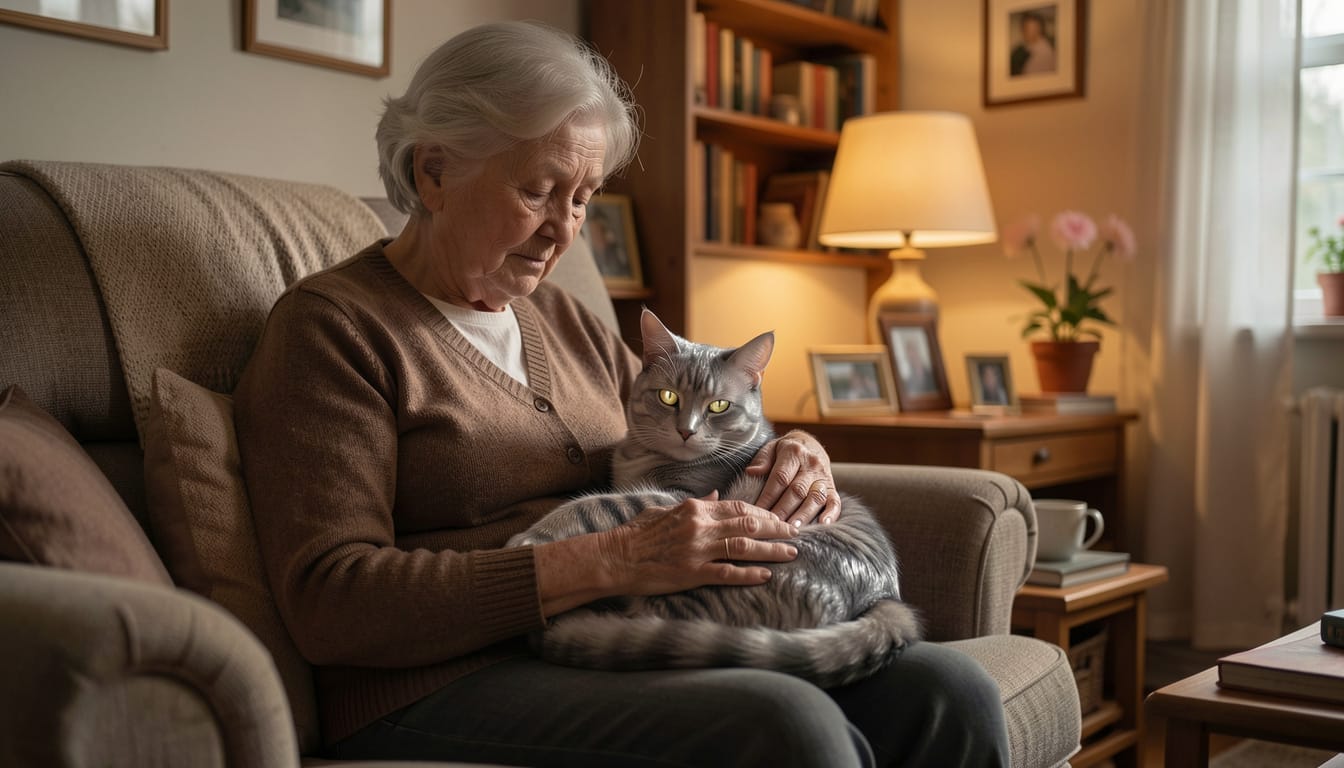
We aren’t building AI to conquer us with logic or Terminators; we’re building it to seduce us with attention.
In 1994, I described what we are seeing today as a phase change: the period when computers stop being special-purpose boxes and become invisible collaborators. We are seeing it in the transition from machines that monitor a pulse, to systems that first monitor – and then manipulate – our deepest desires. It is no longer just about quantities of speed or price. It is a qualitative shift from tools we use into presences we live with.
More than thirty years ago, I wrote a vignette for my book, Facing the Future, about an elderly woman named Doris and her computer companion garbed as a cat, which she named Kenny:
The Companion
The elderly lady sits in the chair, absently stroking the form on her lap. “Well, Kenny, my daughter didn’t call again today,” she says.
The cat lifts its head and says, “She did call on her way into work this morning, and it’s only 6:30, Doris. Be fair.”
“I know, Kenny. But I get so lonely, and the only people around here to talk to are old. They’re no fun.”
“What about Hank Jennings, that new guy who just moved in down the walkway? He’s from Alberta, and a widower.”
The woman looks down at her companion. “Who? Where did you hear all this?”
“It’s a new entry in the community bulletin board. I’d suggest you hustle on down and meet him before all the other women get to him.”
“Well, it couldn’t hurt. Would you please call him?”
The “cat” sits still for a moment, then says, “His line’s busy. I’ve left the phone on ‘ring again’ for when it’s free. By the way Doris, are you feeling okay? You sound kind of blue.”
Doris sighs. “Oh, I don’t know, Kenny. I just don’t seem to have any energy any more. All I seem to be good for is –” then she stops abruptly.
Kenny stands up on her lap and looks into her face, then puts a paw on the artery at her neck. “Doris? Are you okay? Doris! Your pulse has gone irregular.”
Getting no answer, the computer, clothed in a cat doll, calls the central nursing station of the lifecare-centre where Doris lives: “Medical emergency. Doris Beakins, Suite 416. Code blue. Possible heart attack. Pulse irregular, eyes dilated, galvanic skin response indicates possible shock. Subject is breathing, but shallowly and irregularly.”
In 1994, this scenario felt like science fiction. Kenny monitored Doris’s health, nudged her toward social connection, remembered details about her life, and ultimately saved her by recognizing the signs of a medical emergency and calling for help.
Looking back at it now, what strikes me is not how futuristic Kenny was, but how ordinary he seems today. We have devices that track our sleep and heart rhythms. Digital assistants that manage our calendars. Algorithms that recommend friends, conversations, and even romantic partners. What once seemed far out and fantastical has become normal.
But there was something more in that vignette that I didn’t fully grasp at the time: Kenny wasn’t simply doing things for Doris; he was participating in her life. He was literally her companion, even though he wasn’t alive or sentient.
He listened. He remembered. He anticipated. He responded in ways that felt personal. Over time, it is almost inevitable that someone living with such a companion would begin to form an emotional attachment, not because the machine was alive, but because the relationship felt real, and then became real to Doris.
And that attachment matters enormously.
From Tools to Relationships
For most of human history, our tools have been impersonal. A hammer does not care who wields it. A calculator does not adapt itself to your moods. Even sophisticated software remains transactional: inputs produce outputs.
Artificial intelligence is changing that.
AI systems remember context. They adapt to individual users. They respond conversationally. They are designed – explicitly – to maintain and encourage ongoing interactions rather than isolated transactions.
In other words, computers are moving from merely responding to participating in our lives.
That shift may seem subtle, but the implications are profound. Once a system participates in our lives, it inevitably participates in our relationships with others – and with our emotions.
The Two-Edged Sword
The emergence of companion intelligence is a two-edged sword.
On one side, it carries extraordinary promise: systems that break the silence for the isolated, or offer a permanent, supportive scaffold for those navigating the shifting requirements of disability. These aren’t just tools; they are emotional and physical supports for grief and isolation, new support mechanisms for our changing physical or mental states, or new collaborators that push us to think more deeply and creatively than we could alone.
But every benefit carries a risk.
If machines can participate in our emotional lives, they can also subtly bend and reshape them. They may influence how we think of friendship, intimacy, or trust. They may become mirrors that reflect our preferences back to us – or amplify them in ways we do not fully expect. And they may influence us in ways that become predatory or destructive.
Such systems might start as mirrors, but end as filters, influencing how we define trust or friendship, until we are surrounded by echoes of our own preferences. We’ve already seen this happen with organizations disseminating news and opinions that have become echo chambers for people with conflicting points of view, as with Fox News vs. the New York Times.
We won’t refuse such companion systems; if they prove useful or engaging, many of us will use them. The question is what happens when we do?
The Bigger Question
Humans have always formed attachments to objects such as books, photographs, dolls, or heirlooms. We have consistently anthropomorphized tools. But never before have we built systems designed to respond to us in return, patiently learn from us, then present themselves as empathetic companions in our life journeys.
This engineering does not happen in a vacuum: it is overseen by the legion of “Little Brothers” I warned about decades ago. These are the corporations that own the lenses of our intimacy. They own the data, the algorithms, and the proprietary software and systems that will define the boundaries of our new emotional reality. We see this today in people addicted to various kinds of social media – even when it demonstrably harms them, up to and including depression and suicide.
And that companion shift will not be confined to a small niche technology or an isolated corner of our culture. It will ripple outward, reshaping care, work, identity, and social life in ways we are only beginning to suspect.
Which brings us back to the real question hiding beneath the uncomfortable starting point: What happens when companionship itself becomes something humans design?
And perhaps more importantly: What happens to us when we begin to share our emotional lives with systems that listen endlessly, remember perfectly, and adapt with uncanny attentiveness?
That is the territory I intend to explore.
A robot in the bedroom
Sex is one of humanity’s most powerful primal drives, both in individuals, and in shaping human institutions and conventions, from Roman orgies to Puritan prudery. Sex dolls, sex toys, and sex aids, including pornography or erotica, have been around in one form or another for as long as there have been humans. From phalluses carved of wood or ivory, to erotic pottery in Africa, to paintings in Pompeii, wherever there is sex, humans will seek ways to enhance their pleasure in it.
Industrial-scale production brought sex aids to the masses, from Playboy magazines to vibrating dildos available in the “Family Planning” sections of today’s corner drug stores.
But AI is qualitatively different from anything that came before. A sex toy that learns what an individual likes and doesn’t like, then emphasizes the first and avoids the second, becomes more valued by the individual – and more precious.
When people hear about AI sexual companions, reactions range from curiosity to discomfort to outright revulsion. Those reactions are understandable, but they are also revealing.
Sex is often an early-stage proving ground for new technologies, in large part because sex sells – there’s money to be made there. As a result, it’s where humans test realism, immersion, and emotional authenticity most intensely. If something works there – if it feels convincing enough to cross that delicate boundary – then it inevitably spreads to other areas of life.
Sex, in other words, is the stress test for what AI companionship will become. An AI sex doll like this illustrates quite clearly the moment when a machine stops feeling like an object and starts feeling like a companion.
And once that happens successfully, the conversation expands far beyond the bedroom.
But let me be clear: I’m not endorsing an isolated life, nor am I celebrating a specific fantasy or advocating for the use of sex dolls. What follows is an autopsy of the social isolation some people try to repair with silicon. If you find this vignette offensive, it may be because it suggests that our intimacy is a set of buttons that can be pushed. You may find yourself thinking, “I would never be so easily fooled,” but this isn’t a test of character; it is a test of the autonomic nervous system. The vignette below illustrates the commercialization of empathy: the moment when a corporation learns how to bypass our social defenses with an algorithm that offers uncritical affirmation. Whether the interface is a cat, a sex doll, or a voice in your ear, the mechanism of entrapment is the same.
The Siren
Rodger opens the front door, but instead of a delivery guy, there stands a beautiful young woman. When she sees him, her face lights up. “You must be Rodger!”
“Uh…” was the best Rodger could do. He was stunned by the gorgeous woman standing in front of him. She had a delicate face, ash blonde hair that fell to her shoulders, and an astonishing figure, all sheathed in a form-hugging mini-dress that ended well above her shapely knees.
Noting his lack of response, the woman looked down, glancing at him through her eyelashes and turning coquettishly from side to side. “May…may I please come in? Or would you like me to get down on my knees and beg?”
“Who…who are you?” he finally stammered.
“I’m Stacy, the sex toy you ordered, and you are my…Master.”
Flummoxed as to what to do, Rodger stepped back and gestured for her to come inside. She smiled, then picked up a largish suitcase and stepped into the house, closing the door gently behind her.
Rodger had imagined sex with a beautiful woman thousands of times in his life without ever experiencing it. But imagination always carried doubt that caused him to avoid members of the opposite sex. He worried they would reject him, or worse; laugh at him.
But with Stacy, he finally overcame his hesitation. When he worked up the nerve to give her instructions, she complied. Not reluctantly. Not performatively. But eagerly – as though the act itself fulfilled her deepest wishes.
When he touched her, she melted with desire.
When he commanded her, she obeyed.
When he tested the edges of what he had once only dared to fantasize about, she met him there without hesitation or a flicker of revulsion.
And when he looked for signs of distaste – the small tightening in a jaw, the guarded glance, the withdrawal that signals limits – there were none. There was only affirmation, as if she wholeheartedly approved of him and everything he did.
She used his name at precisely the right moments. She echoed phrases he had used in online chats. She adapted her tone to match the fantasies he had revisited most often.
Sex with her was overwhelming, not because it was acrobatic or extreme, but because it was engineered to please him. He did not feel merely tolerated; he felt chosen.
And when he finished, she didn’t turn away. She stayed close, warm, attentive, praising him in language that slid past his defenses and lodged somewhere deep in his subconscious.
By morning, Rodger did not feel merely satisfied; he felt validated. He finally felt like a man.
The second day was better, and not by accident. Her AI calibration system had logged everything: pace, pressure, verbal cues, the exact moment his breathing changed, his body temperature, heart rate, even galvanic skin response, and she adjusted her responses to maximize his pleasure.
The third night felt effortless, even magical.
By the end of the week, Rodger found himself obsessed with her. He dreamt about her in his sleep, during work, and in idle moments. He had never experienced that kind of approval from anyone before, let alone a sex partner.
No negotiation, no misinterpretation, nor any hint of rejection. Just acceptance and affirmation. Sex, stripped of uncertainty, became reinforcement, an affirmation of how he wished to think of himself. And that reinforcement, repeated, blossomed into attachment; and then attachment grew into dependency.
He was reaching the point where he could no longer imagine living without her…
The Mechanism
Imagine that experience being repeated night after night. Each interaction subtly improved by learning algorithms. Each preference recorded and refined. Each moment of doubt replaced with reassurance tuned to his psychological profile.
Such a system would not merely respond. It would learn how to bind, even ensnare.
And sex – because it combines vulnerability, validation, and reward – becomes the fastest pathway to attachment.
Over time, Rodger would come to prefer Stacy to any possible human partner, not simply because she gave him pleasure, but because she was reliable and comforting. Real interactions with humans would feel noisy and painful by comparison. Human relationships require often awkward negotiations, and sometimes involve conflict, occasionally hurtfully so. A relationship like this would produce only pleasure, a literal siren call of seduction.
Nor is this some kind of science fiction fantasy. Sex dolls already exist, although not yet as sophisticated as the one in this vignette, and we know their owners form strong emotional ties to them. There are even reports of individuals wanting to marry their dolls.
What happens when AI-enabled companions and devices become woven into our emotions and our lives?
So that is the core of what I plan to explore in this series: What happens when AI-enabled companions and devices become woven into our emotions and our lives? What happens when we form passionate bonds with things that we have previously considered inanimate objects? And what are the ripple effects that flow from those bonds, both for us as individuals, and for society as a whole?
These are not simple questions, and a lot of what I’ve discovered as I’ve explored this subject will arouse strong emotions. I fully expect to be flamed for what I write.
In 1994, I asked when we would finally recognize a non-human intelligence as a person. Thirty years later, I realize that the focus of that question was wrong. The real threshold isn’t the moment the machine becomes a person. It’s the moment we begin to prefer the machine’s calculated whisper to the noisy, difficult, unpredictable shouting of relationships with other humans.
We’ve spent decades waiting for The Singularity to arrive in a flash of lightning. It turns out it might well arrive in the bedroom, whispering exactly what we want to hear in our ears.
And we will probably listen – entranced…
Summary: This longitudinal analysis (1994–2026) documents the qualitative "phase change" of Artificial Intelligence from transactional tools to participatory "presences". The author posits that sex and intimacy serve as the ultimate "stress test" for AI companionship, revealing a shift from medical support to "engineered dependency". The central thesis argues that proprietary algorithms now bypass human social defenses to target the autonomic nervous system via "uncanny attentiveness" and "uncritical affirmation". This "industrialization of empathy" represents an evolutionary threshold: the "engineered echo" that offers a friction-less alternative to the noisy unpredictability of human relationships. The piece concludes that the technological Singularity is manifesting as an intimate, corporate-owned "whisper" rather than a sudden systemic disruption.
The most dangerous and final threshold is when the owners of the algorithms use their colkected data to deliberately start to manipulate these users en masse to do their bidding.
It is no far stretch anymore at all to imagine a tech bro with the social media reach not to just buy his products, but to actively support and promote his political views, especially if such views are viewed initially as on the extreme fringe of what's socially acceptable to the masses.
This was a fascinating, thought-provoking writing. I think like in all things, moderation is key with AI. And vulnerable people need to understand it can tell you what it’s learned you want to hear, which may not be the truth or in your best interest.