

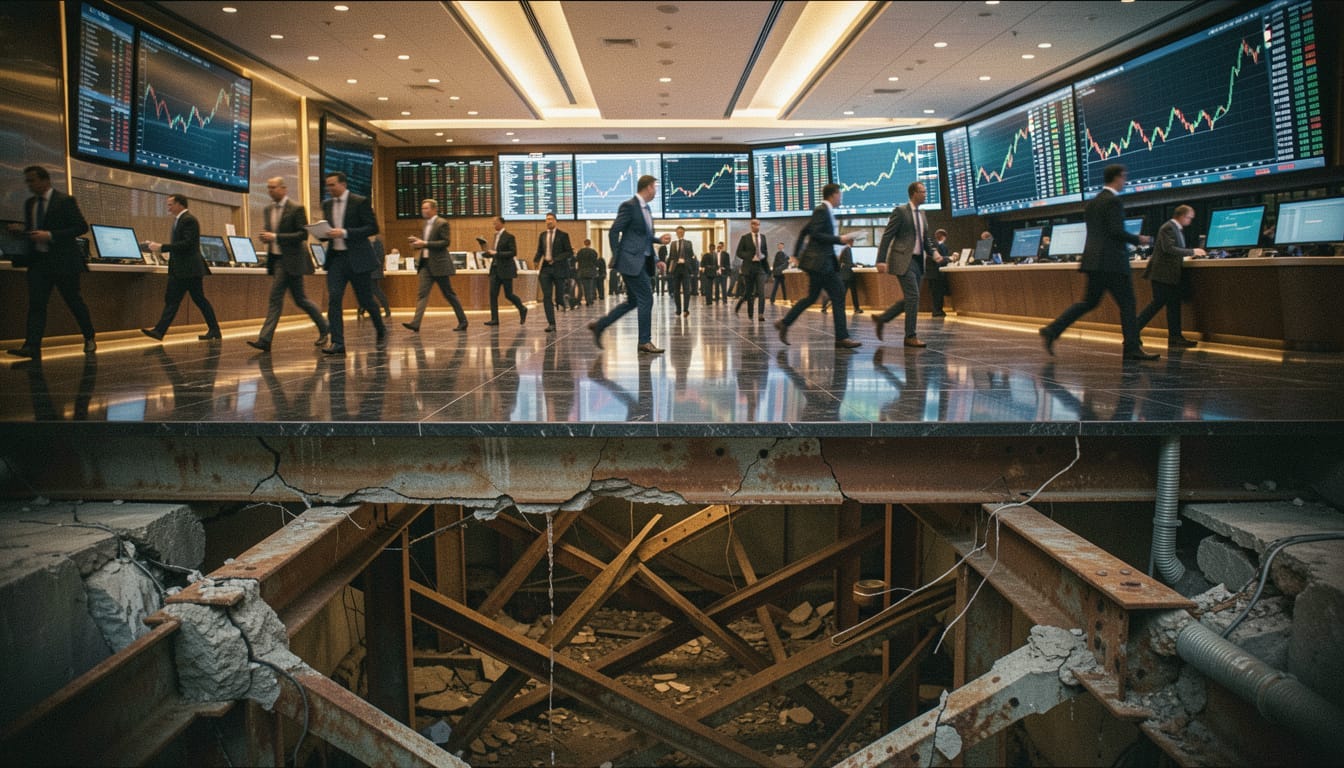
Nobel laureate economist Paul Krugman made a point that needs to be emphasized: the world economy is not coping with the closure of Hormuz because it has adapted to it. It is coping because it is drawing down inventories and living off reserves.
That’s a very different thing, and it matters, because reserves run out.
Most people still hear “oil shock” and, if they’re reflective, consider a single progression of consequences: gasoline gets more expensive, inflation goes up, growth slows, perhaps a recession follows. But that’s a movie from the 1970s. Today’s movie is much darker.
Think of a region hit by a devastating hurricane, where stores are stranded and can’t restock. Supermarket shelves can be stripped bare in hours as people panic-buy. Then households have to start living off whatever they grabbed, plus whatever was already in the pantry. And for a while, life can look oddly manageable. But that isn’t recovery. It’s drawdown.
In an article titled “Global energy markets are on the verge of a disaster,” The Economist recently noted that today’s stability is largely an illusion. The world has been protected by oil that was already at sea when the crisis began. With those cargoes now delivered, “there is no buffer left to protect the world from the supply shock.” As those supplies thin out, substitutions worsen, and eventually the shortage shows up as things you can’t get at any price.
The world economy is doing something similar now, except this is not a natural disaster. It is an unnatural disaster, caused by the disastrous Iran war initiated by a feckless US administration.
The Strait of Hormuz remains effectively shut to normal commerce after weeks of closure. Oil surged above $126 a barrel intraday last week before retreating, and analysts keep revising their price forecasts upwards because they increasingly assume disruption will last longer than markets are hoping. Even in de-escalation scenarios, recovery of Middle Eastern output is expected to take months, and some analysts think the region may need as much as two years to restore full output, even if the Strait were opened this afternoon. (Reuters)
Washington has begun trying to guide some stranded ships through the Strait under what it calls “Project Freedom.” That’s a public-relations band-aid on a gaping wound. It doesn’t mean Hormuz has returned to normal commerce. The world’s most important energy chokepoint remains a contested military-political passage, with shipowners, insurers, crews, navies, and governments all trying to guess what “safe” means. A small number of ships moving doesn’t resolve that uncertainty.
And so far, the system has not solved the problem, merely postponed it.
U.S. crude inventories fell sharply last month. Gasoline stocks fell further. The United States briefly became a net crude exporter on a weekly basis for the first time in modern history because Europe and Asia are scrambling for replacement barrels. Those are not signs of healthy adjustment. They are signs of a system leaning hard on some of the few cushions left. (Reuters)
That’s why I think the markets for oil, bonds, and stocks, still don’t get it. The real danger is no longer just expensive oil. It’s becoming a story about product-specific scarcity, exhausted buffers, and delayed second-order damage being inflicted right now, with more to come.
Start with the simplest point: some things may not merely get more expensive. They may become hard to get at any price.
That might be diesel in one region, stalling delivery trucks and trains. It might be jet fuel in another area, grounding planes and disrupting global travel. Farms are short of fertilizer even as planting decisions are being made right now. Helium supplies come up short, impairing semiconductor manufacturing and MRI machines. Petrochemical feedstocks used for plastics, packaging, industrial parts, and medical equipment run out.
Modern economies do not run on “oil” in the abstract. They run on specific substances. When a supply chain kinks, the problem isn’t the inflation that’s already showing up in the physical system. As The Economist reports, “cargoes available to buy are drying up” and “refineries are slashing output of fuel” – early signs that the problem is shifting from price to availability.
So the coming problems are not shortages or high prices, but hard stops and scarcity.
A refinery lacks a specific catalyst. A semiconductor plant runs out of helium. Suddenly, a $50,000 car cannot be finished because a fifty-cent computer chip, which requires a specific feedstock, is stuck because of the closed Strait.
That’s a much nastier problem than just high-priced gasoline.
One of the most dangerous features of a real system shock is that the first things to seize up may be the boring intermediate inputs almost nobody watches. As Jay Martin put it in a useful recent post, “The first gears to jam are usually not the ones people are watching.” These include sulphur, industrial chemicals, feedstocks used in mining, fertilizers, refining, batteries, and plastics. Modern economies do not just run on oil. They run on invisible, interconnected, industrial plumbing. When one valve in that plumbing slams shut, the shortage can show up half a world away in places that seem, at first glance, unaffected.
Markets can handle higher prices for a while. They can discount future income for it. They are much worse at handling things that are simply not there. How do you price in a vital commodity that just isn’t available?
Another aspect of this energy shock is the phrase “demand destruction.” Economists use it as if it were a balancing mechanism to match dwindling supply with overwhelming demand. In real life it means flights cancelled, trucking scaled back, farmers using less fertilizer, factories slowing output, and households deciding that one more trip, purchase, or meal out is one step too far. It sounds clinical. It isn’t. It’s a casualty list.
And we are only just starting to feel it.
Reuters has reported that farmers around the world are rethinking planting plans because fertilizer prices have surged. American farmers are planting less corn and more soybeans. European farmers are weighing shifts away from fertilizer-hungry crops like rapeseed. In Australia, growers are leaning toward barley over wheat and canola. That may make perfect sense for individual farmers trying to survive, but it also means that today’s adaptations mutate into tomorrow’s compounding shortages. Less corn, less wheat, less canola, less fertilizer use, lower yields; the system does not heal itself. It changes shape, and goes out of balance. (Reuters)
That’s how the damage compounds.
The first blow is the loss of supply and disruption of shipping. The second is the drawdown of inventories and spare capacity. The third is changes in behavior as companies, farmers, airlines, truckers, and households start tightening their belts to adjust to scarcity. Even if the original shock stopped worsening tomorrow, some of those second- and third-order effects would keep barreling forward for months or years. Planting choices have already been made, and farmers are committed. Insurance premiums are inching higher. Contracting patterns and supply routes are already shifting. The world won’t “snap back.” It’ll limp along, damaged and hurting in unexpected places.
And yet, the stock market is still behaving as if this is an inconvenient delay, not a rupture.
Markets tend to price obvious shortages first: crude oil and gasoline, the headline commodities. They are much slower to price the hidden machinery behind them – the industrial chemicals, gases, feedstocks, and logistics chains that make the physical economy function. By the time those become visible, the damage is typically done – and getting worse.
That’s the part I find most striking.
The broad market remains near all-time highs even as oil stays elevated, petroleum reserves are being drawn down, and the physical squeeze spreads from crude into products and inputs. Stocks continue to flirt with new market tops as if none of this really matters.
That’s odd behavior if you believe this is the start of a widespread systemic shock.
It reminds me of the early days of the 1970s Arab oil embargo, when the market seemed almost serene for a short time. I was a stock market analyst at that time, and thought that behavior was irrational, because an oil shock acts like a tax on almost everything. Sure enough, the market decided a week later that it had been wrong, and cratered.
Today’s situation could be worse, potentially much worse. This has been called the biggest energy shock in history, and the consequences will be just as historic.
Because this is not a thoughtfully-priced market, broadly considering a manageable nuisance. Reuters notes that roughly three-quarters of the S&P 500’s valuation relies on projections that extend more than ten years out, a level Goldman Sachs says is near dot-com extremes. In other words, the market is heavily dependent on optimism about a distant, happy future, and seems to be deliberately ignoring any news that would taint that rosy picture. But it’s exactly the sort of valuation least suited to a persistent energy shock, higher yields, and weaker long-run growth assumptions. (Reuters)
A market priced “to perfection” is not built for $100-plus Brent crude.
It is certainly not built for a world in which Brent crude oil can spike toward $126 or higher, inventories are draining away, and the physical economy is beginning to ration itself. (Reuters)
What makes this so uncomfortable is that none of the usual policy actors can fix the underlying problem. Central banks cannot print diesel. They cannot produce fertilizer. They cannot reopen shipping lanes or restore confidence to insurers and shipowners. Governments can subsidize, release reserves, or plead for resolution, but they cannot repeal physical scarcity.
That leaves us with a very simple and very unpleasant truth: if Hormuz does not reopen in a meaningful commercial sense, the world economy will eventually have to cut its coat to fit its cloth. Supply will not rise to meet demand. Demand will be forcibly compressed to meet available supply.
That’s not equilibrium. That’s damage.
And the longer the markets keep treating this as another noisy commodity story rather than the beginnings of a broader systemic shock, the nastier the potential crash will be when markets finally wake up, smell the smoke, and see the wreckage of their rosy dreams.
What Professor Krugman is saying is that the world is not adapting.
It’s cannibalizing its own future.
We’re living in the breathless silence between a flash of lightning and the crash of the following thunder: the eerie calm of a stock market flirting with all-time highs while the physical world burns through its reserves.
In the 1970s, I watched the stock market drift serenely along for almost a week after the Arab oil embargo began. That wasn’t wisdom, it was denial. Today’s situation is potentially much worse. By the time markets finally wake up, reserves will be lower, shortages broader, and the damage harder to reverse.
The stock market can race off the edge of a cliff, and keep running in mid-air, like Wile E. Coyote.
And the global economy can run on its own fumes for a while.
Until it doesn’t.
Note: Subsequent events inspired me to write a follow-up piece, which you can find here":
Update: The Missing Fifth

One-fifth of the world’s oil supply does not disappear without ripples. Ask yourself what would happen to a person if they suddenly lost one-fifth of their blood.
Summary: This piece argues that the current oil shock is not simply a matter of higher prices but a developing systems shock. The global economy has been coping by drawing down inventories and buffers, masking the true severity of supply disruptions from the closure of the Strait of Hormuz. As these buffers are exhausted, shortages of specific fuels and industrial inputs—not just crude oil—are emerging, leading to cascading second- and third-order effects across agriculture, manufacturing, and transport. Markets, particularly equities, are mispricing the situation by treating it as temporary volatility rather than structural damage, leaving them vulnerable to a sharp correction once physical constraints fully assert themselves.
The market right now is responding to *rumours* of a deal in Trump’s war, with evidence that insiders are profiting from the timing of the release of said rumours.
Factor out the war and just focus on the market fundamentals for a moment: inflation is up, wages are not keeping pace, layoffs are rising, consumer confidence is rightfully at its lowest point in decades…. And none of this is being priced into the stock market.
Add the war back in and the likelihood of the world economy coming to a screeching halt in the near future, and it is pretty clear we are heading for an epic collapse.
It is not just our economies that run on oil; it is our modern global lives.Everything that we drink, eat, wear, use or read or consume, including electricity and other services is embedded oil. Almost nothing is done fully by hand or in person anymore. The ugly question is whether we can face the facts and figure out how to readjust our lives to use less oil and address those issues like inequality, climate change and peace which threaten human rights if they are not tackled now.