

Image source: U.S. Department of Energy / Geothermal Technologies Office (Public Domain)
We are facing an energy reckoning. While wind and solar have become astonishingly cheap, their output is at the mercy of the weather. Meanwhile, the AI revolution is driving electricity demand at rates we haven’t seen in decades.
To solve this, we are being told there is only one solution for reliable, 24/7 base power: Nuclear fission generators.
It sounds perfect on paper, but in practice, nuclear projects are plagued by massive delays and cost overruns. The hard truth is that we need power for the climate crisis and the AI boom now, not in 2040.
We need a third option—one that is carbon-free, always on, and doesn’t require a decade of permitting. Ironically, the solution is right beneath our feet in geothermal power. Geothermal electricity has been around for decades, but recent technological breakthroughs have materially improved its advantages. Despite this, utilities are barely even considering it.
What Geothermal Actually Is
At its heart, geothermal energy is simple. The Earth is hot inside — hot enough to melt rock — and that heat constantly rises toward the surface. In some places it breaks through dramatically as geysers or hot springs. But everywhere on Earth, even in the coldest climates, the ground a few hundred feet down stays at a steady, moderate temperature all year.
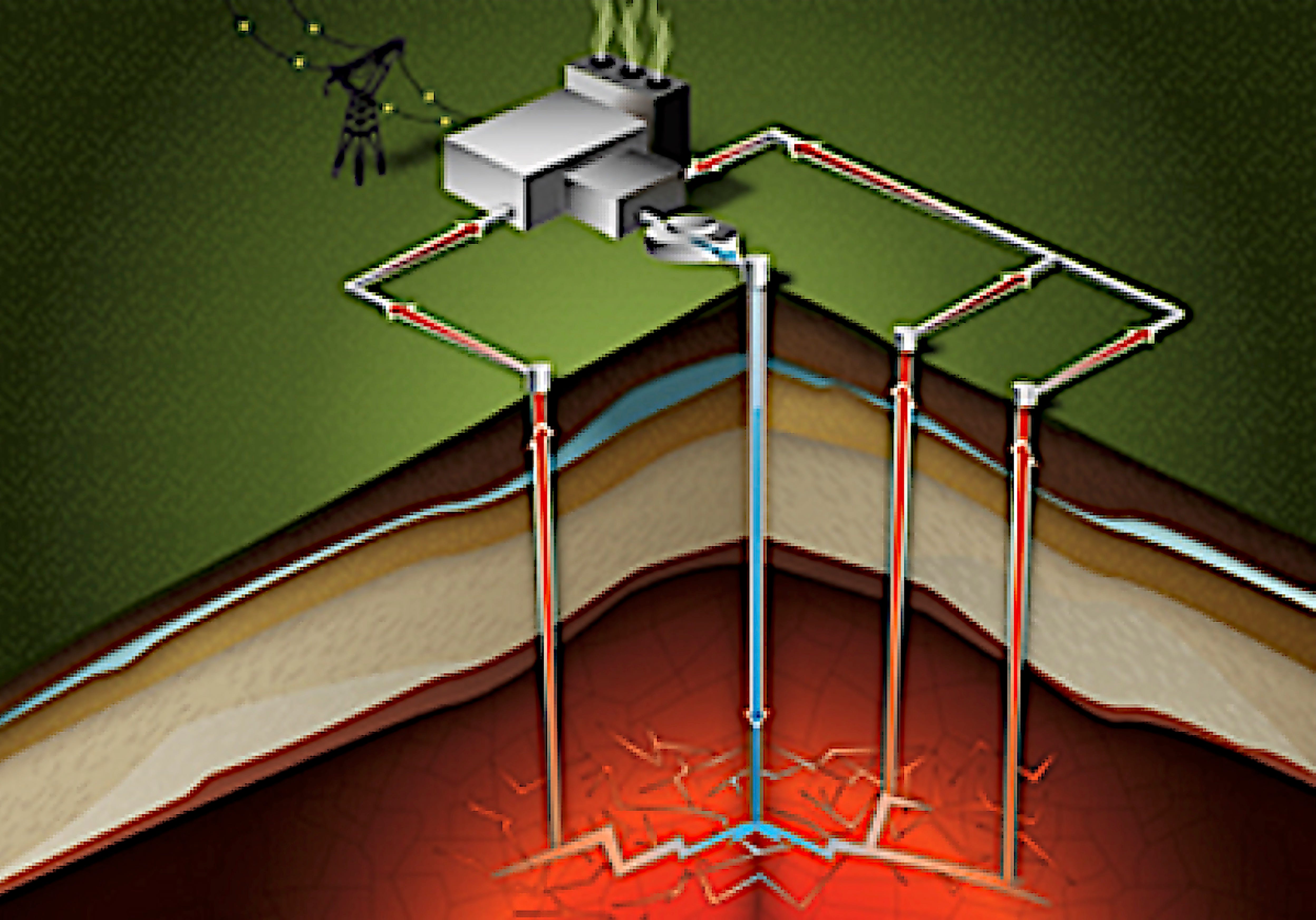
Utility-scale geothermal taps this deeper heat. Companies drill narrow wells — much like drilling for oil, water, or natural gas — and send water down to where the rocks are naturally, perennially hot. The water returns to the surface as steam or near-boiling water, which spins a turbine or exchanges heat with a generator. It is steady, continuous, weather-proof power.
Home and commercial geothermal is different from utility-grade geothermal. It doesn’t chase deep heat; it uses the shallow, constant temperature a few meters underground. Plastic pipes are buried horizontally or drilled vertically beside a home or office. A heat pump moves heat in and out of the ground the same way a refrigerator moves heat out of a fridge and into the air of the kitchen. Ground-source heat pumps are quiet, efficient, and require almost no maintenance from homeowners.
Neither kind of geothermal is exotic. They’re really just ways of moving a little of the planet’s warmth from underground to where we need it.
Why Geothermal Suddenly Matters
For decades, geothermal lived on the fringes of the energy conversation. It was promising but expensive. Only the luckiest geological regions where heat rose near the surface could afford it as drilling was difficult and unpredictable. Meanwhile, the cost of solar and wind power collapsed, and batteries steadily improved.
But more recently, that picture has changed — decisively.
Modern drilling techniques, borrowed from the oil industry, have vastly expanded the geothermal map, making it possible to reach stable heat reservoirs in regions previously dismissed as impossible. We now know how to drill deeper, cheaper, and faster. New “closed-loop” systems circulate water through sealed pipes, so we don’t need natural underground water. Horizontal drilling opens up long stretches of productive rock. The costs that once made geothermal uncompetitive are falling every steadily.
But the real shift is happening above the ground.
Power grids are under pressure from forces we barely anticipated. Climate change drives extreme heatwaves and cold snaps that push electricity demand to unexpected heights. Electrification is spreading into homes, vehicles, and industry. Each step is good for emissions, but each one adds strain to a grid already stretched thin.
And then came the Artificial Intelligence hyperscalers. The AI giants are building data centers that use as much electricity as a small city — not someday, but right now. Some regions are already seeing double-digit annual increases in electricity demand driven purely by AI data centers — and utilities are struggling to keep up. Entire power-generation plans are being rewritten around the expanding needs of servers that run 24/7, and the costs often fall on unsuspecting consumers.
Solar and wind can’t run a giant data center on their own. Batteries help, but not enough to cover days-long calm periods or prolonged storms. Fossil fuels fill the gaps, but at the cost of decades of new emissions.
Which leaves nuclear — the theoretical solution. It seems to provide a perfect base load to counter the fluctuations from renewables. But the real problem isn’t just safety or waste; it’s time. In practice, modern nuclear projects often take a decade or more to approve and build. We need power for the AI boom and the climate crisis now, not in 2040. Small modular reactors sound wonderful, but none exist at commercial scale, and the final costs are still unknown.
Geothermal, by contrast, can be drilled and operational, generating power, in a couple of years. It is safe, not controversial, and scales gradually, not all-or-nothing. It plays perfectly with renewables. And unlike nuclear, it doesn’t require a pitched battle to get past regulators and a reluctant public.
Utilities ignored it for decades because the old economics didn’t work. Now the economics do work — but habits and assumptions haven’t caught up.
At the same time, it’s important not to oversell geothermal.
Not every project will succeed, and not every form of geothermal is equally mature. Enhanced geothermal systems — which attempt to create artificial reservoirs deep underground — remain technically challenging and may prove uneconomic in some locations. Critics are right to warn against treating geothermal as a miracle solution.
But that caution cuts both ways. Geothermal today is not a single technology but a spectrum: conventional hydrothermal projects, closed-loop systems that reduce geological risk, and shallow ground-source heat pumps that are already proven and widely deployed. The question is no longer whether geothermal replaces every other energy source. The real question is whether it can provide reliable, always-on power in enough places, fast enough, to help bridge the widening gap between intermittent renewables and the growing demand for steady electricity. On that question, the answer increasingly appears to be yes.
A Way Forward
The irony of this moment is that we already possess much of what the future demands. We don’t need to wait for energy miracles like fusion, or gamble on megaprojects that won’t arrive until the 2040s The Earth itself offers a source of steady, predictable heat — one that ignores weather, shrugs at storms, and keeps working no matter what the sun or wind decide to do.
Geothermal will not replace solar and wind; it will reinforce them, and make battery storage more effective. And unlike nuclear, geothermal doesn’t demand a leap of faith. It doesn’t require decades. It requires something ordinary but rare: the willingness to look again at something we previously dismissed as impractical, to sidestep the “Oh, we looked at that, but it was too expensive” dismissive attitude towards a technology that has evolved.
For utility planners, engineers, regulators, and investors, this is the moment to take that second look. The tools have changed. The economics have changed. The urgency has changed.
If you are involved in generating, regulating, or financing electricity, the question is no longer Why geothermal? The real question now should be: When do we start?
The future needs reliability. The climate needs speed. Humanity needs solutions that work today.
Geothermal is one such solution — and its moment has come.