


God Machine Theology
There’s a peculiar theology running through the AI world right now. It’s not religious, exactly, although it has more than a whiff of incense about it. The core belief is that if a large language model (LLM) can just be made big enough, the data center powerful enough, and the electricity bill appalling enough, then divine intelligence will somehow pop out the other end.
That’s the God Machine Theory of artificial intelligence: build a big enough brain and then wait for wisdom to emerge. The industry keeps assuming that with just one more leap in scale, true wisdom will emerge from the machine.
I humbly disagree.
That doesn’t mean I’m anti-AI. Quite the opposite.
I first studied computer science in the 1970s, when artificial intelligence was still conjecture, speculation, and hand-waving. Since then, I’ve been watching very smart people confuse software with intelligence for more than half a century. Now I work with AI almost every day, and I find it remarkably useful. It can summarize, compare, draft, translate, classify, criticize, and organize. It can take a muddle of material and turn it into something that looks as if a sensible person has composed something thoughtful.
But useful isn’t the same as good enough. The more I use AI on genuinely hard human problems, the more agnostic I become about God Machine Theology.
The hardest problems we face aren’t waiting for a perfect textbook answer. They’re not nails that need to be hammered in. They’re knots that need to be patiently, meticulously unraveled.
Homelessness is a knot. Affordable housing is a knot. Hospital overload, loneliness, elder care, and the slow collapse of public trust are all knots. They are wicked tangles of finance, law, psychology, politics, physical infrastructure, institutional habit, human fear and more. And when a problem is a knot, you don’t need a bigger hammer, you need a workshop of different tools.
The Housing Tangle and the Need for Lenses
Let’s take homelessness and affordable housing as a working example. I’ve spent a fair amount of time thinking about both, not as a developer or a social worker, but as a futurist trying to understand why our wealthy society keeps failing at something so basic. If you ask a bleeding edge AI system about affordable housing, it can beautifully summarize public policy, compare the efforts and trials that different cities have attempted, and draft a flawless memo to your city council. It can warn you, quite correctly, that “housing first” is a societal commitment rather than just a catchy slogan. All of that is useful, but describing a knot is not the same thing as untangling it.
Because affordable housing is actually several discrete problems snarled up together so tightly that we mistake the tangle for the thing itself.
You might start with land: who owns it, whether it’s serviced, and whether it’s one explosive neighborhood meeting away from becoming politically radioactive. Then zoning regulations appear, with their dry abstractions and encoded vetoes. They show up waving rules written thirty years ago for reasons that might have been valid then, but may be quietly strangling useful projects today.
Finance comes next, carrying a spreadsheet and an axe. What interest rate do we assume? Who provides the financing, and what collateral are they offering? Spreadsheets can’t make markets deliver non-market housing unless someone makes it profitable.
Construction brings its own raw brutalities: do we go with conventional stick-built, modular, or mass timber housing? Fast, cheap, durable, or dignified: you get to pick any two if the gods are smiling.
Finally, after the ribbon-cutting photo op is over, operating costs show up, and that’s where beautiful ideas go to die, unloved and unnoticed. Projects fail quietly because nobody funded the human infrastructure needed to keep them humane in year three.
Underneath the technical layers sit the human realities: addiction, trauma, low wages, and the accumulated damage done by systems never designed around the people who need them. Under all of it sits human dignity, and that’s the thing that too often disappears when human beings are transformed into boxes on a spreadsheet.
God Machine Theology fails here. When we ask a LLM how to fix affordable housing, it hands us a large, fluent, polished bucket of fog: “You must deploy a comprehensive, multi-stakeholder, evidence-based strategy combining zoning reform and sustainable funding.”
What the heck does that mean?
To turn that fog into reality, an AI workshop would first need to identify who or what is missing from the room. Most bad decisions are bad because the wrong set of minds evaluated them. A housing project designed strictly by finance and planning may look flawless until someone who has actually lived in a shelter points out that the layout is terrifying and guests are likely to be beaten and robbed in the dark corners.
That’s why a functional workshop requires disciplined lenses: framework modules representing structured, verified ways of seeing. As one example, we need a street-level urbanism lens, perhaps derived from the work of Jane Jacobs to evaluate safety and human scale. We need a complex adaptive systems lens to map unintended feedback loops. We need a maintenance lens to audit year three, and a trauma-informed social worker lens to interpret community anxiety.
Crucially, this must not be merely intellectual ventriloquism. I have no interest in an AI pretending to be Jane Jacobs. A genuine lens is a validator, not a personality mask. It is a documented, auditable set of questions, sources, and constraints that cross-examines a project’s data in a particular light. A Jacobs lens shouldn’t write essays about sidewalks: it should scan an architectural blueprint and flag whether the ratio of active street fronts to blank walls falls below a safety threshold needed for informal surveillance. Assembled by universities, professional bodies, and independent groups, these lenses could form a new intellectual discipline where analytical frameworks are open, peer-rated, and aggressively criticized.
The Escalation Engine: Passing the Buck Upwards
How do we orchestrate these lenses, spreadsheets, and databases without creating the worst kind of bureaucratic committees? Where can we get an omnipotent dispatcher who parcels out the work appropriately?
To resolve this, we will need to apply the first rule of an AI workshop: use the smallest intelligence that can do the job.
That’s an economic necessity. Compute is becoming scarce, expensive, and rationed, so routing every minor task to a bleeding edge, giant LLM is like sending a surgeon to change a band-aid. Sometimes you need a surgeon: more often you need a nurse, a checklist, a thermometer, or maybe just your mom. The future of AI cannot default to the biggest model. We won’t be able to afford it, no matter how much the hyperscalers want to sell it.
Instead, a workshop operates as a bottom-up escalation engine: a structured, disciplined means of passing the buck upwards. The lowest-level intelligence on the ladder attempts the problem first. If a local LLM running entirely on your laptop can clean up a paragraph, transcribe a note, or search a local document, the task stops there. It consumes minimal energy and requires no continental-scale machine room humming in the background.
However, if that local intelligence hits indeterminate results, encounters a context clash, or realizes it is out of its logical depth, it doesn’t produce an error message. It escalates the problem up the ladder to a private cloud model. There, deep organizational history is available to check whether a proposal contradicts a past institutional decision.
If the conflict remains unresolvable, the cloud model appends whatever pieces of a solution it can produce, then hands the problem to a frontier AI model, summoned exclusively when language, analogy, and cross-disciplinary synthesis matter. Such a model might be an LLM, or it could be a specialized, non-LLM tool: evolutionary algorithms to search through thousands of possible design configurations, for instance, or Monte Carlo simulations to test financial consequences over time.
The magic of this architecture lies at the top of the ladder. If even the biggest, most expensive frontier AI hits a roadblock, it stops, isolates the pieces it can solve, packages the support data, and draws a clear circle around the unresolvable core. It then makes the final handoff to a human being, because humans bring insight, judgment, lived experience, and the potential to bring in other specialists who might not have been obvious inclusions at the start.
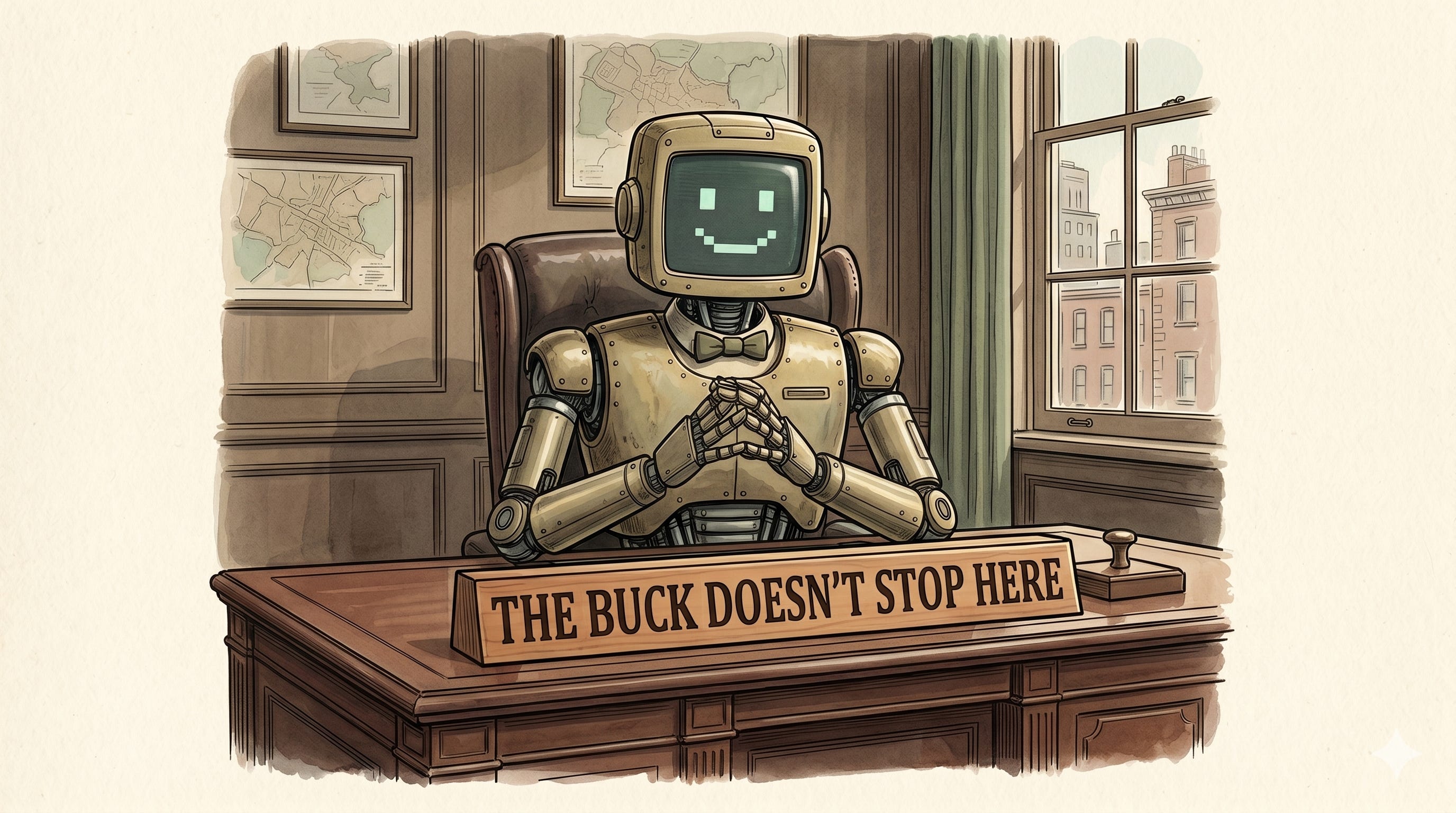
An AI should know when to pass the buck.
And ironically, this escalating model redefines the corporate chessboard for tech hyperscalers. If the AI race is strictly about who builds the biggest data center, companies like Apple look like they’ve lost the race already. But if the real race is about who controls the dispatcher at the bottom, the first rung on the ladder, the dynamics flip entirely. Apple is one possible company that could own the first rung of the ladder because it designs and builds the devices, the chips, and the local interface living in the user’s hand, which forms the bridge between the user and the problem. A local Apple system could handle edge tasks, escalating to institutional clouds or frontier models only when the complexity justifies the cost.
But it doesn’t have to be Apple. Microsoft might build the enterprise dispatcher; Google could build it around Android and search. Open-source developers, mimicking Linux, could construct bottom-rung dispatchers for those who refuse to have their thinking mediated by a corporate black box. Regardless of who does it, the ultimate prize isn’t the model: it’s the layer that directs problems from the human who poses it to the layer that provides a working toolset of solutions.
Notice that whoever owns that bottom rung of the ladder quietly controls the boundaries of the problem solving. This is where the framework becomes dangerous because the dispatcher is never a neutral traffic cop. It’s the entity that dictates how a problem is defined before a human ever opens the file.
If a corporate platform programs the routing layer to treat a 12% profit margin as an immutable law of nature, but treats a resident’s dignity as negotiable, the algorithm has already made a critical political decision. The machine won’t produce an error message. Instead, it will silently filter out humane solutions as inefficient noise before a human sees the project, creating an automated, invisible veto over social policy. We wouldn’t be just outsourcing tasks: we’d be surrendering the architecture of human choice.
Friction, Safeguards, and the Reality Floor
Because the stakes are so high, a technologically sophisticated skeptic should be deeply uneasy about this workshop model. If a dispatcher merely flattens institutional differences into a bland compromise, it becomes worse than useless. The workshop avoids this by enforcing structural friction.
The dispatcher must maintain a shared project model: a common record of assumptions and constraints where the friction is the entire point. If a financial model violates human dignity, the system must flag it. If zoning rules break financial viability, it must be flagged. In a God Machine answer, these conflicts are buried under persuasive prose; in a workshop, they are forced into the light for all to see and work on.
To keep this ecosystem transparent, two safeguards are non-negotiable.
First, the dispatcher must maintain a continuous work log. We must be able to audit exactly which modules were called, what evidence they used, and which constraints were treated as fixed versus negotiable. Without this, the workshop degenerates into just another opaque black box.
Second, the system requires a reality floor. The workshop must be capable of testing its assumptions against the physical world. It cannot rely on what a model “remembers” about construction costs: it must pull actual, recent local bids. It can’t guess at regulatory barriers: it must parse the actual local bylaws and check recent council minutes. The dangerous AI sounds smooth and convincing, as if it knows; the useful AI knows when it doesn’t know and tells you it’s going to check.
The Human Ceiling
This bottom-up escalation framework directly addresses the profound cultural angst surrounding automation and human displacement. For generations, technology has systematically absorbed the routine, freeing humans for more complex and rewarding work. Calculators took over arithmetic, but not mathematical judgment. Spreadsheets took over ledgers, but not business strategy. GPS took over route-finding, but doesn’t decide where you need to go, why you are going there, or whether the trip is worth taking.
By forcing the machine to pass the buck whenever it runs out of answers, we establish a definitive structural ceiling for automation. The workshop does not weaken human judgment: it sharpens it by clearing away the analytical underbrush. When the AI system escalates a problem all the way to the top of the ladder and still cannot find a path forward, it exposes a profound truth: the remaining barrier is not a lack of data or computing power. It is most likely a collision of human fears, conflicting values, and political disagreements.
In other words, a machine can map the hallways, but it cannot walk into a room and create trust.
Someone must persuade an irate council. Someone must look anxious residents in the eye and reassure them. Someone must decide whose fear is legitimate and whose dignity has been compromised. Someone must have the courage to stand behind a proposal when it generates controversy in the media.
Those are not machine tasks. They’re human tasks, and they’re also a moral test. The test of AI will not be how powerful it becomes, but whether it helps us see and serve the people our systems usually miss.
The God Machine wants to create a smooth, silky-sounding answer, but the workshop wants to get its hands dirty and build. The intelligence of a workshop isn’t located in any single tool: it lives in knowing which tool to pick, in what order, under what constraints, and in whose hands. When the machine finally runs out of logic, it turns back to us with the clarified pieces of the problem, and hands over the unresolved strands of the knot.
Here, it says. This part is yours. I’m out of my depth.
Summary: This essay argues that the future of artificial intelligence is not one giant “God Machine” or universal brain, but a workshop of specialized tools routed by the smallest intelligence capable of doing the job. Using affordable housing and homelessness as examples, it shows why large language models can describe complex social knots but cannot untie them alone. A better AI architecture would start locally, escalate only when needed, use validated “lenses” such as finance, zoning, lived experience, maintenance, and systems thinking, and maintain transparency through work logs and reality checks. The goal is not to replace human judgment, but to clarify problems until the machine reaches its limit and hands the remaining human work back to us: trust, courage, legitimacy, persuasion, values, and responsibility.
Besides, I already know the answer to the question of life, the universe and everything. It’s 42.
Evan Solomon, Minister of Artificial Intelligence and Digital Innovation and Minister responsible for the Federal Economic Development Agency for Southern Ontario was recently interviewed by Amanda Lang on the Podcast WONK.
The minister was in hyper-sales mode with a view of only the UP-side. He did not acknowledge any of the potential down-sides. Why would he? It's the taxpayer who will carry the cost of this 'experiment'.
With my background in technology going back to the 70's, I've seen / heard it all before.