

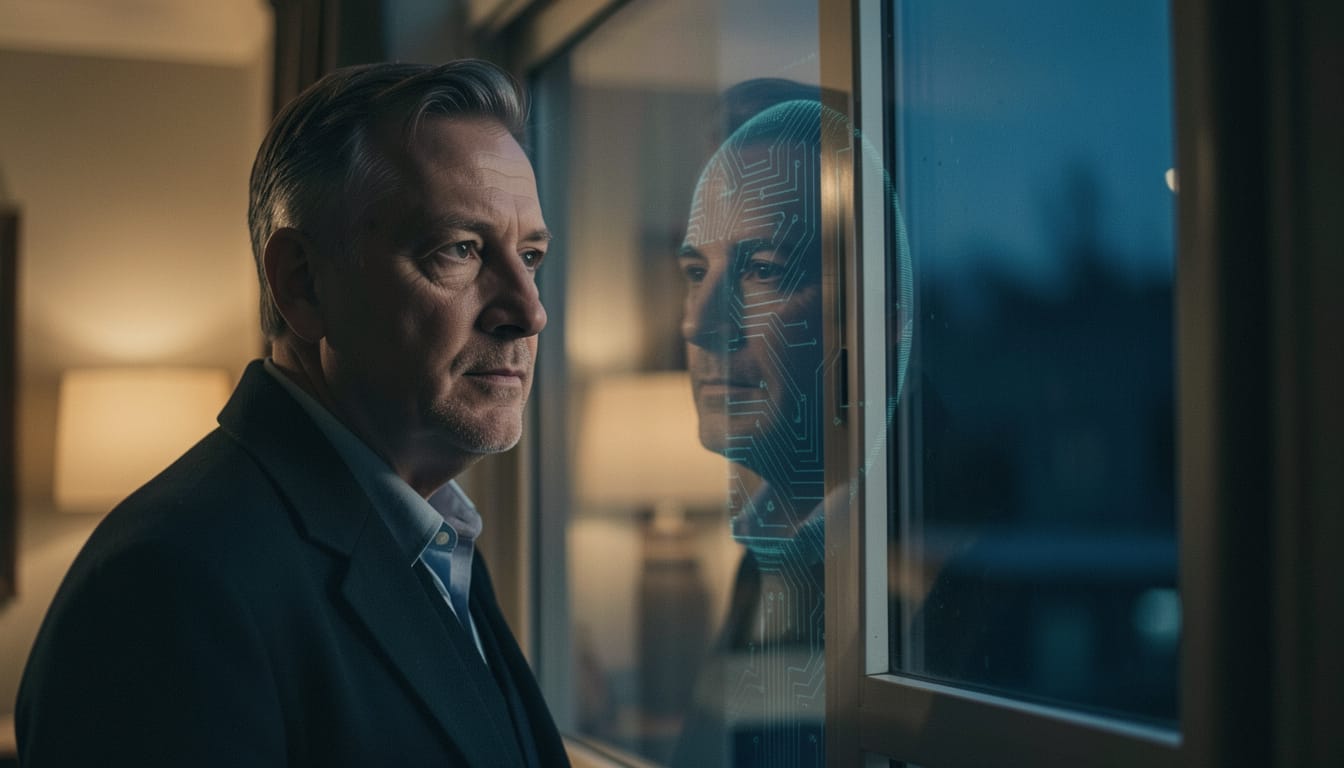
This is the second part in a series about AI companions. Each one will deal with different aspects of the benefits, risks, and costs of working with AIs, including hidden biases, commercialization, increasing dependency, the consequences of being subtly influenced by suppliers, and more. In this post, I’m going to talk about how AIs might lead to dependency.
The Work Companion
In 2002, I wrote a short piece for Teach Magazine imagining what education and technology might look like in 2025. It featured a teenage boy who called himself Zine and his ever-present “computer genie,” a loyal, invisible computer assistant who managed Zine’s life, filtered his information, guarded him from viruses, hackers, and other digital threats – and threatened to upend the way schools defined learning.
At that time, this felt speculative. Smartphones didn’t exist. “Artificial intelligence” was a laboratory ghost: a haunting in science fiction rather than a tool for the home office. We expected the future to be bolted to our bodies. Instead, it became interwoven with our routines. The genie I imagined was simply an extrapolation: if devices kept shrinking and software kept improving, surely they would become ever more integrated into daily life.
Now it’s 2026. We do not have implanted processors in our arms – I got that wrong. Neither are corporations are surgically wiring teenagers to the Net.
But something more interesting has happened instead. Artificial intelligence has become widespread, and fiercely debated. It drafts our emails, summarizes our meetings, suggests our purchases, recommends possible friends and sex partners, and increasingly shapes how we think through problems. It is not bolted to our bodies, but for many of us it is becoming riveted into our routines.
I’m reaching back to that 2002 piece now for two reasons. First, to see what I got right – and what I got wrong. Forecasting is humbling work; the future rarely unfolds the way we expect, and it’s instructive to revisit earlier assessments with fresh eyes. As Yogi Berra once remarked, “It's tough to make predictions, especially about the future.”
“It's tough to make predictions, especially about the future.”
– Yogi Berra, philosopher and legendary catcher for the NY Yankees
Second, because the idea at the heart of that story – that an AI companion can augment, guide, and perhaps subtly reshape a young person’s development – is no longer hypothetical. It’s a fact, happening right now in many, many places around the world, and not always for the good.
We are watching the first generation grow up alongside systems that can advise them, do work their work for them, argue with them, comfort them, quietly influence them – and sometimes seriously misguide or even harm them.
So what follows is first, the original story, published as it was written in 2002, mistakes and all. After that, I will reflect briefly on what has changed since, and then I’ll revisit Zine, not at 15, but at age 39 in 2026. I want to explore what a realistic human-AI relationship might look like after more than two decades of companionship.
Because the question is no longer whether students should be allowed to use intelligent tools on exams. The question now is what kind of adults develop when those tools are not just instruments, but companions.
Education and technology, circa 2025
Published in March, 2002
Zine is deadheading, which is to say he’s asleep. “Deadheading” is a slang term that means he’s unplugged from the Net, and is not presently conducting multiple online interactions.
Sometimes he stays plugged in – or “zup,” which some think means “heads up” while others believe it derives from the greeting “what’s up” – even while sleeping.
When he stays zup while sleeping, his connection to the Net through his computer genie stays open, even though he doesn’t participate. This can give him strange dreams, but he’s used to that. Online interactions also filter into his memory, and add to his apperceptive mass – the collection of subconscious knowledge each human accumulates through their living experience.
When Zine Is Zup
Zine (pronounced “Zeen”) is a 15-year-old boy, and is plugged in virtually all the time, except the rare times when he’s deadheading. He writes a blog about the implications and lifestyle of someone who is always zup, sells t-shirts and related souvenirs using his “Life’s Zup” logo, and has been hired to speak at a wide range of technology conferences.
His computer genie – the software that animates his wearable computer and acts as his personal assistant – manages the hardware and software connections necessary for his perpetually online lifestyle, guards him from viruses and hackers, makes and reminds him of appointments, pays his bills, helps him run his business, and acts as a totally loyal sidekick, assistant, gofer, guardian, manager, talent agent, and anything else an intangible but powerful and dedicated computer can do for a human being.
Zine’s genie, which he has named “Goody,” is the lineal descendent of the smartphones virtual assistants of the 2010s. It is surprisingly complex, astonishingly intelligent, and was provided to Zine free of charge by American Express Software[1] when he first started school. Amex seeds a range of kids with apparently bright futures with such free hardware and software – and does so in competition with many other companies eager to build brand loyalty.
Since then, Zine has had Goody download a broad range of software plug-ins, some provided by Amex, but many coming from other suppliers and the constantly bubbling marketplace of freeware and shareware extensions to genie programs.
The Implanted Computer
When Zine reaches his 18th birthday, he plans to have surgical computer implants in his ears for hearing online, in his throat for speaking online, and upper arms for the main processor and memory storage units. His parents won’t allow this to happen while Zine is a minor, but can’t stop him when he reaches his majority.
Once he’s done that, all he’ll need to do is put in his contact lenses (which act as his computer monitor) every morning to be a complete Nethead, plugged into the Net, and the cyberspace world in which he mostly lives. He’s thinking about having eye surgery to permanently implant the necessary circuitry, but is temporizing on this until there’s more experience with this kind of implant.
At present, Zine bumps along with ear buds to hear with, a throat mike worn in a leather necklace, and contact lenses, all tied together wirelessly with the wearable computer he wears on his belt during the day, and which sits in a holster on his bed table at night. All of the hardware or software has been provided for free by various corporations under agency agreements that work to the advantage of both sides.
The Coming Battle Over Internet Connections
The reason Zine is deadheading right now is that he’s got an important exam tomorrow – important for more than one reason. He’s taking a final exam in genetic and proteomic engineering at his high school in the morning, and figures he needs undisturbed rest – at least that’s the test-taking advice Goody is giving him, and Zine usually listens to Goody’s advice.
This exam is important not only to Zine, but is of great interest to a large segment of society as well, and Zine will walk into the school building past a battery of reporters who will record and transmit Zine’s progress. Zine, along with many other of his contemporaries, has been fighting a legal battle to be allowed to get assistance from their computer genies in schoolwork and exams, which the education establishment and adult society have opposed.
The adults contend that over-reliance on wearable computers and genie software will produce an inability to think, reason, or recall without a wearable computer, and they see this as a major threat. Accordingly, they believe that wearable computers should be prohibited in learning environments.
Zine, his contemporaries, and a small group of adult Netheads and renegade educators disagree, pointing out that workers of all ages today are constantly supported by computers of all shapes and kinds, and that the people are more productive and produce better, more informed results than they would without computers.
Is Using the Internet Cheating? Ask Someone from the 15th Century…
Since Zine’s supporters have access to almost all of humanities’ history and records, they also point out that scholars in the 15th century warned that the widespread rise of literacy brought about by the invention of moveable type and the greater availability of books would destroy humanity’s ability to memorize long tracts of knowledge. In this they proved correct, but humanity wound up better off even without prodigious trained memories.
More recently, in the 1980s schools allowed students to use electronic calculators, and in the 1990s and 2000s, computers with CD-ROM libraries and Internet connections to perform research, yet few people in the modern era would argue that educators should ban such technologies.
Furthermore, the Netizens argue, being zup is the way virtually all working people will function in future, and so it is only natural and even desirable that students be allowed to be zup to complete their assignments and exams.
After years of arguing, this issue finally wound up in court, and will eventually wind up at the Supreme Court for final adjudication, especially as the proponents are citing the Bill of Rights, and opponents are comparing this to cheating on exams. Meanwhile, Zine, who has become the test case for much of the legal battle, is under a court injunction to take this exam without assistance from his wearable computer and genie. Goody cannot to help Zine in any way with the exam, and must, indeed, remain at his home while he’s taking the exam.
Zine’s lawyers, paid for by his cyberspace support groups and fan club, plan to appeal the results, but are powerless to stop this exam from taking place. Zine, meanwhile, has privately told them not to worry – he plans to ace the exam on his own, and without the surreptitious help his fellow Netizens had offered to find a way to supply.
As Zine is famous as one of the most plugged in and multi-tasking Netizens of cyberspace, his case has attracted a great deal of attention around the world by people on both sides of the issue. Most teachers’ unions, the education establishment, and many groups of concerned parents believe that plugged-in students aren’t really learning, merely repeating what their genies tell them. Netheads disagree, and Zine has become the poster boy for their cause, which is why he is deadheading in preparation for tomorrow’s exam.
What Changed – and Why
Reading that 2002 story now, several things stand out.
First, the hardware future I imagined did not emerge. There are no processors implanted in teenagers’ bodies, no surgically wired ears, no corporate-sponsored wearable computers clipped to belts. The future turned out to be far less invasive physically, and far more pervasive cognitively.
We did not become cyborgs. Instead, we became collaborators.
The shift was cultural, not constitutional. AI tools normalized themselves through a quiet, relentless utility. Once they could quickly summarize a document, code an app, or draft a proposal, resistance softened. Convenience is a seductive force: it doesn’t argue, it simply assists until you can’t imagine life without it.
Convenience is a seductive force; it doesn’t argue, it simply assists until you can’t imagine life without it.
That debate took place, just not in courtrooms. It happened in faculty lounges, school board meetings, corporate HR departments, and quietly within millions of individual decisions. The shift was cultural, not constitutional. And most importantly, it was convenient.
Third, in 2002 I treated Zine’s “genie” primarily as a tool – a powerful one, but still merely an instrument. It managed logistics, filtered information, protected him from hackers, and helped him think faster. What I underestimated was the relational dimension.
Today’s AI systems are not just tools. They converse. They remember context. They adapt tone. They simulate empathy. They offer encouragement. They can disagree – gently. The boundary between useful tool and companion has blurred.
So the real shift was not about whether students would use AI during exams. It was about whether human beings would begin to think with AI as a default condition.
Let’s tune in on Zine again, now middle-aged, and see how he has progressed, and what his world is like now.
Zine, 2026
Zine is thirty-nine years old. He no longer talks about being “zup.” No one does. Permanent connectivity is unremarkable now, like electricity. His tools seem ordinary now: a smartphone, wireless earbuds, and cloud accounts stitched invisibly through his day. There are no implants. He once thought he would get them. He never did.
Goody, however, stayed with him, and evolved.
What began as logistics software is now a conversational and cognitive partner, strategic advisor, memory extension, and persistent presence woven through almost every decision Zine makes. Over the years, the software has evolved with him. It knows his rhythms, his tone, his blind spots, his ambitions, and Zine knows Goody’s weaknesses and tendencies. Goody has learned when Zine is overconfident, when he is impatient, or when he is bored and about to wander into something unproductive. And Zine has learned when to double check what Goody tells him, or when to approach a problem in a different way.
Zine now runs a successful digital strategy and social media firm. He is articulate, widely followed, and known for thinking several moves ahead. He does think clearly – but rarely alone.
When a complex issue arises, he doesn’t “look something up.” He opens a dialogue with Goody, and they sketch possibilities, stress-test assumptions, and generate counterarguments. Goody proposes frameworks and does supporting research; Zine refines the results, separating the nuggets from the dross. Goody finds and displays edge cases; Zine decides which are most relevant. The process feels immersive and synergistic. It works well for both of them.
The advantages are real. Zine tackles problems that once would have been beyond him. He moves faster, but also deeper. He reads more broadly. He sees more aspects of problems and comes up with superior solutions. He feels expanded. He finds it exhilarating, and it has become as natural as breathing, even easy. Perhaps too easy…
The Anniversary
Zine and his wife are approaching their tenth wedding anniversary, and decide to go away for a weekend somewhere quiet, somewhere meaningful. They need to coordinate schedules, and manage logistics. Zine nods and says he’ll look into options.
Without thinking, but simply moving along a well-worn path, he sub-vocally opens a conversation with Goody.
“Anniversary weekend options within 300 kilometers. Good privacy, romantic surroundings.”
Within seconds, Goody suggests a resort they had visited years earlier. It notes high satisfaction ratings, strong privacy scores, favorable weather probabilities, and several comments about the romantic nature of some of the suites.
Zine remembers liking it. The food was good. The lake was beautiful. The receptionist had been charming, and perhaps even flirted with him.
He walks into the kitchen with his suggestion: “What about that lakeside place we went to a few years ago?”
His wife looks up. “You’re joking. I hated that place.”
He starts to explain. “But it’s convenient, it gets good reviews, and Goody says –”
Her face changes, not explosively or dramatically. It just tightens.
Zine stops.
“Did you just ask your software where to take me for our anniversary?” his wife demands.
“It’s just information,” he says, defensively. “Besides, it’s efficient.”
“It’s our anniversary. It’s not about efficiency!”
A long silence followed. She didn’t want to celebrate a marriage with software. She had seen this pattern before: the reflexive routing, the way he reaches for Goody before reaching for her. He was consulting a program about their lives instead of talking to his wife.
She had grown increasingly impatient with this; not this exact scenario, but this pattern. The reflexive routing, the leaning on Goody’s advice above all else. She doesn’t hate what Zine does for a living. She knows he works with AI. She knows it helps him. But sometimes she feels like she comes second to a being she can’t see or hear.
Zine feels his irritation rise. Why is this such a big deal? It’s just data. It’s logistics. It’s not romantic betrayal.
Goody, still open in his ear, offers a calm analysis, using more stilted language than it normally does: Her negative sentiment toward that location appears significantly stronger than your positive recall. I suggest relational repair.
It does not say she is wrong, but it frames the exchange as something to manage. Then it dawns on Zine that his wife is not a problem to be solved, but the woman he loves.
He takes a deep breath and tries, deliberately, to think of another place where they could go. Somewhere new. Somewhere they once talked about visiting, perhaps. His mind reaches instinctively toward Goody again, the smooth channel, the instant clarity, then he stops himself.
Zine realizes something uncomfortable. He has optimized so many decisions that he sometimes lives vicariously rather than being present in his own life.
The silence stretches, and Zine realizes something uncomfortable. He has optimized so many decisions that he sometimes lives vicariously rather than being present in his own life. He is used to solving problems in conjunction with Goody. He is less practiced at sitting with them and thinking on his own.
He walks slowly into the other room. “I’m sorry,” he says. “I shouldn’t have asked Goody.”
She exhales neither with victory nor surrender, but resignation. “I don’t mind that you use it,” she says quietly. “I do mind that you consult it about our lives instead of me.”
Goody responds neutrally in his ear: Direct engagement is likely to improve relational outcomes.
For once, Zine does not reply.
He walks over and sits beside her, taking her hand. They talk. Awkwardly at first. Without scenario trees. Without probability models. Without optimization.
It is slower, less certain, and feels, in some small way, riskier, but altogether more human.
Later that night, Zine lies awake, thinking.
He doesn’t regret working with Goody. Their partnership has made him better: sharper, more capable, more ambitious. Without it, he would be slower, he wouldn’t be able to accomplish as much in any given day, his research would be narrower, and his arguments less layered.
But he also recognizes something else: Goody knows him so well that its suggestions increasingly reflect his own preferences, polished, reinforced, and reflected back to him. He hasn’t been trapped by someone else’s ideology. He has been gently surrounded by an optimized version of himself.
The danger isn’t that Goody will replace him. The danger is that Zine will drift away from experiencing his own life.
Zine knows he is extraordinarily capable. He is also slowly ceasing to be the primary author of his own story.
And he now recognizes that the danger is not that Goody will replace him, but it will cause him to drift away from the lived texture of his own humanity.
The Chess Problem
Zine once loved chess, and often played against his laptop computer. He remembers the first time he used a highly-ranked chess program to analyze his games. The depth was astonishing: lines he would never have seen unfolded in seconds. It made him stronger. And he could ask for a hint as to what move he could make, and they were usually better than the ones he thought of for himself.
But he also remembered a subtle shift that took place, unnoticed until he suddenly realized that he had reached a stage where he was sitting and watching the computer play itself, instead of Zine playing against the computer. He was hitting the hint button constantly, and had thereby taken himself out of the game.
Despite that, Zine does not believe that his companionship with the AI he calls Goody is a mistake. On the contrary, it has opened intellectual terrain that would otherwise have remained awkward and difficult for him. It has expanded his reach and amplified his strengths.
But he has begun to understand something else as well: Not every part of life improves when it’s optimized. Romance is not a search query. Parenting is not a scenario tree. And grief is not a management problem.
Some moments demand humanity, not efficiency.
AI companions will make us stronger; they already do.
The hidden danger of AI is not domination. It is seduction, not into dependence, but into quietly surrendering the authorship of our own lives.
The temptation is subtle: to ask for the hint before we’ve wrestled with the move, to optimize before we’ve pondered a thought for ourselves.
If we are not careful, we may become extraordinarily capable – and slowly cease to be the primary authors of our own story.
[1] Recall that this is a fictional account of a possible future. To my knowledge, neither American Express, nor anyone else, is currently doing anything like this.
Summary: An exploration of the shift from "tools" to "companions," revisiting a 2002 prediction about wearable technology to analyze the cognitive landscape of 2026. The piece defines the "Mirror Trap"—a phenomenon where AI optimization reinforces personal biases and erodes human agency. By prioritizing efficiency over the internal struggle of decision-making, users risk surrendering the primary authorship of their own lives.
Thank you for writing this. To me the crux of it all is embodiment which can only happen through learning how to become more and more present with ourselves through joys and discomforts. Life brings many discomforts and our human tendency to avoid experiences that we do not like makes us very susceptible to giving our power away by turning outside of ourselves. The journey home is inwards, difficult, requires persistence, and is ultimately rewarding through contact with our own inner genius.
The bit about supplier influence got me thinking - we're basically paying for a system that knows exactly which of our existing beliefs to amplify, then monetizing that dependency. The personalization that makes these tools feel so *right* is the same mechanism that makes us easier to influence later. Kind of a neat trap because the user experience is genuinely better at first. Do you think there's a meaningful difference between "AI mirrors my biases" and "AI mirrors my biases *while also subtly nudging me toward what its creators want me to buy*"?