

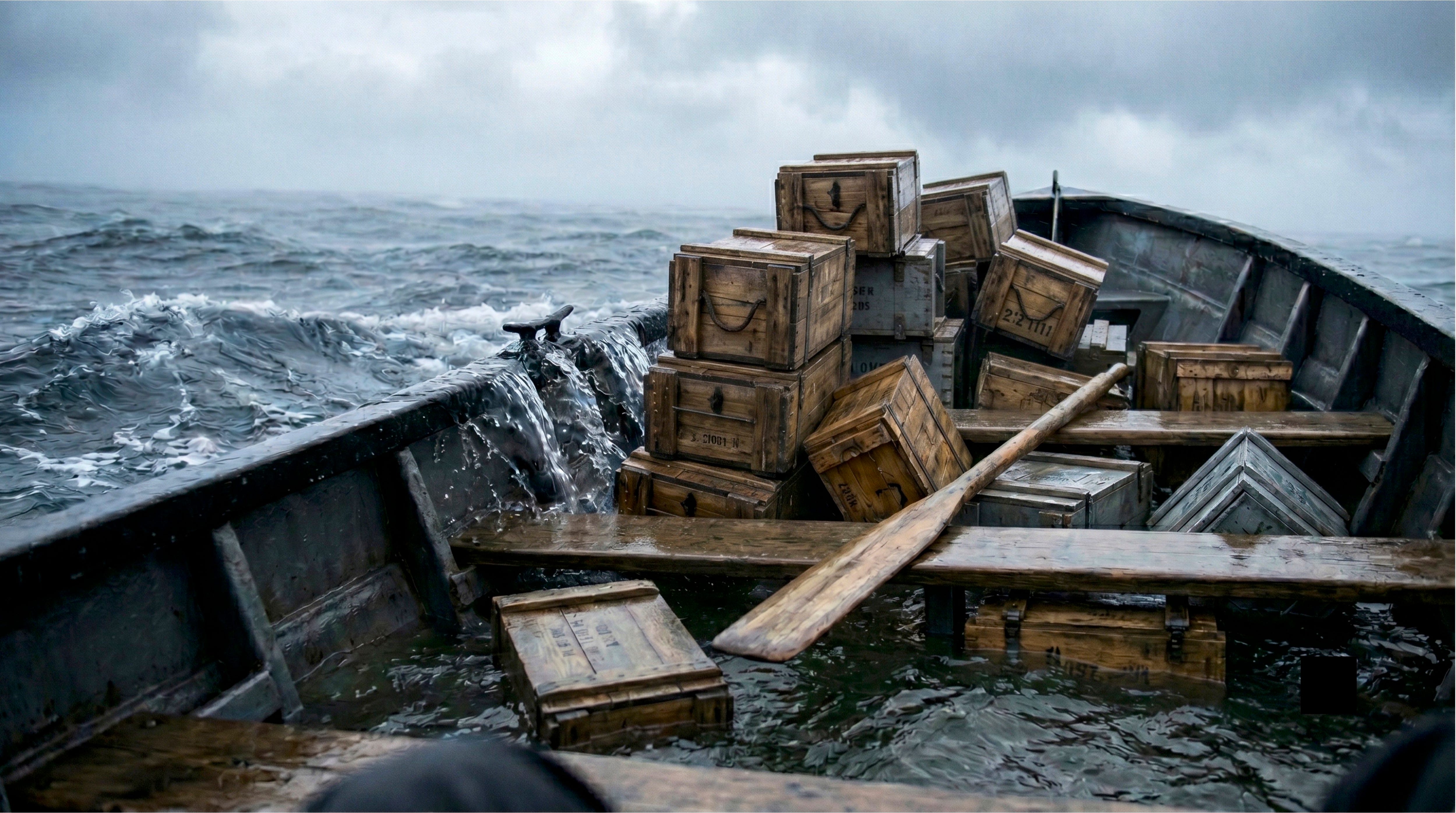
The global economy today is like a lifeboat loaded to the gunwales with debt, pension promises, defense commitments, mortgage payments, private credit, corporate leverage, supply-chain assumptions, and the comforting delusion that tomorrow will look enough like today that everything will be fine.
In calm water that works, but there’s a storm coming, one of unusual force, and it’s arriving at a bad time. Not because the world has never had energy shocks before, nor because markets have never faced war, inflation, shortages, or panics. What makes this moment dangerous is the combination: an energy shock of potentially unprecedented magnitude approaching a world that has spent decades whittling down its margins of safety.
This energy shock will hit especially hard because balance sheets and run-down reserves have little or no room left to absorb it, and that, I think, is what markets are still missing. They’re treating this as an oil-price story. Crude prices go up, then come down. Traders tweak their models and drive on. Analysts mark down earnings for airlines, truckers, refiners, chemical companies, and consumers, then rewrite their forecasts. Investors rotate from one sector to another, cutting losses and seeking renewed profits. Eventually, the shock is priced in, the headlines fade, and markets climb through fear, as they often do.
Sometimes it works out that way. Markets can be very good at looking past fearsome events.
But this is different. Fear can be traded and priced. Shortage can only be endured. If diesel gets too tight, crops do not move themselves from farms to processors. If jet fuel becomes expensive or uncertain, aviation does not merely suffer a margin problem; flights start thinning. If insurance costs rise for tankers, if shipping routes become longer, if refineries are forced to scramble for the right grades of crude, if inventories start being drawn down faster than they can be rebuilt, then this is no longer a story about the price of oil.
It becomes a story about what the system can survive when supplies just aren’t there, and the damage does not arrive all at once. It arrives in sequence: first in the places with the thinnest inventories, the fewest substitutes, and the shortest clocks.
Energy is not just another commodity.
It is the commodity that lets everything else move. It’s embedded in food, freight, heat, plastics, fertilizer, mining, construction, emergency services, military logistics, and almost everything that looks, from a distance, like a normal modern economy.
When energy gets tight, the economy doesn’t merely pay more. It has to start deciding what it can’t afford to do at all – and that is where the overloaded lifeboat matters.
A leaner, more disciplined world would still suffer from a major energy shock, but it would have more room to bend before it broke. Governments would not already be spending so much just to service old promises. Families would not be stretched to the edge before the grocery bill went up. Companies would not be depending on cheap credit, flawless logistics, and customers with one more credit card to tap. There would be more slack in the ropes.
That’s not the world we’ve built. It’s not the world we’re living in today.
We’ve built a world that treated slack as waste. Spare capacity was seen as inefficient, inventory was lazy capital, redundancy was duplication, and local sourcing was worthless sentimentality. Long supply chains were efficient because they were cheaper on a bean-counter’s spreadsheet. Debt was acceptable because rates were low and asset prices were rising. Government promises could be kicked down the road because someone else would be in office when the bill came due. Corporate leverage could be refinanced. Households could expand their spending because home prices always went up, wages would catch up eventually, and credit cards could bridge the gap.
For a long time, that worked. Or it seemed to.
But the trick with a lifeboat is that danger does not always announce itself in calm water. An overloaded boat may look perfectly safe while the sea is calm. The passengers can sit comfortably. They can argue about who deserves the best seat. They can congratulate themselves on how much they managed to bring aboard.
Until the weather changes.
That’s why I’m wary of theories that mechanically predict crisis according to a cycle. Kondratieff waves, Georgist-theory land cycles, stock-market rhythms, generational resets: all of them may contain reminders of past follies. They may help us notice patterns we might otherwise miss. Debt does build up over time. Speculation does repeat. Human beings do forget pain once the scars fade.
But cycles do not sink economies, and the calendar won’t sink the lifeboat. The cargo does, and right now, the cargo is piled dangerously high.
The numbers are almost too large to grasp. The IMF’s global debt database puts non-financial public and private debt at a little over 235% of world GDP, about $251 trillion. The Institute of International Finance, using a broader market measure, says global debt reached a record $348 trillion at the end of 2025. And the OECD expects governments and companies to borrow another $29 trillion from markets in 2026, $4 trillion more than in 2024 and roughly double the level of a decade ago. These are not abstract balance-sheet entries. They are the excess luggage in the lifeboat. [1]
You can see it almost anywhere you look. Governments are rolling old debts into higher rates while promising voters they won’t have to give up much of anything. Companies are discovering that “efficient” supply chains can also be brittle ones. Households are trying to carry mortgages, rent, food, insurance, and credit-card balances on incomes that already feel spoken for. And markets, perhaps most dangerously, are carrying the belief that someone competent will always be there to supply liquidity, lower rates, or concoct a rescue plan.
Perhaps, but it’s a dangerous assumption to build a market on.
Humanity has surprised me before. I’ve been too bearish at times because I underestimated how stubborn and inventive people become when trouble stops being theoretical. A farmer with a crop in the field does not wait politely for the macro picture to improve. Families cut, swap, mend, postpone, and somehow keep going. Even governments, after denying the problem for as long as possible, occasionally stumble into doing something useful.
That matters. It is one of the reasons straight-line catastrophe forecasts are so often wrong. Civilization is not a porcelain teacup.
But neither is it magic.
Ingenuity works best when it has trust, credit, and time to respond. Strip those away, and even capable people are forced into triage. They stop optimizing and start choosing what has to be saved. That is when politics gets ugly. Not in speeches, but in dispatch rooms, cabinet meetings, procurement offices, and kitchen tables. Someone decides which shipment moves first. Someone decides which factory can wait. Someone decides whose promise is still sacred, and whose can be postponed until the crisis has a nicer name.
This is what makes an energy shock so politically dangerous. It reveals priorities.
As long as energy is abundant, societies can pretend that most trade-offs are temporary. If prices rise, markets adjust. If one supplier fails, another fills the gap. If one route is blocked, ships go another way. If one household is strained, credit fills the space.
But a deep energy shock exposes the hierarchy underneath the rhetoric. Food outranks leisure. Heat outranks comfort. Emergency services outrank entertainment. And if the shock lasts long enough, governments begin rationing even if they refuse to use the word. They do it through price, permits, priority access, procurement, and delay. The queue becomes policy.
That is why this is not an ordinary market crisis.
A stock-market correction is painful, but it is mostly financial. A banking crisis can be contained if governments and central banks still have credibility. A tariff fight damages trade but leaves the physical systems largely intact. Even inflation, brutal as it can be, is still partly an accounting of money against goods.
Energy is more primitive. It sits below the accounting layer.
You can print money. You can’t print diesel.
You can refinance debt. You can’t refinance an empty storage tank.
You can persuade investors to wait. You can’t persuade a harvest to hold off for a while longer.
This does not mean collapse is inevitable. That kind of language is both easy and lazy: it lets us pose as prophets instead of doing the harder work of preparation. The right question is not, “What year does the cycle say the crash must come?” The right question is, “How much margin remains if the shock is larger or longer than expected?”
That question points toward a different kind of politics. It starts with admitting that resilience is not a decorative afterthought. Fuel logistics, rail capacity, ports, spare parts, grid resilience, and maintenance budgets aren’t dull background details. They’re the difference between a price shock and a stoppage. They’re the bones of a functioning society. We only call them boring when they work.
It also means being more honest about efficiency. A company that depends on perfect logistics, cheap credit, low energy prices, and uninterrupted global shipping may look efficient on a spreadsheet. It may even be profitable. But it has not proved itself strong. It has only proved that it can make money in calm weather.
The same principle applies to households and investors. Not everyone can build a buffer, which is part of the tragedy. But those who can should think twice before trading resilience for one more bit of consumption or one more percentage point of return. Markets often climb through fear. They don’t climb so easily through repeated delivery failures.
So, the prescription is not panic. Panic makes lifeboats worse. The prescription is to reduce the load before the storm arrives.
Reducing the load will not be glamorous. It means being less casual about debt, less eager to make permanent promises on temporary revenue, and less willing to let whole systems depend on a single chokepoint. It means giving more respect to food, fuel, water, electricity, transport, and maintenance: the unglamorous systems that keep a society from becoming theoretical.
Above all, it means changing the question. For decades, the governing question has been: What’s cheapest in calm weather?
That question gave us long supply chains, low inventories, leveraged balance sheets, just-in-time everything, and a society that often looked rich because it had sold its spare capacity.
A better question now is: What works when the weather gets worse?
That isn’t doom-scrolling; it’s the opposite. It’s what hope looks like when it grows up. Hope is not the belief that storms will miss us. It is the decision to make the boat more seaworthy while we still can.
Human beings are astonishingly good at surviving. I’ve seen it often enough to mistrust my own darker instincts. But survival is not helped by pretending the boat is lightly loaded when it’s not.
The storm may pass. We may get lucky. The world often does, for a while. But luck is not a plan.
A lifeboat can survive rough weather. It cannot survive if everyone insists on holding onto their excess baggage.
[1] Sources: IMF, 2025 Global Debt Monitor / Global Debt Database, September 2025, which put global public and private non-financial debt at about US$251 trillion in 2024, just above 235% of world GDP; Institute of International Finance, Global Debt Monitor, reported by Reuters, February 25, 2026, which estimated total global debt at a record US$348 trillion at the end of 2025; and OECD, Global Debt Report 2026, March 2026, which projected governments and corporations would borrow US$29 trillion from bond markets in 2026, US$4 trillion more than in 2024 and roughly double the level of a decade earlier.
Summary: This post argues that the coming energy shock is dangerous not simply because fuel prices may rise, but because it is arriving when the global economy has very little margin left. Governments, corporations, households, and markets are already overloaded with debt, fragile supply chains, thin reserves, and assumptions of continued stability. Markets may be treating the crisis as another oil-price event, but sustained shortages in diesel, shipping, fertilizer, petrochemicals, and critical logistics could turn it into a systems-capacity crisis. The central warning is that an overloaded lifeboat can survive rough weather only if it reduces the load before the storm fully arrives.
I've been trying to teach for years that risk (generally, not just supply chain) is never about probability - if probability was sufficiently calculable to be relevant, it then becomes just a routine cost of business. It's about impact. And those supposed to be judging the matter are corporate types who by definition never have skin in the game (limited liability). Adam Smith's real views of corporations, as drains upon the economy rather than benefits (V.1 Wealth of Nations) are as sparkingly relevant now as in 1776 ( ok, book V came a few years later).
Extending your storm-at-sea analogy, it's now about who can man the tiller when the real decisions are made by an "expert" committee of landlubbers whose sole claim to expertise derives from their riverboat passenger experience.
We must acknowledge that the average person has no experience or knowledge about how the economy works. They are disconnected from the supply chain and take for granted that they can get what they need or want by driving to a store or ordering on line. They are also just trying to survive life which is hard when you’re battling keeping your job, paying the bills, looking after children and worrying about whether you can keep all the plates spinning. When I discuss the ideas and forecasts posted here I get glazed eyes, and accusations about being a worrier. The shock of what’s ahead will be tremendous. I appreciate your articles very much. 🇨🇦