


For years we’ve been living in a forest that didn’t burn.
Each time a small fire tried to clear the underbrush—a market correction, a budget fight, a mild recession—the authorities rushed in to put it out. Central banks cut rates, governments borrowed more, and investors cheered. Everyone told themselves this was smart management. We were protecting prosperity.
But in a forest, small fires are healthy. They clear debris and make room for new growth. When you smother every spark, you don’t get rid of the risk, you store it up. The fuel piles up, the air dries out, and one day a single spark is all it takes to set everything ablaze.
That’s roughly where we are now. Investors have forgotten that markets can go down as well as up. They think that if there is a dip, someone will come and rescue them from it. Hence the conventional wisdom, “Buy the dip.”
But that ignores a market saying of much longer standing: No tree grows all the way to the sky.
This uncleared investment underbrush is called “moral hazard,” and markets have forgotten what that means.
The signs of piled-up danger
The stock market is priced as if everything will work perfectly forever – “priced to perfection,” as market traders describe it. AI companies are burning through trillions of dollars of investment capital with no foreseeable way of recouping it, riding on a wing and a prayer, fearful of getting left behind, and willing to spend “whatever it takes.”
Corporate debt has never been higher, and much of it is hidden in private credit markets that nobody monitors or fully understands. The U.S. government is spending and borrowing as though interest rates will stay low forever – even though US government interest costs now rival defense spending. Meanwhile, bond investors are showing signs that they are getting uneasy about how much US debt they are being asked to swallow, and the rating agencies are warning about America’s creditworthiness – again.
New tariffs are raising prices across the board. The wealthy, buoyed by inflated stock portfolios, keep spending as if a recession can’t happen because of what is known as the “wealth effect.” That keeps headline GDP numbers looking healthy, but it’s the kind of health you get from caffeine and painkillers—borrowed energy masking fatigue. Meanwhile, the bottom 60-70% of the population is being squeezed, treading water if they can, and having to choose between rent and food if they can’t.
The result is that consumer spending looks healthy – but only as long as stock prices are high. If stock prices wobble, then the upper income brackets will stop feeling as flush, and stop spending as freely. When that happens, suddenly consumer spending – and the economy – will look much, much worse.
Meanwhile, for the last couple of years, companies have cut back on job postings, yet unemployment has barely moved. That may well be about to change because of a kink in the employment market described by the so-called “Beveridge Curve.”
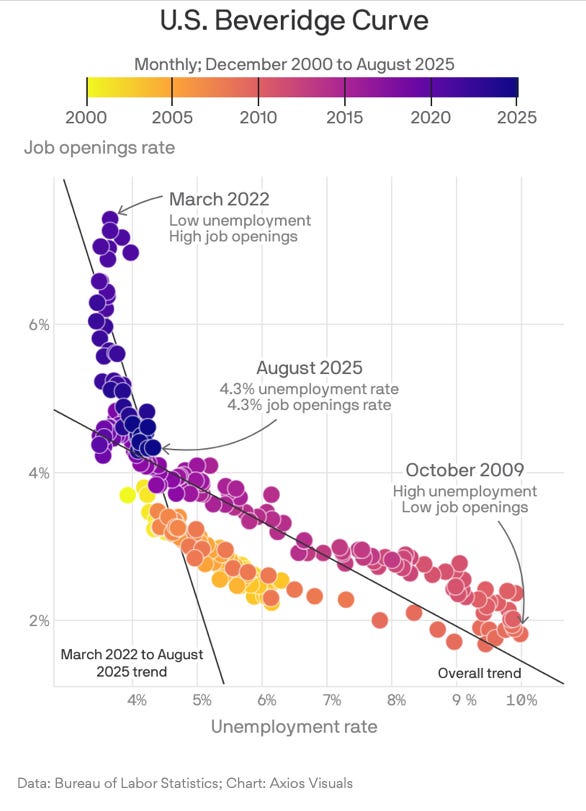
Chart source: Axios, “The worrying kink in this job openings, unemployment curve,” October 2025
What this chart shows is that a tighter labor market with low unemployment corresponds to high vacancies with employers advertising for help, while a slack market with high unemployment has few vacancies and few employers advertising jobs. But at the kink in the curve, where the line changes from largely vertical to mostly horizontal, a small change in the job openings rate implies a much bigger jump in the unemployment rate.
This makes sense because when employers stop advertising for workers, it means that the demand for labor is lagging – and people are more likely to be unemployed than when employers are actively seeking help. The US is now sliding into that kink in that curve—the spot where a small drop in openings corresponds to a jump in joblessness.
Think of unemployment like a rubber band: hiring has been stretched as far as it will go without snapping. If employers pull back even a little bit now, the band can snap suddenly, not gradually. That’s why the Fed is cutting rates even while inflation looks hot: they’re trying to keep the band from breaking and keep employment up.
The political accelerant
Add politics to the mix, and you have a wind billowing through a dry forest.
Congress lurches from shutdown to showdown. The Treasury treats markets like an inexhaustible credit line. And a sitting president is arguing that America can “grow its way out” of $37 trillion in debt while handing out tax cuts and rebate checks.
Each of these by itself might be manageable. Together, they form what engineers call a “coupled system”—where one stress amplifies another until the whole structure rattles.
How dry is our forest?
An economy under stress behaves like a forest in drought. For a long time, everything looks stable — trees still stand, birds still sing — but underneath, dry needles pile up. Tension builds quietly, a little more each day. Nothing seems to be happening until one spark – a failed Treasury auction, an unexpected bankruptcy, a geopolitical jolt – makes the whole system go up in flames, and faster than anyone expects, rather like the Palisades or Camp wildfires that ripped through California, spreading faster than a person could outrun them.
Gold doesn’t lie
Look at gold bursting through the $4,000 an ounce mark. That’s not a sign of exuberance; it’s a barometer of fear. When investors quietly trade paper assets for metal, they’re saying, We don’t trust the paper. Gold doesn’t predict the fire—it’s a measure of how dry the forest is.
What happens next
Maybe the inflation that has so far been banked suddenly flares up, spooking the bond markets. Maybe it’s a bankruptcy of some obscure private equity lender no one is monitoring. Maybe it’s a constitutional clash that freezes incompetent Treasury officials when action is critically needed.
The truth is, it doesn’t matter which spark ignites the flame. What matters is how much fuel we’ve let accumulate, because real resilience doesn’t come from suppressing pain; it comes from dealing with the causes before they becomes fatal.
The question isn’t if the conflagration is coming—it’s how well we’re prepared when the spark is struck. And it could happen … Any Minute Now …
For reference: this essay examines the moral hazards behind market complacency, the coming firestorm in global finance, and the fragility of an economy built on debt, AI exuberance, and political paralysis