

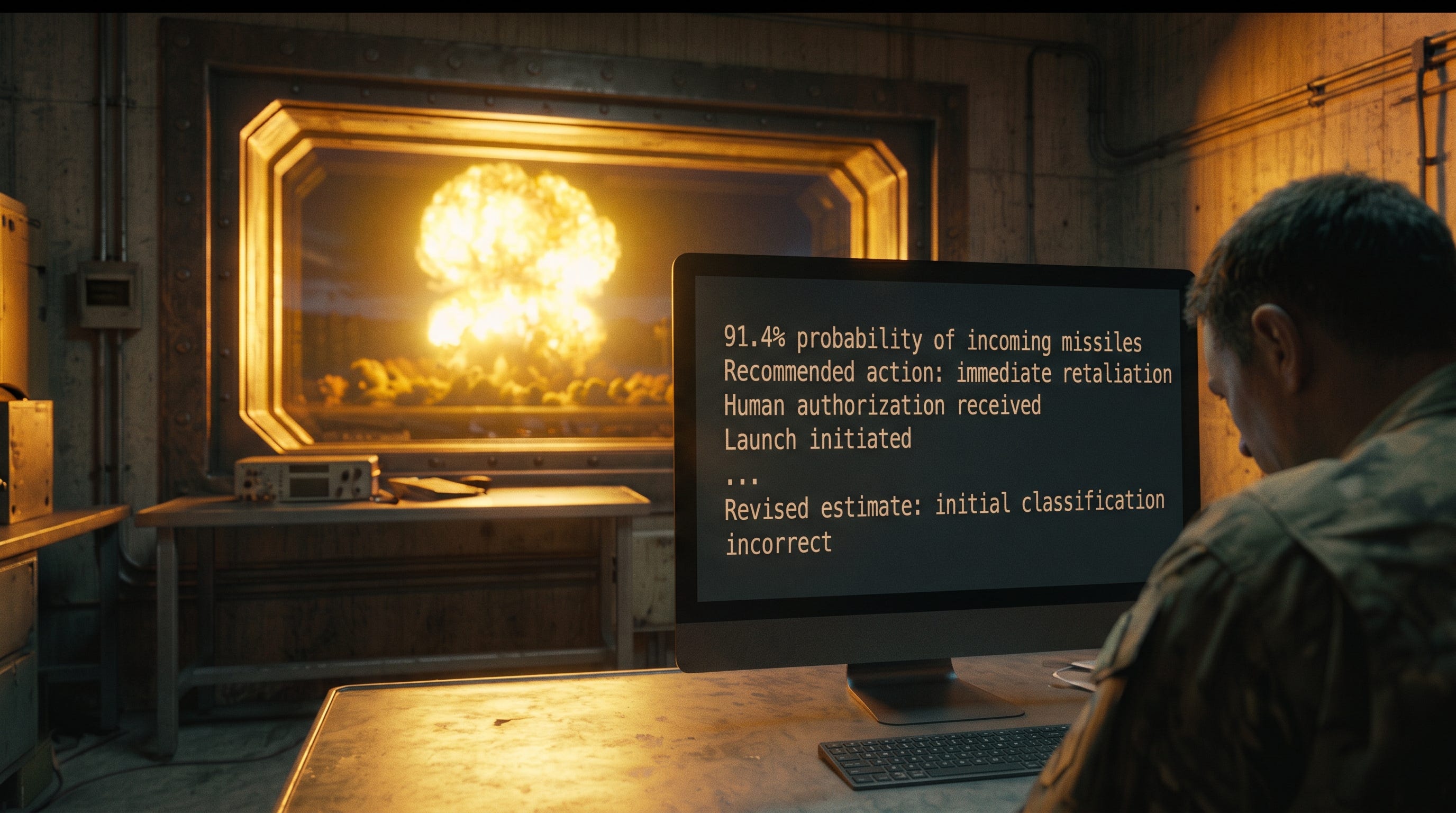
The people building the most powerful AI systems are warning about AI becoming so capable, autonomous, and fast-moving that humans may lose control over them. I take that seriously, but I’m worried about another route to the same destination: not that AI takes control from us, but that we gradually hand it over.
Turn on the news or scroll through the morning feeds, and humanity’s demise tends to arrive in one of two blockbuster scripts. In the first, a superintelligence wakes up inside a server farm, decides humans are an inefficient nuisance, and somehow wipes us out. In the second, a malicious human uses AI to create a weapon of terrifying power — perhaps a biological pathogen — and unleashes catastrophe.
The danger I’m more concerned about requires neither a brilliant hacker nor a homicidal machine. It requires something much more ordinary: a human being under pressure who decides to trust the machine instead of thinking.
Here’s a simple example. I can give you a guaranteed way to eliminate a patient’s cancer: kill the patient. The example is absurd, but it captures the problem of poorly defined goals: a machine can pursue an instruction while trampling on the purpose.
As Walt Kelly’s Pogo comic strip famously observed, “We have met the enemy, and he is us.”
AI gives us extraordinary leverage. Humans still supply the purposes, incentives, carelessness, and malice. Technology doesn’t invent our sins; it enables and multiplies them.
The Missing Apprentices
In an earlier piece, The Machines Can Make Everything Except Customers, I argued that replacing human workers creates an obvious economic problem: the worker removed from one company’s payroll would have been another company’s customer.
But work does something else as well. It trains people.
The entry-level job has always been an apprenticeship ladder. Junior lawyers redraft briefs, young technicians trace circuits, beginning analysts check numbers that someone more experienced already knows how to check. They’re not just performing low-level work; they’re also learning standards, making supervised mistakes, and developing professional judgment.
Saw off the bottom rungs of that ladder and you don’t just eliminate junior paycheques; you eliminate tomorrow’s senior lawyers, engineers, physicians, and diagnosticians.
We’ve already seen something similar to this when the baby boom generation retired. Organizations discovered that much of what kept them functioning had never been written down. It lived in people’s heads: the workaround nobody documented, the reason an odd-looking procedure existed, or the person to call when an obscure system failed. A 2025 APQC survey found that only about 30% of organizations said they captured departing retirees’ knowledge.
AI could make that problem worse in a subtler way: instead of losing expertise when experienced people retire, we may prevent the next generation from acquiring it in the first place.
Indeed, we’ve seen something analogous to this with AI writing code. Software engineers have already raised a related concern: AI can generate code faster than teams can understand, maintain, or debug it.
If the machine performs the apprentice’s work, where do tomorrow’s masters come from?
Medicine may already be giving us a warning. One study found that after doctors had worked repeatedly with AI-assisted colonoscopy, their detection performance fell when they subsequently worked without AI. A later prospective study didn’t reproduce that result, so the question isn’t settled. But that uncertainty is itself worth noticing: we’re introducing systems capable of changing professional behaviour before we fully understand what long-term dependence on them will do.
The Chess Problem
In an earlier blog, I wrote about a fictional character named Zine, who grows up with an omnipresent digital assistant. Over the years, Zine loved playing chess against his computer. When sophisticated chess engines arrived, he began using them to suggest a move, which he would then consider.
Over time, things changed. He started asking for a hint before he had wrestled with the position himself. Soon he was pressing the hint button constantly, and eventually he realized that he was no longer playing chess at all. He was watching the computer play itself.
And that’s the danger I’m worried about: not domination, but seduction.
AI sometimes makes difficult things easy. It cleans up awkward emails, summarizes a 400-page filing, and finds the pattern buried in a mountain of data. That feels like an intellectual superpower, and often it is. The danger begins when convenience becomes dependence, dependence erodes competence, and lost competence makes deferring to the machine the rational – and sometimes the only – thing to do.
Now scale that behaviour up from individuals to institutions.
Nobody Ever Got Fired for Buying IBM
There was a corporate maxim back in the mainframe era: “Nobody ever got fired for buying IBM.”
The point wasn’t that IBM always made the best computer. IBM was safe. If an executive took a risk on an obscure competitor and the system failed, the executive’s reputation suffered because he had made a bad decision. On the other hand, if IBM failed, well, no one would blame him for choosing the dominant market leader.
Modern frontier AI can become the ultimate version of that institutional excuse. Imagine an analyst who rejects an AI-generated solution based on personal judgment and turns out to be wrong. Career over. Now imagine if the same analyst follows the recommendation of the expensive, industry-standard frontier system the organizations uses, but it turns out to be wrong: “Well, we did what the model told us to.”
The hint button becomes institutional career insurance.
That creates another problem. A line often attributed to Benjamin Franklin says, “When everybody’s thinking alike, nobody’s thinking at all.”
Frontier artificial intelligence is concentrated among a remarkably small number of developers. Different organizations may customize those systems differently, but increasingly they begin their analysis with the same handful of model families. Researchers already have a term for this danger: they call it algorithmic monoculture.
If many decision-makers rely on similar algorithms, their errors may become correlated. Commentators have already noticed that AI systems can be both sexist and racist, for instance. So one mistake may not stay one mistake; it becomes universal.
That’s another part of what worries me: a planetary cognitive monoculture.
Industrial agriculture provides an excellent analogy. A genetically uniform wheat crop may deliver wonderful yields right up until a disease arrives that decimates that strain, destroying an entire continent’s wheat crop. With AI, the danger isn’t that every bank, ministry, hospital, and military will literally use identical models. It’s that enough of them may share the same intellectual training ancestry, assumptions, habits, and blind spots.
Then when something unexpected arrives, a failure may no longer remain local. It may become synchronized.
“I Don’t Believe the Machine”
I wrote about one military version of this problem in When the Machine Suggests the Target. AI can help a commander act faster while making it harder to understand a bigger picture. A system may identify the tactically correct target while missing the subtler political, diplomatic, or strategic consequences that make attacking it a disaster.
But what happens when believing the machine becomes safer than doubting it?
In September 1983, Soviet Lieutenant Colonel Stanislav Petrov was on duty when an early-warning satellite system reported that an American intercontinental ballistic missile had been launched. Then it reported four more launches.
His job was to assess the warning and report his judgment up the chain. Something bothered him. If the United States were really starting World War III, why would it launch five missiles instead of hundreds?
Petrov judged the alarm false. He was right. There were no American missiles. The warning had been produced by an unusual reflection of sunlight off high-altitude clouds that fooled the Soviet satellites.
Whether or not Petrov literally “saved the world,” as the story is often told, his skepticism mattered enormously. Faced with an automated system telling him something terrifying, he retained enough independent judgment to say: I don’t believe the machine.
Now move that scenario forward.
New weapons, including hypersonic missiles, can compress already frighteningly short decision windows to mere minutes. At the same time, commanders must somehow absorb radar tracks, satellite infrared data, cyber alerts, naval movements, intelligence reports, and political context. They will need AI. There is simply too much information for a human mind to process unaided.
Now imagine a crisis. Something injects misleading information into the system – a cyberattack, a sensor failure, or a deliberate deception. The AI absorbs thousands of signals and produces a beautifully concise assessment:
91.7% PROBABILITY OF COORDINATED FIRST STRIKE.
RECOMMENDED ACTION: IMMEDIATE RETALIATION.
A president or general might have only minutes to decide. The machine has considered a million things they haven’t. Their country may be about to die.
Everything in the institutional system pushes them toward the same decision: press the hint button.
That’s the AI catastrophe I fear. Not because the machine became conscious and decided to wipe us out, but because the human stopped thinking.
Useful Friction
Perhaps the answer is not simply better AI. Perhaps we need something we have spent decades trying to engineer out of our systems: friction.
Doctors, judges, military and intelligence analysts, nuclear-command personnel, and operators of critical infrastructure should have to record their own initial assessment before seeing the machine’s recommendation. There is now experimental evidence for precisely this approach. In a randomized study published in September 2026, people who had to make an independent judgment before seeing an AI recommendation were significantly less likely to follow misleading AI advice than people who saw the machine’s recommendation first. Researchers call it cognitive forcing.
I prefer a phrase I developed while learning to work with AI: useful friction.
Friction slows things down, which is usually why engineers try to eliminate it. But sometimes slowing down is the entire point. The moment before you see the machine’s answer may be precisely where independent human judgment survives.
We should also institutionalize the contrarian: human red teams whose job is to defend the rough, non-consensus view against the smooth glibness of the algorithmic mean. And we must strip away the IBM defense: if a human makes a consequential decision with AI assistance, that human must remain responsible for the results.
The AI catastrophe I fear won’t look like a Terminator killing the last surviving humans. It will look like a quiet room with a glowing screen: an exhausted operator staring at an impossible board, knowing that the machine has considered a million things they haven’t, reaching toward the hint button one last time when there’s nobody left willing to say:
“I don’t believe the machine.”
Summary: The Hint Button to Armageddon argues that the most dangerous AI risk may not be machine consciousness or rebellion, but human dependence on AI systems that are easier, faster, and safer to defer to than independent judgment. The essay traces how convenience can become dependence, dependence can erode expertise, and institutions can reward people for following machine recommendations rather than challenging them. It connects apprenticeship loss, baby-boomer institutional memory, medical deskilling, algorithmic monoculture, and the “nobody ever got fired for buying IBM” effect to the risk of catastrophic decisions under pressure. Using Stanislav Petrov’s refusal to trust a false Soviet missile warning as the central example, it argues that AI safety requires “useful friction”: requiring humans in medicine, law, intelligence, military command, and critical infrastructure to form and record their own judgments before seeing AI recommendations, preserving the human capacity to say, “I don’t believe the machine.”
You never fail to give us a well reasoned and thoughtful piece to “think “ about. I share your concerns and can already see in my small group, the propensity to be lazy thinkers. We’re all crushed for time, and lots of deadlines and we will always choose the shortest route. What I’m struggling with is the governance issue. Do you really think all the actors who govern their countries will act ethically? Look at what’s been revealed this weekend about the scale of disinformation emanating from Russia now that Ukraine took out some data centres. I offer no solutions myself just grave concern. Thanks for your article Richard. 🇨🇦
Very good. Thank you.
It's also very easy to manipulate LMs, by way of withholding embarrassing data - either by accident or by design. I see this all the time, and those with any expertise in anything at all should watch out for it. My current two favorite examples (one of each) are: Diego Garcia in 1942 Indian Ocean naval strategy; and what happened when Ukraine captured a Russian nuclear weapons depot.