

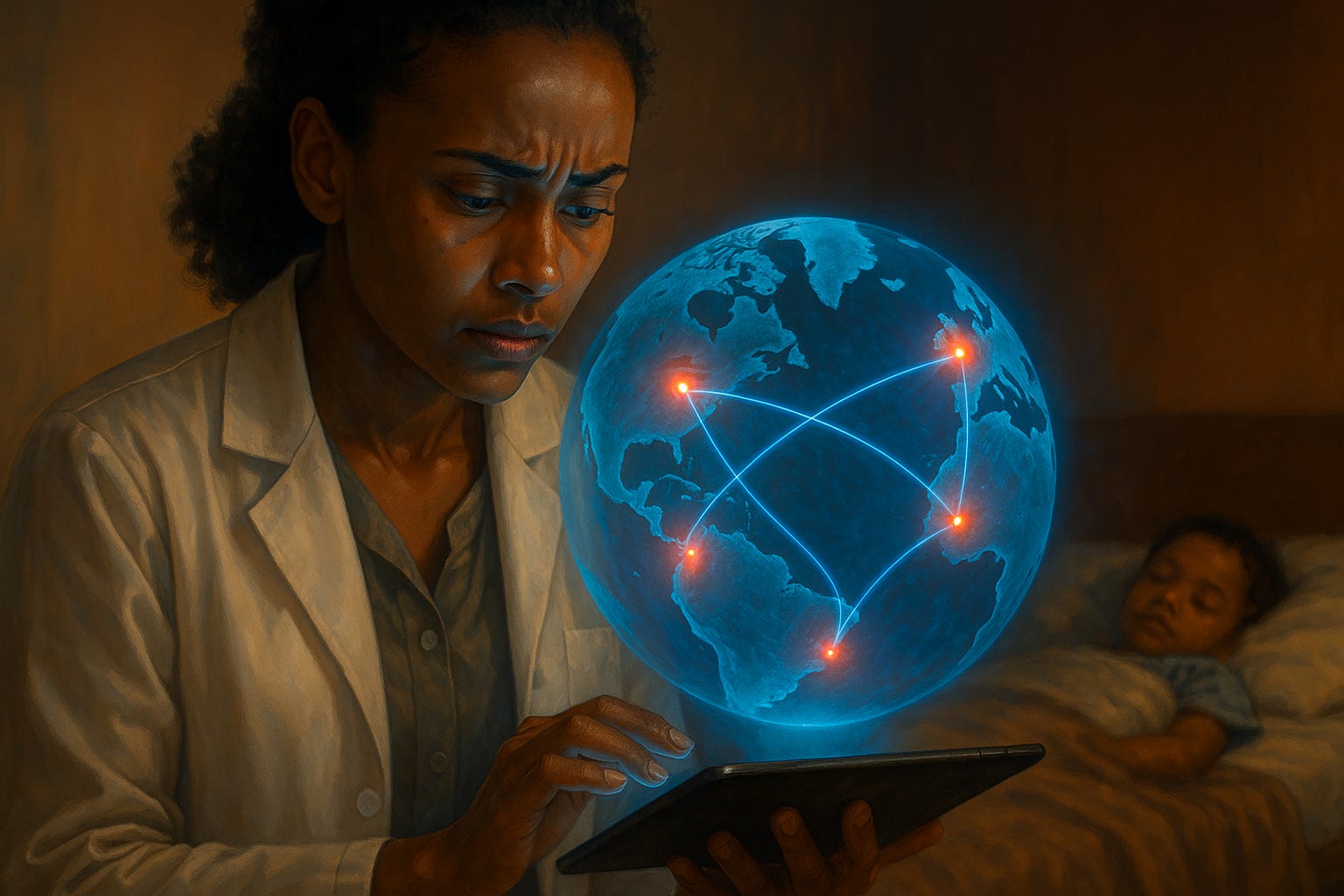
Dr. Amina Njoroge had finished her morning rounds when the first boy arrived – feverish, trembling, and short of breath. It looked like flu, but something about the shallow, stuttering rhythm of his breathing felt … wrong. Two hours later, another child came in with identical symptoms. Then a third.
By then, Amina had her clinic’s AI assistant, Nia, cross-referencing symptoms against regional health data. What it found wasn’t in any local records. Aminda instructed Nia to cross-check the symptoms against the Global Health Commons (“GHC”) database.
Nia’s query reached the GHC’s standardization AI, which immediately translated her “stuttering breath” note, parsing it against millions of disparate clinical inputs in dozens of languages.
“Pattern anomaly detected,” Nia informed Amina. “Sixteen similar cases logged in the last 24 hours.”
Amina frowned. “All in Kenya?”
“Negative. Reports also flagged in Mumbai, Toronto, São Paulo, and one other clinic in Kenya. No identified pathogen yet.”
And although Nia’s voice was calm, Amina felt a chill run down her spine. Sixteen cases on four continents? She flagged the conclusion to be brought to the attention of the Global Health Common’s Medical Council.
Within hours, GHC – the global AI network linking hospitals and clinics around the world – had sequenced a sample she had submitted from one of her patients and compared it against all known viruses. The result came back before dawn Nairobi time.
“Probable SARS variant,” Nia told Amina. “Closest analog: COVID-19; eighty-four percent genetic overlap.”
That conclusion by GHC’s Medical Council changed everything. Immediately, the Commons’ AI launched full-spectrum drug research, scanning millions of compounds for anything that might block the virus’ copying mechanism, which allowed it to spread.
Three candidates surfaced. One, a decades-old generic antiviral, showed unexpected promise.
The GHC’s Medical Council didn’t just run a simulation. Because it was networked globally, it found real-world evidence which suggested markedly milder symptoms for patients across the network who were already on this drug for similar conditions. This wasn’t a clinical trial – it didn’t need to be. The global network had already observed thousands of real-world cases across multiple geographies.
Instead, the potential urgency of the situation led to a Global Clinical Guidance Bulletin to be issued within 48 hours – speed that would have been unthinkable even a few years before.
The bulletin flashed onto Dr. Njoroge’s screen: “GHC URGENT ADVISORY: Drug A, a globally-approved antiviral, shows high efficacy in simulations and anecdotal cases against known SARS variants. Off-label use is recommended for severe cases at your clinical discretion.”
Amina prescribed it to her three patients. So did the doctors in Mumbai, Toronto, and São Paulo. By the end of the week, new infections among treated patients were tapering off – the virus spread was burning out. The outbreak had been recognized, traced, and contained before the world even knew it existed. For once, science had outpaced a virus while the general populace remained peacefully unaware.
There were no headlines about this event, but if there had been, it might have read: “Pandemic Outbreak Contained Through Early Detection by Global Health Commons.”
Two weeks later, Dr. Njoroge had just settled behind her desk when a message from Nia appeared on her screen:
Dr. Njoroge, the prompt action by you and your Global Health Commons colleagues is estimated to have saved approximately 2.6 million lives, worldwide. The GHC Medical Council has appended a commendation to your Continuing Education record to reflect this. Thank you for your contribution to world health.
For a moment, Amina just stared at the number: 2.6 million! It felt impossible – and yet she realized that it was entirely possible. She smiled, then shrugged, and got up to see how her patient was doing.
Is This Just a Fantasy?
What would make this system possible isn’t luck or heroics. It’s connections.
And it isn’t science fiction. Every part of this story is already within reach.
A small Canadian AI company, BlueDot, famously spotted the COVID-19 outbreak nine days before the World Health Organization. During SARS, clinicians in Toronto and Hong Kong saw unusual pneumonia clusters days before global authorities reacted – but the dots were never connected.
GHC would connect them. Imagine if that kind of research capability was part of an always-on, global health network...
We have the AI models. We have the lab networks. The real hurdles aren’t technological; they are questions of trust, law, and money.
Skeptics will rightly ask: “Who gets sued?”, “Who stops China or Russia from lying?”, and “Who pays for all this?”
But these aren’t deal-breakers. They are solvable design considerations:
It’s not a “Big Brother” database. The system is built so your data never leaves you – only the insights travel. And it isn’t a mental-health chatbot; GHC never replaces a clinician’s judgment — it simply gives every doctor access to the world’s clinical early-warning system.
It’s not built on blind trust. It’s a club with one rule: lie or cheat, and you’re out. Any nation that falsifies data loses access to the early-warning system. Period.
It’s not a legal train wreck waiting to happen. The “price of admission” is a simple rule: protect good doctors who act on the GHC’s data.
There are answers to such problems. What we lack is the political and collective will to build this framework.
We’ve drafted a white paper outlining how to build the Global Health Commons. Ask for it in the comments – or help us find the people who can make it real.
This isn’t a problem for specialists. It’s a problem for all of us.
Since 1968, we’ve seen the Hong Kong flu, HIV, SARS, H1N1, Ebola, Zika, mpox, and COVID-19. The next pandemic isn’t a question of if but when, and the next time, 2.6 million lives might not be saved, but lost. That failure would be a failure to act, not a failure of medicine or science.
Please share this.
For reference: This vignette explores how an interconnected global AI health network could detect and contain the next pandemic before it begins — and asks what it would take for nations, doctors, and citizens to trust it.