

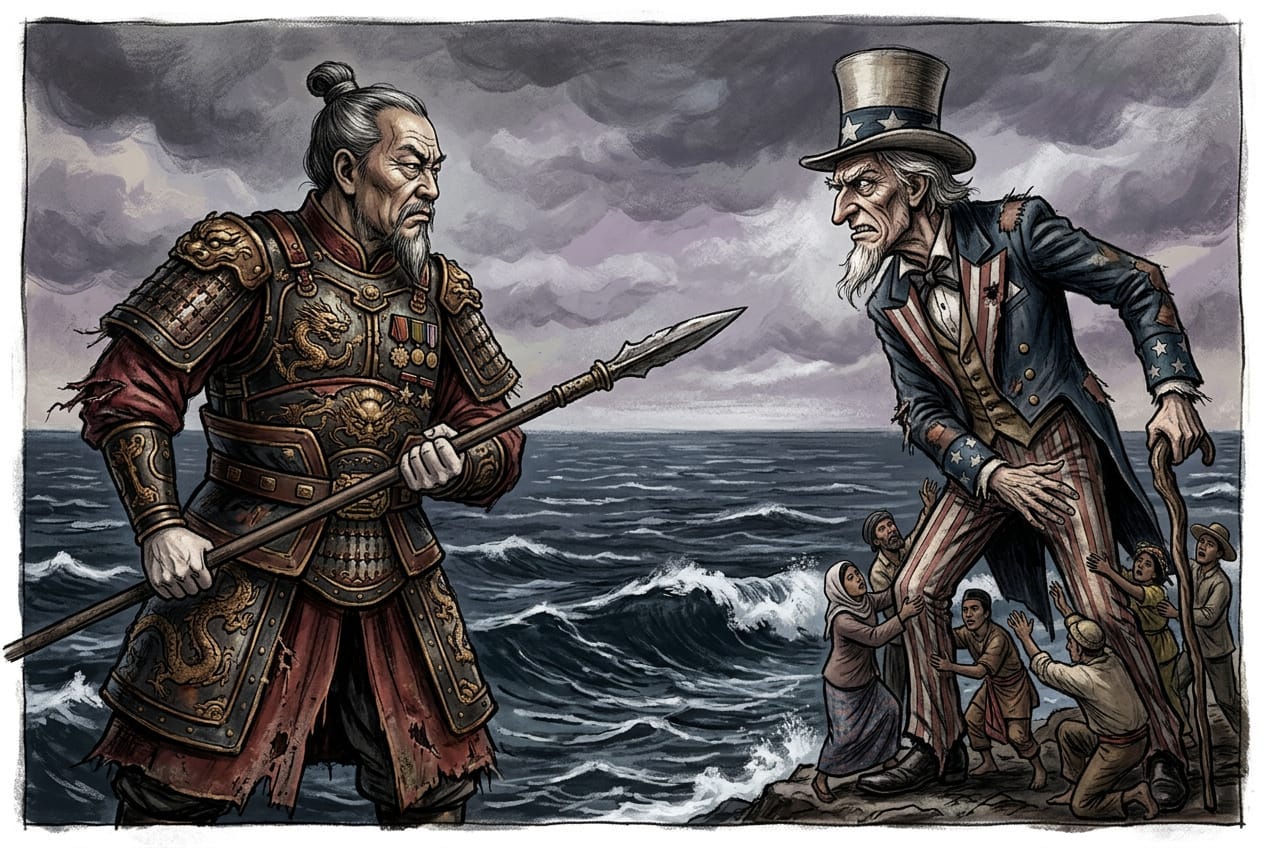
Japan showed us aging as care. The wider world showed us aging as a possible bargain between the old and the young. China and America may show us what happens when aging takes root inside superpowers.
It’s tempting to think aging makes countries harmless: quieter, poorer, more cautious, less willing to spend blood and treasure on ambition. Sometimes it does. But superpowers don’t age like villages. They don’t simply grow old, sit quietly, and withdraw from the world. They remain armed and proud. They remember when the future seemed to belong to them, and that memory can be dangerous.
Aging changes the temperament of power. It can make countries anxious, defensive, resentful, and impatient.
The danger is not that aging makes superpowers weak. The danger is that it makes them afraid of becoming weak.
That fear is now working its way through the two most important countries in the world: the United States and China. They aren’t aging in the same way. America has a demographic escape route but seems too enraged to use it. China may be feeling its window of greatness beginning to close.
Let’s start with America, because Americans still tend to think of aging as something that happens somewhere else. Japan gets old. Italy gets old. China gets old. America renews itself. It draws in immigrants, births new companies, absorbs outsiders, and turns yesterday’s stranger into tomorrow’s citizen.
That has always been one of America’s greatest strengths. It’s also becoming one of its deepest political wounds.
The Congressional Budget Office projects that deaths in the United States will exceed births starting in 2030, and that net immigration will account for all U.S. population growth from then on.
Without immigration, America will begin to shrink. CBO also projects that the U.S. population may grow only slowly over the next 30 years, while its average age rises.
That’s a major turning point. America’s demographic advantage was never a law of nature. It was a policy choice, reinforced by geography, opportunity, the mythic power of American openness, and need. People came because America was rich, open enough, large enough, and confident enough to absorb them.
But confidence is exactly what aging societies begin to lose.
Immigration can make old societies younger, but it does so by bringing in neighbors who look and live differently – and that is precisely what demagogues exploit for petty personal gain.
That sentence sits near the heart of America’s problem. Immigration is treated as a border issue, a crime issue, a housing issue, a wage issue, a drug issue, or a culture issue, and some of those anxieties are real.
But immigration has become the bucket into which every fear is being dumped: the rent, the border, the overdose, the stranger next door – even rape, murder, and drugs.
I’m surprised that they haven’t blamed immigration for bad weather or rock ‘n roll as well.
That’s politically useful to a certain kind of politician because it gives anxiety a face, and someone to blame. It is also demographically dangerous, because the same people being blamed are often the people keeping America younger. The Brookings Institute found that immigration accounted for more than four-fifths of U.S. population growth in 2023–24, and that only high immigration would keep U.S. population growing through the rest of the century.
So America is caught in a contradiction. It needs immigrants to remain an exceptional rich country: younger, larger, more dynamic, less trapped by the arithmetic already weighing down on Japan, South Korea, Italy, Germany, and China. But America’s politics increasingly treats immigrants as the cause of national decline.
America is trying to blame someone else for aging.
That blame won’t fall evenly, because America does not age evenly. The Census Bureau reported that older adults already outnumber children in 11 states and nearly half of U.S. counties. From 2020 to 2024, the number of Americans 65 and older grew by 13%, while the number of children declined. (Census.gov)
Geography matters here, too. Some places are still being renewed by migration: universities, technology, and the churn of metropolitan life. Other places are getting older, emptier, more nostalgic – and more vulnerable to the feeling that the country they remember is being taken away.
This is not just a red-state/blue-state story, but it maps onto that divide in important ways. Big metropolitan areas, which are typically blue, experience immigration as renewal. Older rural and exurban places, which are typically red, may experience it as loss — as if the future is being stolen by strangers: changed neighborhoods, unfamiliar faces, pressure on housing, and proof that their old cultural majority is no longer guaranteed.
So the same fact can look like renewal in one place and invasion in another.
That’s where aging becomes political. The argument is not just about how many people enter the country. It’s about whether America still believes newcomers can become “us” – and, increasingly, it doesn’t.
A young country can afford confidence. A country that feels old starts ferociously guarding its past.
The danger is that a superpower doesn’t need to collapse to be dangerous. It only has to become erratic, resentful, and unwilling to tell itself the truth, and to my eyes, that increasingly looks like America.
America’s aging problem has an obvious partial answer: let in the people who keep the country young. But that answer arrives in human form, and American politics is being organized around resisting the young outsiders who might help renew it.
Japan managed aging. America will litigate it, monetize it, automate it, and blame someone else for it. So that’s one superpower.
The danger from China is different.
China isn’t fighting over whether immigrants can keep it young. Culturally, China has no comparable immigration escape route. Its problem is more brutal: China is aging before it becomes rich, and before it has achieved the national future its leaders promised.
Because China’s population has already begun shrinking. Official Chinese statistics reported that the population fell by 3.39 million in 2025. By the end of that year, 23% of China’s population was 60 or older, and nearly 16% was 65 or older. (National Bureau of Statistics of China)
Those numbers aren’t just social-policy problems. They strike at the story China tells itself about its glorious future.
For decades, the Chinese Communist Party’s bargain with its people was built around forward motion. Accept control, and life will improve. Accept discipline, and China will rise. Accept the Party, and humiliation will be replaced by restored greatness.
That bargain worked brilliantly for a long time. Hundreds of millions were lifted from poverty. Cities rose, factories filled, and China became the factory floor of the world – then tried to become much more.
But aging changes you experience time. A rising power can afford patience. A power at its peak may start to feel the clock running out.
China still has enormous strengths: industrial depth, engineering capacity, infrastructure, military modernization, and a leadership class obsessed with national power. The danger is not simple weakness. The problem is a powerful country that begins to suspect its window to greatness is about to slam shut.
And if Beijing believes time is no longer on its side, it may become more aggressive.
Not because war is certain, nor because China is irrational, but because waiting begins to look like losing. A younger, faster-growing China could tell itself that time would improve its position. An aging China may grow anxious.
That’s where Taiwan matters, though it is not the only issue. If Chinese leaders believe demographic decline, slower growth, technological containment, and Western resistance will make the future harder, then patience becomes harder to sustain. The question changes from “Why act now?” to “What happens if we wait?”
That’s the danger of urgency. Demographic decline may not make China peaceful. It may make it impatient.
There are domestic reasons for that impatience as well. China’s property sector has damaged household confidence. Young people face a future that looks poorer and less expansive than the one their parents experienced. The bargain of tomorrow’s growth is harder to maintain when apartments stop rising in value, jobs feel less secure, and the population begins to age faster than the safety net can protect them.
An aging China will need to spend more energy caring for its old, supporting weaker localities, managing debt, and preserving employment. But authoritarian systems typically respond to internal strain by tightening control and leaning harder on nationalism. When a government cannot promise easy growth and better lives, it may promise global greatness as a distraction – as the current US administration has been trying to do.
That doesn’t make China unique or even unusual. Aging can make any great power defensive. But China’s version has a special edge because the national story is so tied to restoring the greatness of the Middle Kingdom.
The phrase “national rejuvenation” itself becomes sharper in an aging society. Rejuvenation means becoming young again. China is not becoming young again. It’s becoming older while still insisting that history is moving toward its restoration – and that contradiction matters.
So America’s danger is scapegoating while China’s danger is urgency.
Both dangers come from the same deeper fact: superpowers are not good at accepting limits. They are built around stories they tell themselves about their greater destiny. America tells itself it is exceptional. China tells itself it is rising back to its rightful place. Aging pierces both stories, creating wounds in the national psyche.
That wound could produce wisdom. It could force reform, humility, prudence, and adaptation. But it can also produce violent denial.
That’s why aging superpowers are dangerous. Not because they’re finished, but because they fear the future is slipping away from them.
America could still choose to remain younger, if it can stop turning renewal into resentment. China could still manage aging, if it can accept that patience may be safer than urgency. But both countries have to admit what time is doing to them, and that may be the hardest thing.
Superpowers are accustomed to bending history.
Aging is history turning against them.
Summary: Aging does not make superpowers harmless. In America, aging collides with immigration politics, turning the very people who could keep the country younger into scapegoats for housing, drugs, cultural change, and national decline. In China, aging creates a different danger: urgency. As its population shrinks and its promised future narrows, Beijing may become more aggressive if it believes time is no longer on its side. Japan showed aging as care; the wider world showed aging as a bargain. America and China may show aging as power under pressure.
America could leverage its youth sector's positive influence on this predicament by FINALLY focusing on what children and young adults need to maximize their potential in all ways: academics, health, nutrition, housing, EDUCATION!, specialist training, values, travel, the arts, music, international relations, and everyday social, business and practical skills. We have never, ever, asked, "What do all of our people need in order to be FULLY productive and participate FULLY in our democracy?" -- and then made darned sure that our governments provided it. We have hardly ever insisted that our governments be rigorously functional, or that we efficiently weed out the scheisters, thugs, parasites and idiots. We could utterly transform our nation in under a decade if only...
But given the bigots, those who think a country should run well on very low taxes for the obscenely wealthy, and shockingly underfunded, shallow, inconsistent, and incomplete educational development of the People's potential, I think we are in for a very rough ride. Stupidity and perverted vision are costly and unforgiving, always.
Thought-provoking, as always. And as always, fear is the root cause of everything.