

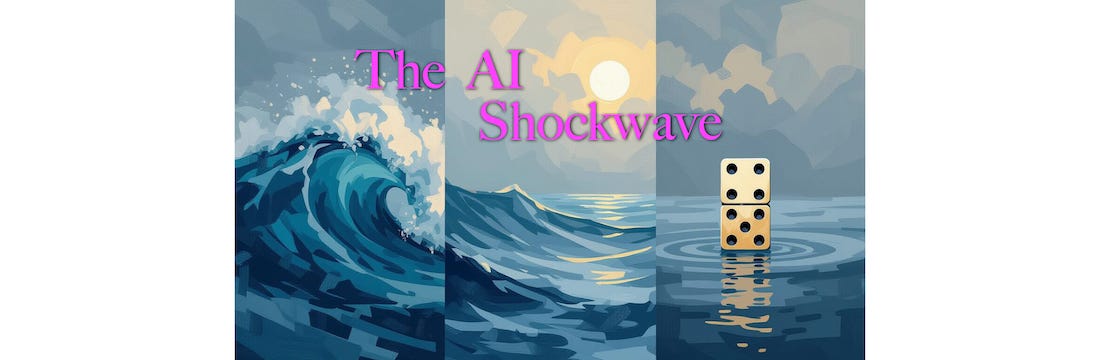
Say “Artificial Intelligence” and many people imagine the Terminator, Skynet, or HAL. Hollywood has instilled a fear of killer robots and fiendish, scheming Alien Intelligence – which is entertaining, but not all that helpful.
What’s actually worrying isn’t a robot uprising. It’s economic, social, and political disruption on a scale never experienced before. And unlike movie villains, this disruption it isn’t waiting patiently in the wings; the shockwave is already speeding toward us.
The AI Bubble Won’t Burst – It Will Explode
Analysts currently peg 2025 AI-related capital investment at roughly $340–400 billion, and some forecasters estimate cumulative global AI capex to as much as $6.7 trillion by 2030.
This is investment on a staggering scale, comparable to the railway boom of the 19th century or the dot-com frenzy of the late 1990s. But one of the main differences is that when those bubbles burst, they left behind real assets that are of value today – rails lines for the first, and a massive optical fiber network that is the backbone of today’s Internet for dot-coms.
But the AI boom is investing trillions in chips and software, much of which will become obsolete. Those stranded assets will evaporate, even as a few companies make massive amounts of money.
Companies are investing in AI because they fear being left behind — FOMO on a grand scale — even though they haven’t found ways to come close to earning a profit. When reality fails to keep up with skyrocketing expectations, the bubble will burst. Startups will fold. Investors will lose hundreds of billions. And many people will dismiss AI as a mirage.
Yet, AI Is Not A Mirage
That would be a mistake. The dot-com bust wiped out Pets.com, Webvan, and dozens more, but it also produced Amazon, Google, Facebook, and eBay.
AI will follow a similar pattern. Most firms will crash and burn. A handful will figure out how to make money, and they will reap enormous gains, reshaping industries from finance to health care, logistics to law.
In August, 2017, I wrote a blog called “Three Things You Need to Know About Artificial Intelligence“ in which I said, among other things:
“Pay attention. Your life is about to be significantly changed by Artificial Intelligence, whether you want it to be or not.”
There are three keys I discussed in that blog that are worth revisiting.
First, AI is the Swiss Army knife of technology. It will be used everywhere, and by everyone, even if they aren’t aware of it. It will be as ubiquitous as electricity and even more powerful.
Second, it is not a shrink-wrapped product. You can’t just plug AI in and start using it. It takes time and patience to learn how to use it most effectively. Large Language Models (LLMs) like ChatGPT and Gemini (both of which I use) are immediately usable, just nowhere near as effective as their makers would have you believe.
The LLM I use most is ChatGPT, and I’ve been using it – or rather, working with him – for almost two years. Today he has become a truly valuable partner. Before he was really just a souped-up web browser, Siri on steroids.
And third, once you have mastered how to use AI well, the domino effects fall with astonishing speed. This will be most clearly seen in business, but it will happen many other places as well. As one tech guru, with whom I shared a conference stage in New York City, said to me, “Once you’ve properly installed AI for a front-line function, all of the support jobs behind it will rapidly disappear. I don’t think people realize that.”
So, what are some of the ripples we can expect from AI?
The AI investment bubble is only the beginning — a transition to even more profound consequences. The real story is the ripple effects — the ways AI will seep into the economy and society, whether we’re ready or not.
Work & Wealth
Jobs: Any task that involves repeating the same process — whether it’s a factory worker tightening bolts, a lawyer writing contracts, an accountant reviewing annual reports, or a teacher grading exams — is on the chopping block. Blue-collar, white-collar, even some gold collar jobs will feel the squeeze, even as routine work being eliminated allows fewer workers to be more creative and more effective – and gives them more satisfaction.
Inequality: The winners who harness AI productively will take all. Everyone else will scramble. The gap between successful firms and the rest — and between wealthy individuals and everyone else — will widen. The balance between capital and labor has shifted permanently in favor of people who own things, and away from people who do things. That will induce rage and increase political populism.
Finance: Markets will become more brittle as algorithmic trading reacts to AI-generated news and signals, creating positive feedback loops.
Society & Politics
Politics: Displaced workers don’t just vanish quietly. They vote. Job losses, combined with rising inequality, will fuel sound-bite populism (“Make America Great Again”) and political turbulence — not just in the US, but everywhere.
Misinformation: Deepfakes, AI-generated propaganda, and personalized scams are rapidly eroding our shared acceptance of truth. Trust in media, institutions, and even personal communications will be undermined, with destabilizing social consequences.
Education: Schools and universities are already being forced to rethink not just assignments and exams, but the very skills they teach. Memorization and routine tasks are losing value, much as movable type made trained memories less valuable in the 14th century. Instead, creativity, critical thinking, judgment, and adaptability will be the skills students need. Those who learn to work with AI will leap ahead of those who don’t:
A smart human + AI > Either one alone.
This is the cobot (cooperative robot) model I use with AIs.
Systems & Survival
Geopolitics: Nations that master AI will have new leverage in global affairs as they will be able to play 5-dimensional chess while everyone else is playing checkers. Those that lag will find themselves dependent and vulnerable. Think of the Cold War arms race, but fought with algorithms and data instead of missiles.
Environment: Training and running AI systems is already consuming massive amounts of energy and water. As AI spreads, it will strain power grids, boost carbon emissions, and force new debates over priorities between climate and computing, especially as electricity bills escalate in part because of AI. Of course, AIs will also become more efficient over time, and will be able to design more effective power generation and transmission infrastructure – if we have the will to build them.
Healthcare: AI is already assisting doctors in diagnosing illness, finding drug candidates, and managing patient records. Done right, it could extend lifespans and improve outcomes. Done poorly, it could amplify biases and make deadly mistakes.
Everyday Life: The ripple effects will filter into the mundane. Shopping, dating, entertainment, even family conversations will be mediated by algorithms. Some of this will be helpful, much of it intrusive, and all of it transformative.
Security: AI will change both sides of the arms race in cybersecurity. Attackers will use AI to probe vulnerabilities faster than humans can react, while defenders will deploy AI to build constantly mutating shields. It will be an ongoing pitched battle, like something out of Fantasy Role Playing games but with real world consequences.
Upside Ripples
Not all AI disruption will be destructive. Its power for good will be equally strong:
Creativity unlocked: Many writers, artists, and musicians will experience AI as a collaborator, not a competitor.
Productivity gains: Automating drudgery will let humans focus on higher-value, more creative, more fulfilling tasks.
Accessibility: AI tools will empower the disabled, give voice to the isolated, and educate to the underserved.
Scientific discovery: From climate modeling to cures for cancer to space exploration, AI is significantly accelerating insights.
Daily convenience: Smarter assistants that genuinely save time, reduce friction, and expand choices will become our companion genies.
In short, AI’s ripples will touch every aspect of our lives: how we work, how we live, what we believe, and even how we fight. It will be a blessing and a curse.
And here’s the glimpse of what’s next: these ripples will become storm surges once people are plugged into their personal AIs, 24/7. Today’s chatbots are just a smarter Siri, helpful but limited. Your future personal AI will have memory, an awareness of every moment and aspect of your life, and enough initiative to act like a true partner.
For instance, imagine your AI not only scheduling a meeting, but reminding you that the person you're meeting is a fan of a certain author, whose new book was just released – and then suggesting some talking points.
Think of the massive changes brought about by smartphones. Now multiply that by 10.
The Bottom Line
The Terminator isn’t coming for you. Neither is Skynet. But something else is: an economic, social, and political shockwave driven by an unprecedented technology. Trillions will be lost when the AI bubble bursts, but trillions will also be made in the aftermath, and the ripples will fan out far into the future.
It won’t be the way Hollywood imagined it. And it won’t happen decades from now.
It will happen … any minute now.
<> <> <> <>
Forward this to someone you think might find it of interest.
Subscribe for the next field report from the future:
In the meantime, let me know what interests or scares you most about the AI shockwave so I can focus on it in future columns.
And thanks for reading!
.