

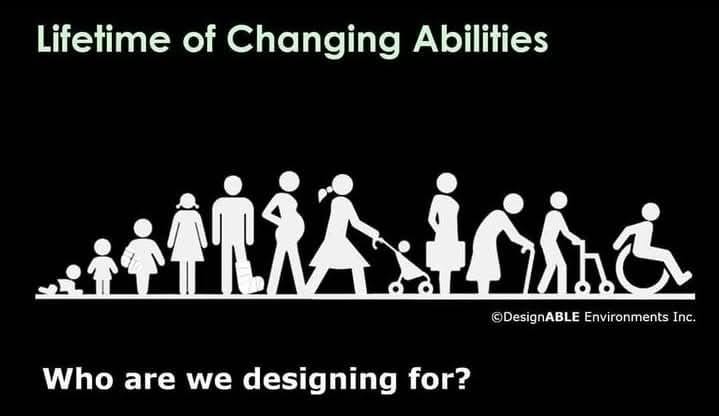
Image used courtesy of Thea Kurdi of Accessibility Edge
This is the third in a series about AI companions. Each one will deal with different aspects of the benefits, risks, and costs of working with AIs, including hidden biases, commercialization, increasing dependency, the consequences of being subtly influenced by suppliers, and more. In this post, I’m going to talk about how AIs might help people with disabilities, and how they might harm them.
The first surprise about disability is how easily it can happen.
A skiing accident. A concussion. A slipped disc. A stroke. A spell of vertigo. A medication reaction. Sometimes just getting older.
The second surprise is discovering how poorly the world accommodates a disability once it appears – and how little attention the non-disabled world has paid to those barriers. Doors open the wrong way. Software assumes perfect eyesight. Hiring systems expect a certain kind of eye contact. Service counters have nowhere to rest a cane. Everyday systems quietly assume that bodies, senses, and minds will work the way designers expect them to, usually based on perceptions of what a “normal” person needs.
As artificial intelligence begins to reshape everyday systems, we may discover a third surprise: technology that promises accessibility but that sometimes creates new barriers of its own.
Many of the new accessibility tools now emerging – speech recognition, adaptive interfaces, cognitive assistants, robotic support devices – are powered by AI. In principle they could remove barriers that have existed for decades.
But technology rarely arrives without side effects, and is only as thoughtful as the people who design it.
The vignettes that follow are thought experiments. They contemplate situations where AI systems intended to help people with disabilities intersect with ordinary human systems: workplaces, hospitals, insurance companies, government portals, and families. Some of these scenarios highlight new possibilities. Others explore unintended consequences. None of them are intended to be the final word on either AI or people with disabilities.
A disability advocate I consulted, Thea Kurdi of Accessibility Edge, reminded me of a principle widely used in the community:
“Nothing about us without us.”
These vignettes are therefore not conclusions, but attempts at exploration. They are sketches intended to consider some of the possibilities that deserve deeper discussion with people who live these realities every day.
They will not provide answers, but if they’re useful, they might cause some readers to pause and think about what’s to come for people with disabilities – which may well include them at some future date.
And finally, these vignettes explore some of those possibilities. They are not intended to be an exhaustive exploration of an exceptionally complex and textured field.
The Coffee Shop Step
Marina had been in the wheelchair for twelve days as the result of a skiing accident. The doctor said six weeks, maybe eight. It’s only temporary, everyone reassured her.
But she soon found out that temporary felt like forever, especially as she had to go back to work.
So this morning she decided to reclaim her life and do something ordinary. Nothing ambitious, just coffee at her usual café, the place where she liked to sit by the window and chat with the regulars before catching the bus to work. After nearly two weeks of carefully navigating her apartment and short trips outside, the thought of returning to something normal felt like a small victory.
But when she rolled up to the entrance, her plan collapsed.
Two shallow stone steps led to the door. They had never seemed like much before, just part of the building’s worn old façade, but now she stopped and stared at them. The eight inches of stone steps might as well have been eight feet. There was no ramp, no rail, and no obvious way to lift the chair while pulling open the heavy door.
“Seriously?” she muttered. “How the hell am I supposed to get in there?”
Her phone vibrated in her lap: Accessible entrance detected. Rear access via laneway. 21 meters to your left.
The city’s new mobility overlay app mapped curb cuts, slope gradients, and doorway widths across the downtown core. The companies building it liked to describe the system as “a model of smart inclusion,” a seamless digital layer that guided people around obstacles the physical city had never quite bothered to remove.
Marina looked toward her left. “The alley?” she said aloud. “You want me to go through an alley?”
The phone remained cheerfully silent.
She turned the chair and wheeled around the corner. The laneway smelled faintly of yeast and garbage. Metal dumpsters lined the wall, and a delivery truck blocked half the pavement, forcing her to maneuver cautiously around it. The space felt narrow and oddly exposed, and she found herself suddenly wondering whether this was the route anyone else used, or whether it was only used by people like her.
The rear door slid open automatically as she approached. Inside, the barista looked up and waved. “Hey, Marina! Good to see you! I was so sorry when I heard about your leg. I’ll bet you’re glad that we have accessibility now. Did it work okay?”
“It worked,” Marina said, trying not to sound too grumpy about it.
He nodded toward the front window, missing her mood. “The City says they’re prioritizing digital accessibility now. It’s more efficient.” He turned to smile at her, “I’ll bet you’re glad it’s there, right?”
She ignored his sally and ordered her coffee, then wheeled over to her usual table by the glass. From there she could see the front entrance clearly. Customers stepped easily up the two small stone steps without even noticing them. The threshold that had stopped her cold was invisible to everyone else.
Nothing about the doorway had changed, only the route she was expected to take. Her leg made her feel like the garbage she had rolled past on the way in.
When she finished her coffee, Marina turned her chair and headed toward the back door again – then the thought struck her: How was she going to get on the bus to work?
The Gold Certified Building
Nadia had checked the website twice before coming. The new co-working hub advertised itself as fully accessible: gold-standard certification, inclusive design, state-of-the-art facilities. Her screen reader had read the description aloud the night before, and the language had sounded reassuring, precise even. Buildings that claimed accessibility sometimes meant well but failed in small, but exhausting, ways. Still, the promises were clear enough that she decided to give it a try.
The entrance plaza was spacious and open, the kind of welcoming plazas that architects loved to photograph and feature in magazines. Nadia moved carefully across it, following the tactile walking surface indicators (TWSI) in the pavement. At one point, the path branched in two directions, with no indication which was the way to the entrance, and which went somewhere else, likely the designated place for service dogs to relieve themselves. Nadia stopped to listen for cues: footsteps, doors opening, fragments of conversation drifting through the air. Large empty spaces distorted sound, making it harder to judge distance or direction, and while there were tactile walking surface indicators She listened carefully before finally choosing the one from which door opening sounds seemed to be coming.
The entry plaza seemed oddly disorienting for a building that was supposed to be certified as fully accessible.
She had a sighted colleague with her, but had asked him not to help. She wanted to see if this was a facility she could navigate on her own in the future. When they got to the door, her colleague, walking beside her, said, “There’s a plaque by the door. Gold accessibility certification.”
Nadia grimaced slightly. She had encountered plaques like that before.
Inside, the lobby felt cavernous. High ceilings and polished floors amplified every sound until voices seemed to echo from several directions at once. Nadia paused briefly to orient herself, letting her ears settle.
“Reception’s straight ahead,” her colleague finally said. Nadia nodded, and walked in what she thought was the right direction.
The receptionist called out a cheerful greeting. Nadia thanked her companion, who went off to where he was going to work this morning. Following the receptionist’s instructions, Nadia moved toward a row of workstations, tracing the layout mentally as she walked. The working spaces were new, clean, and quiet. For the moment, it felt promising.
She opened her laptop and logged into the workspace booking system. Her screen reader fell silent.
Nadia waited, then refreshed the page. Nothing changed. The interface, as it turned out, was built around a visual calendar—blocks of color sliding across a grid, rooms reserved by dragging and dropping them into place. It was elegant, intuitive design – if you could see. To her software, it was invisible.
There was a help document. Nadia opened it hopefully, only to discover it was a PDF that her screen reader could not interpret. She closed the file and returned to the reception desk.
“The booking system isn’t accessible,” she said evenly.
The young man behind the counter smiled sympathetically. “Oh, I can book whatever you need.”
“I don’t need assistance,” she replied. “I need the system to work.”
He hesitated, as if searching for the correct response. “Well … we passed the accessibility inspection. We have gold star certification, you know.”
Nadia felt the familiar wave of frustration rise. Even if she stayed, she would have to ask someone to book a room every time she needed one. She would have to ask where the washrooms were, ask how to find the kitchen, ask how to navigate a building that had supposedly been designed for everyone.
The receptionist shifted awkwardly. “We’ve tried really hard to make it accessible.”
“I’m sure you have,” she said.
For a moment she considered staying, but the thought of negotiating the building all day, of asking for help at every step, already felt exhausting.
She closed her laptop.
“You know what?” she said quietly. “It’s just as easy for me to go home and book my meetings on Zoom.”
Outside, stopped by the plaque beside the door, and ran her fingers over the raised letters: Gold Certification.
It seemed to promise a great deal. And it did – to the company that issued the certificate.
The Hiring Algorithm
Jared practiced his answers with a speech-support AI for a week. The system acted as a digital mirror: it regulated his pacing, modulated his tone, and rehearsed his eye contact. It analyzed behavioral cues just as other applicants might study industry trends. The goal was simple: use one machine to trick another.
Over the previous week he had practiced his answers repeatedly with the speech-support AI he relied on for coaching. The system helped him regulate pacing, modulate tone, and rehearse eye contact. It also analyzed common behavioral cues that hiring systems often look for, the same way other applicants might study industry trends or company culture.
Because of the volume of applicants, this company’s hiring process began with automated screening. Applicants recorded answers to five standardized questions, and an artificial intelligence system evaluated the recordings before any human recruiter reviewed them.
Jared read the instructions twice before starting. The platform explained that advanced AI would assess communication confidence, leadership presence, and cultural fit.
He positioned the camera carefully and began recording. Throughout the interview he concentrated on keeping his gaze near the camera lens. He resisted the familiar impulse to rock slightly in his chair and paid careful attention to the rhythm of his voice, using the techniques he had practiced.
The rejection arrived twelve hours later. “While your qualifications are impressive...”. He loaded the recording into his own assistant to try to figure out why he had been rejected. The results filled the screen: eye contact consistency, affect variability, engagement score. The verdict was clinical: the system was calibrated using neurotypical communication patterns.
For several seconds Jared said nothing, absorbing the bitter news.
Then another message appeared on the screen. The assistant had flagged a possible legal concern. Automated evaluation criteria might conflict with disability accommodation legislation, it suggested, and it asked whether he would like to consult an employment lawyer.
Jared leaned back in his chair. He knew the road to legal enforcement was long, tedious, and paved with neurotypical assumptions. His AI assistant offered a different path: “Interview analysis complete. Feedback available for future interviews.” He moved the cursor and clicked yes. He decided to try to improve his score rather than his rights. At least, for now…
The AI Interpreter
Linh has been Deaf since childhood, and over the years she has learned to read hands the way most people read faces. Small changes in rhythm, emphasis, and gesture carry meaning that outsiders rarely notice. Sign language, for her, is not simply a translation of English. It is its own language, with its own grammar and personality.
At the hospital check-in desk, the clerk swivels a tablet toward her.
“We now provide AI sign-language interpretation,” he says with evident pride. “It’s really good!”
An avatar appears on the screen and begins signing. The movements are precise and technically correct. Every gesture lands exactly where it should, and the grammar is flawless.
But after watching for a few seconds, Linh feels the familiar discomfort that comes when language is technically right but somehow off.
The avatar’s movements are too smooth and evenly spaced. Each pause is identical, as if measured by a clock. The rhythm feels mechanical, stripped of the subtle emphasis that real signers use to shape meaning in conversation.
She signs to the clerk that she would prefer a human interpreter.
He hesitates before replying, signing awkwardly while he speaks. “This system meets accessibility requirements.”
Linh signs again, explaining that the avatar is misunderstanding her phrasing. With a human interpreter she could interrupt, clarify, and adjust a sentence as she signed it. Real conversations rarely move in straight lines.
The avatar continues translating the clerk’s words without pause.
Technically the signs are correct, but they follow standardized dictionary forms. It is the neutral version of the language that designers assume everyone uses. Linh recognizes the pattern immediately. It ignores the regional variations and personal styles that make real conversations possible.
The system functions exactly as it was designed: It translates. What it doesn’t do is listen.
After a moment Linh lowers her hands. She can already feel the effort the appointment will require: watching the screen constantly, checking for errors, correcting misunderstandings that a human interpreter would have caught instantly.
The hospital will record the visit as successful, and confirmation that its new accessible system is working fine.
For Linh, it will simply be exhausting.
The Veteran
Thomas has only been home for three weeks.
The neighborhood seems peaceful enough. Maple trees line the street, kids ride their bikes in loose circles after dinner, and people mow their lawns in the long light of early summer evenings. His sister insisted he stay with her for a while until he figured out what came next.
He is still getting used to how quiet civilian life can be.
On the afternoon of July 1st he notices small flags appearing on porches and fences. Someone down the street hangs a banner across their garage door. The decorations barely register. He assumes there must be some neighborhood event he has forgotten about.
That evening he is sitting at the kitchen table when the first explosion hits.
The sound cracks through the air with a deep concussion that punches straight through his chest. For a fraction of a second he cannot place it. His body reacts before his mind catches up, muscles tightening as he drops instinctively toward the floor.
Another boom follows almost immediately, sharper this time. Then comes a rapid cascade of crackling pops that sound uncannily like automatic fire.
Thomas is already on the carpet, heart hammering so hard he can hear it. His breathing shortens as his mind scrambles to reconcile what he is hearing with the quiet kitchen around him. Outside, voices rise.
Not in panic.
In celebration.
A third explosion blooms somewhere above the houses, followed by another burst of sharp crackles. For a moment there is silence, and his mind begins to hope it might be finished.
Then another one detonates.
His phone vibrates on the table.
The resilience app he downloaded during demobilization has been monitoring his pulse through his watch. The screen lights up with a calm message suggesting a grounding sequence. Thomas reaches for the phone with hands that are still shaking.
The instructions are simple: breathe slowly, match the rhythm on the screen, focus on objects in the room. Gradually the pounding in his chest begins to ease.
Outside, another round of fireworks bursts overhead. This time he manages to stay upright in the chair instead of dropping to the floor.
Weeks later, during a routine call to finalize his medical insurance, the representative pauses while reviewing his file.
“I’m seeing some recent behavioral markers,” she says carefully. “Your monitoring data shows several high-intensity stress events.”
There is a brief silence on the line.
“Based on that data, your premium category will need to be adjusted.”
Thomas looks down at the phone resting on the kitchen table.
Outside, somewhere in the neighborhood, someone sets off a leftover firework in the middle of the afternoon. The sudden pop makes him flinch, but this time he grips the back of the chair and remains standing.
The insurance representative notices Thomas’ reaction, but says nothing.
The Slow Drift
Elias first notices his lapses in small ways. A name hovers just out of reach during a conversation with a neighbor he’s known for years. A sentence stalls halfway through while he searches for the right word. At first he dismisses these moments as ordinary aging. Everyone slows down a little, he tells himself.
But the pauses begin to happen more often.
His daughter suggests installing a small AI assistant through his eyeglasses that speaks quietly to him through an earbud. The system listens for conversational gaps and offers help when he gets stuck. If he hesitates in the middle of a sentence, it suggests the missing word. If he forgets why he walked into a room, it reminds him of the task he had just started. It prompts him about appointments and medications when it’s time for him to act on them.
“It’s just there to support you,” she tells him. “That’s all.”
At first the system works remarkably well. Elias feels sharper and more confident. Conversations begin to flow again. When he struggles to remember a neighbor’s name, the answer arrives softly in his ear before the silence becomes awkward. For a while the technology feels almost miraculous, restoring small pieces of the competence he thought he was losing.
What Elias does not notice is that the assistant is also recording patterns. Each hesitation is logged, along with every repeated question and every reminder the system has to supply. The data accumulates quietly in monthly reports: tidy graphs charting conversational pauses, memory lapses, and deviations from baseline. And because the assistant smooths over the rough edges of his memory, no one worries very much about the future.
Then one afternoon the earbud speaks while Elias is alone in the kitchen. A calm voice offers a reminder to take a prescription he has forgotten.
He freezes.
“Who’s that?” he says aloud.
The voice repeats the prompt.
A sudden surge of fear rises in his chest. He doesn’t remember the device. He cannot remember why someone would be speaking into his ear. The sensation feels less like assistance than intrusion, and scares him.
He yanks the earbud out and hurls it across the room.
That evening the family gathers around the dining room table. His daughter has the monitoring report open on a tablet. The graphs are neat, precise, and strangely persuasive. They show a mild decline, a moderate trend, and a projected trajectory. Someone mentions financial oversight of his affairs. Someone else raises the possibility of moving him to a supported living community – out of his beloved home.
The charts make the discussion feel objective, almost clinical, and certainly difficult for him to argue against.
Elias studies the line graph of his forgetting while the conversation continues around him. He cannot remember agreeing to be monitored, and he finds himself wondering, not for the first time, when assistance quietly turned into evidence.
The Benefits Portal
Carla spreads her paperwork across the kitchen table before opening the laptop. Medical reports, therapy notes, and old claim numbers form small, orderly piles around her coffee mug. Experience has taught her that the system rarely remembers what it promised to remember.
The government’s new disability portal greets her with a cheerful avatar. The website promises that artificial intelligence will simplify accessibility claims by guiding applicants through a conversational interview instead of forcing them to navigate complicated forms. According to the announcement email, the system reduces delays and improves fairness.
Carla clicks Start Application.
The chatbot begins asking questions in a calm synthetic voice. Carla answers slowly, choosing her words carefully. Years of muscle fatigue in her jaw blur certain consonants, and she knows from experience that speech recognition software often struggles to understand her. Her South Asian accent does not help.
Within the first few minutes the system interrupts her.
It informs her politely that her response was unclear and asks her to repeat it. Carla does so, more slowly this time, exaggerating the shape of each word the way speech therapists once taught her. The system pauses longer than before, processing the audio.
Then it asks her to clarify the answer again, noting that her response appears inconsistent.
Carla closes her eyes briefly before continuing. She has spent much of her life explaining the same condition to officials who need reassurance that her disability still exists. The questions continue methodically, each one feeding the system’s internal checklist.
At one point she pauses mid-sentence to rest her jaw. The chatbot interprets the silence as an incomplete response and prompts her to continue. By the time she reaches the final question, her throat aches and the careful piles of paperwork have begun to slide out of order.
A week later the decision arrives by email.
Her application has been flagged for review due to inconsistencies in her answers, and her claim is denied pending further verification.
Carla calls the helpline and wades through the confusing maze of menus until a human voice finally answers. The operator sounds apologetic but distant as he reviews the AI-generated summary of her application. According to the system, several responses conflicted with earlier statements.
He explains that he cannot see the underlying transcript and therefore cannot determine exactly where the discrepancies occurred. The best option, he suggests, is to submit the application again.
When the call ends, Carla sits quietly at the table for several minutes.
Finally she opens the assistant on her phone and explains what happened. The software analyzes the recorded conversation from the application portal and compares the speech-recognition transcript against the eligibility criteria used by the agency.
After a short delay the assistant produces a report. Several of her answers were incorrectly transcribed. Others were flagged as inconsistent because the system interpreted pauses caused by muscle fatigue as incomplete sentences.
The summary concludes that the denial may conflict with disability accommodation rules and offers to submit a formal review request. It also offers to speak for her when she resubmits her application. Carla studies the screen for a moment before accepting both suggestions. Carla’s automated system quietly begins assembling a case against another AI.
But for Carla, enough is enough. This time, she’s planning to fight the bureaucracy that seems intent on proving that her impediment isn’t real.
The Subscription
Miguel lowers himself into the exoskeleton the way other workers shrug into heavy jackets before the start of a shift. The frame settles along his spine as he tightens the straps across his chest and legs, and the small motors embedded in the joints hum quietly while the system calibrates itself. Once everything is aligned, the device moves with him so smoothly that it almost feels like an extension of his own body.
Two years earlier a warehouse accident crushed several discs in his back. Months of surgery and rehabilitation allowed him to walk again, but lifting anything heavier than a grocery bag triggered a flare of pain that ran straight up his spine. When his employer announced a partnership with a technology company to test adaptive workplace equipment, Miguel volunteered immediately.
The exoskeleton changed his life. Sensors in the frame amplify his movements, shifting the load through mechanical joints that absorb most of the strain. When he bends to lift a box, the motors carry the weight that his back no longer can. For the first time since the accident, he finishes a full shift tired but not crippled by pain.
The company promotes the program proudly. Posters in the break room describe the initiative as a model for accessible employment. Miguel even appears in one of the photos, standing confidently inside the metal frame that allows him to work again.
What no one emphasizes in the promotional material is that the suit runs on licensed software.
During the pilot phase the costs are covered by the company and the vendor. Engineers occasionally visit the warehouse to update the system, gather data, and talk about how adaptive robotics could transform workplace inclusion. Miguel doesn’t worry about the technical details. As long as the suit works, he can keep doing the job he knows.
When the pilot program ends, however, the arrangement changes quietly. The vendor converts the equipment to a standard service plan that includes firmware updates, diagnostic monitoring, and a monthly license fee. The warehouse decides it cannot justify the ongoing cost for every unit.
No one sits down with Miguel to explain how the decision will affect him.
One morning he straps into the exoskeleton and presses the activation switch. Instead of the familiar calibration sequence, a notification appears on the display mounted near his wrist informing him that the system license has expired and that he should contact an administrator.
The motors disengage almost immediately, leaving the frame locked in a restricted safety mode that provides minimal stabilization but no lifting assistance. Miguel straightens slowly and looks across the rows of stacked pallets waiting to be moved. Without the suit’s full support, he cannot handle most of the loads assigned to him.
Later that afternoon he learns that renewing the license would cost more each month than he can reasonably afford from his wages, and that management doesn’t want to pay the greatly increased fees.
Miguel looked across the rows of stacked pallets. Without the suit, he was a man with a crushed back in a warehouse that needed a machine. The technology was still on his shoulders, but the permission was gone.
These stories are sketches, not conclusions.
They explore how artificial intelligence might interact with the everyday systems that shape life with a disability: buildings, workplaces, hospitals, government programs, insurance policies, and families. Some of the scenarios show ways AI could help remove barriers that have existed for decades. Others explore how the same technologies might unintentionally create new ones.
Real lives are far more complicated than any short vignette can capture. Every disability is different. Every person’s lived experience is different. Even within the same community, preferences and priorities can vary widely.
The disability advocate who advised me while I was developing these scenarios reminded me of a principle often used in the accessibility community: “Nothing about us without us.” These stories are therefore intended as questions rather than answers – an invitation to think about possibilities that deserve deeper discussion with people who live these realities every day.
If you live with a disability, work in accessibility, or design systems that people rely on, I would welcome your perspective. What feels accurate here? What did I get wrong? What important experiences or concerns did I miss? I know this is not an exhaustive list of disabilities nor of possibilities, but I wanted to use these vignettes to open a discussion, not complete one.
Accessibility conversations can sometimes be messy, because they involve real lives and real frustrations. But they are also necessary.
If artificial intelligence is going to reshape the systems we depend on, then the voices of people who navigate those systems with disabilities need to be part of the design from the very beginning.
Technical consultant: Thea Kurdi, accessibility design specialist. Any errors or omissions are mine alone.
Summary: An exploration of the "Accessibility Paradox" in the age of artificial intelligence, presenting eight narrative vignettes that examine how AI tools intended to remove barriers can unintentionally create new systemic obstacles. The piece analyzes the intersection of automated systems with lived experiences of disability, covering physical mobility, neurodivergence in hiring, cognitive decline, and the "subscription model" of assistive technology. It argues that AI-driven accessibility often fails when it prioritizes technical translation over human "listening" and "friction," potentially turning assistive data into evidence for systemic exclusion.
I have a speech problem that used to mean talking on the phone was a problem from the beginning of a call. Sometimes I blocked and was silent when I was asked who I was, you can imagine the difficulty I was facing. Sometimes I relaxed enough to speak - often with more pauses. I am now 85 and over the years have improved my phone calling! As a young person I might have appreciated an AI response!
As someone who must use a walker and wear a leg brace for the rest of my life, I have to say I understand and have lived through circumstances much like those you outline. However, in Toronto at least, there is a resonance amout of thought for handicap access for many public buildings as well as many commercial, retail, and residential properties, thanks to.legislation that has come in effect in the last couple of years. This extends to public transit, including door to door WheelTrans paratransit service for those who medically qualify. It's not perfect, but it is miles better than what it was 10 years ago.