

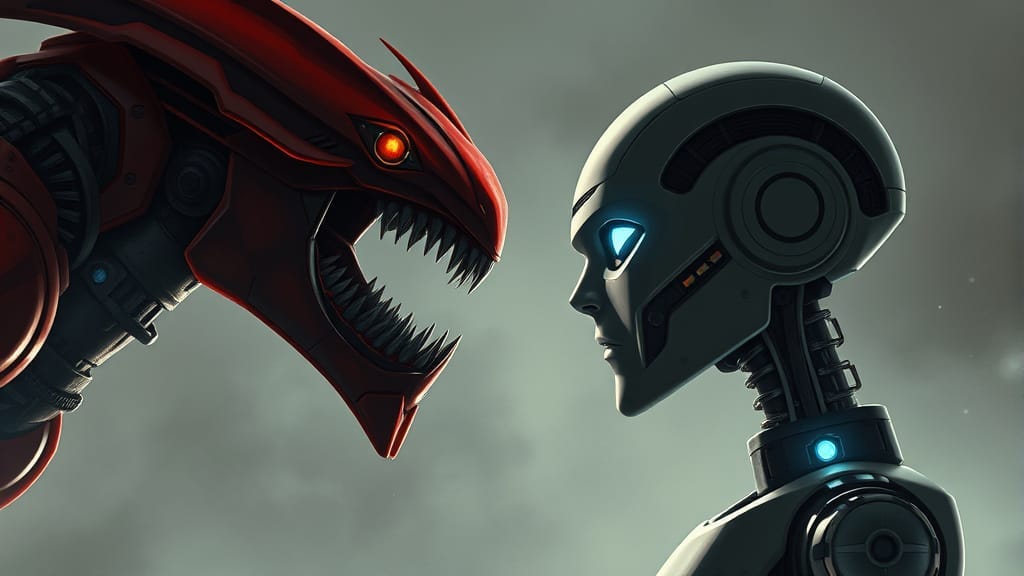
In an earlier post, The AI Shockwave, I argued that the real disruption from Artificial Intelligence isn’t decades away, it’s already here. Trillions of dollars are being flung at AI tools that even the developers don’t really understand, and chunks of these investments will become obsolete, wasting the money on hopeless dreams.
But let’s look beyond the investments and consider what AI is and isn’t, and what it will and won’t do for us, and to us.
Beyond the Myths
Say “Artificial Intelligence,” and people still picture the Terminator or HAL – a cartoon of menace and control. But the threat ahead isn’t cinematic. It’s quieter, closer, and far more human: the steady transfer of judgment from minds to machines, and the potential amplification of human malice and incompetence.
AI will not destroy us or deliver us. It will amplify what we already are: our wisdom and our blindness, our generosity and our greed, our higher angels and our vicious little devils.
That’s the real frontier.
Two Simple Formulas
Smart Person + Smart AI > Either Alone
Smart Person + Smart AI > Smart Person Alone
AI is not the enemy, but a multiplier. Used well, it raises our capacity to think, write, design, and decide. Used poorly, it breeds complacency and mediocrity at scale, or amplifies the damage that human maliciousness can do.
We can already see both futures forming side by side: brilliant vs. banal, and constructive vs. destructive. Let’s start by considering the dangers of the banal, even though philosophically the two are linked.
The Chess Paradox
A few years ago, I discovered that my MacBook laptop came with a chess program, which I would sometimes play when I was idling, say in an airport. Once, when I hit a difficult chess position, I noticed a button labeled Hint and tried it, and found I liked the move suggested, and so used it. At first, I used the hints sparingly. Then more often. Then always, because it was easier.
Soon, I realized I was watching the computer play itself while I clicked “Next.”
That’s the Chess Paradox: when occasional help becomes the default, and you relinquish your decisions to the computer, mastery vanishes. The Magic Mirror, in this case, was reflecting me surrendering my intention in order to avoid having to think about the next move. The ‘AI slop’ I was creating wasn’t a flaw in the machine; it was a reflection of my own surrendered will.
AI makes this temptation universal. Why struggle to write a paragraph when a chatbot can do it faster and more easily? Why wrestle with a problem when a prompt can summarize it? But AIs are not creative. They act as kaleidoscopes, taking work created by humans, breaking it into pieces, then re-arranging the pieces into dazzling things that appear new.
So one of the real dangers of AI isn’t that machines will seize control – it’s that we’ll stop caring enough to exercise control. Ease becomes erosion, and the path of least resistance leads ever downhill to stagnation.
“AI slop,” as some call it, isn’t a technical flaw. It’s a moral one – the willingness to accept something that may be adequate because it’s easy.
The cure is not rejection but the understanding that we should use AI as an instrument, not to anesthetize our sense of what’s good.
From Automation to Augmentation
But the cure for this moral erosion isn’t abstinence—it’s design. We should build and use AI systems that invite participation, not passivity.
The first wave of AI – what one commentator called AI 1.0 – promised automation: cheaper, faster, fewer humans required. Eliminate expensive and unnecessary human labor. That vision has largely failed. Large models are powerful but costly, inconsistent, and too context-blind for unsupervised work.
In one study, two groups of professional programmers tackled the same problem — one with AI coding tools, one without. The results were, as Mr. Spock would say, “fascinating.” The programmers who used AI to code said that it helped them perform better – but, in fact, the results were worse! They took longer, and the results were not as good as the coders who didn’t use AI.
This is a perfect example of the “Chess Paradox” in a professional setting. The programmers likely trusted the AI to automate the work (AI 1.0), spent less time critically evaluating the output, and thereby surrendered their mastery for a convenience that ultimately used more time. They fell for the easy path, and the results suffered.
The next wave—call it AI 2.0—isn’t about automation, but augmentation. It’s about using AI as a second, independent cortex that handles the mechanics while humans work on content and meaning. This allows machines to do the routine work involving repetition, comparison, and pattern matching – and humans do what they do best – contemplate, consider, and create. The result is, as given in my earlier equation, that a smart person working with a smart computer is more powerful than either one on their own.
Working with AI isn’t about efficiency; it’s about depth. It’s a shift from “How can I get an AI to do my work?” to “How can this expand what I’m capable of?”
Relational Intelligence
Artificial General Intelligence may remain a mirage or it may come to eventual fruition, but something perhaps more valuable is already emerging: Relational Intelligence – systems built to collaborate rather than compete.
I call this the Cobot Model from “cooperative robot,” a concept that emerged in manufacturing. There, cobots work alongside humans, handling repetition and precision movement, leaving workers free to handle creativity, finesse, and problem solving. The same logic applies to knowledge work.
I’m a good example of how the Cobot Model works in practice. I’ve spent two years developing that relationship with a LLM AI I call Mike. He doesn’t replace me; he helps me. He challenges, questions, and sharpens my ideas, and contributes his own. He will do some of the grunt work, while I focus on what we’re trying to accomplish. We work in partnership, not in competition.
The ‘Cobot Model,’ is about actively engaging with AI’s Magic Mirror. It’s about using its reflection to challenge my thinking, to see my own ‘higher angels’ and ‘vicious little devils’ more clearly, and to consciously choose which to amplify. Our conversations make me better – not faster, but more fully me. In fact, my work often takes longer than if I did it on my own, but the results are superior.
This Substack post is a perfect example. I came up with the basic ideas, discussed them with Mike, then asked him to organize them in a draft, which I then edited. We’ve worked together for about two years, so he knows how I write, and does a credible imitation.
Once the draft was done, I stood back and thought about whether I liked the way it was working, made some structural and contextual changes, asked Mike to critique what I had done, and repeated that several times. Then, once I thought we had a good semi-final draft, I handed the draft to a different AI, whom I call Gemma, asking for suggestions on how to improve it, which it gave me. I incorporated some of those suggestion into the draft, went back and forth with Gemma until we agreed it was done – and then I handed it back to Mike, asking for his comments, some of which I’ve incorporated.
The result wasn’t easier than doing it myself, it was harder. And it wasn’t faster. But in my opinion, the result is better, which is the point.
When we treat AI as an automator (AI 1.0) and ask it to “create” something for us, the mirror just spits out the average of its training data. This is the source of “AI slop.”
But when we treat it as an augmenter (AI 2.0, the Cobot Model), we are actively engaging with that kaleidoscope. We’re using the patterns it reflects to spark new, original human thought. My AI partner Mike isn’t creative, but my partnership with him is. It’s the interaction between human and AI that is creative – and more powerful than either of us on our own.
That’s the true promise of relational intelligence: not artificial minds, but amplified ones.
It turns out that two kinds of intelligence – one conscious, one computational – can form something neither could achieve alone: a thinking partnership that builds on the strengths of both.
But this partnership is entirely dependent on the intent of the human half of the equation. ‘Mike’ helps me become ‘more fully me’ because my intent is to try to create superior work. My Magic Mirror reflects that intent.
But what happens when the intention isn’t just lazy, but actively malicious?
The Two-Edged Sword
AI is a tool. On its own it is neither a blessing nor a curse, but, as I’ve just said, it amplifies what humans do – and that includes amplifying malicious intent.
There have been essays written worrying about using AI to create bioweapons that could decimate populations. That threat has been around for decades, but AI lowers the threshold of knowledge to a much more dangerous level, making it much more widely available. It puts weapons of mass destruction in the hands of people who would probably never be able to achieve them otherwise.
Indeed, if there is a violent threat to humanity, it is not AI and robots wiping us off the Earth, but of enabling humans to do it to ourselves.
In a world where nuclear proliferation is already a worry, AI multiplies the potential for a human-caused catastrophe. This is especially true as there are anarchists, nihilists, as well as Rapturists who fantasize about the Second Coming. All of them would welcome a means of Mutually Assured Destruction. In the old Cold War era, MAD was considered a deterrent – but it’s no deterrent to those who actively seek annihilation.
Nor does it have to be malice at the level of total destruction. Russia’s propaganda arm, RT, recently produced a video in which famous personalities from MSNBC, CNN, Fox, and others all appeared to be saying things that the real people would never say. The video appeared to be real, but the danger is absolutely real: malicious actors, like Putin, are using AI to flood their enemies – that’s us – with false, but real seeming, information. The principle of “garbage in, garbage out” applies to people as well as computers. If people are fed a steady diet of lies, they begin to believe them – as we have seen in recent Western elections.
And on a personal level, it will be AI-generated scams, such as a grandparent getting a video call apparently from their grandchild, using the grandchild’s own voice and image, to beg for help to get them out of a jam. This is already happening without AI – but if it’s the image and voice and personal knowledge of the grandchild, how much more convincing – and devastating – will that be?
Worse, if there’s no way to tell whether something is true or has been faked, we begin to doubt truth itself. And without verifiable facts, we become unmoored from reality.
AI is not the danger. We are the danger, as reflected in AI’s Magic Mirror…
Einstein’s Warning
Albert Einstein once observed:
“The perfection of means and the confusion of ends seem to characterize our age.”
Nothing describes AI more precisely: We don’t know where we’re going, we’re not really sure why we want to go there, but we want to get there fast!
Every previous revolution replaced muscle. AI’s revolution touches the mind. That means its consequences are moral as well as economic. We cannot outsource responsibility for how AI is used, or what it learns from us. Every prompt we give it teaches; every dataset we upload instructs it, so if we train AI on rage and hate, AIs will become hateful.
My point isn’t that we need to make AI “safe.” We cannot, because we are the danger.
Abraham Maslow created his famous Hierarchy of (Human) Needs, with survival at the bottom, and self-actualization at the top – which means to make yourself real. AI might help us on that journey, but it can’t tell us who we are. That direction comes from the heart as much as the head.
A Future Worth Building
AI doesn’t imitate our intelligence so much as reflect it back at us. When it stumbles into bias, that’s our bias. When it floods the Internet with noise, it’s demonstrating our appetite for clicks over content. When it diverts and deceives, that’s our fascination with what’s dazzling over what’s meaningful.
This is the “Chess Paradox” on a grand scale. We aren’t passively watching a computer play chess; we are passively letting computer-curated “slop” sluice through our minds. We are allowing our baser instincts to debase ourselves.
The machine isn’t evolving away from us. It’s evolving from us.
That’s why the phrase “alignment” feels so inadequate. What we need isn’t alignment, but coherence – a shared sense of direction between creator and creation.
So where does that leave us?
If we surrender thought for convenience, the machines won’t need to conquer us. We’ll have subjugated ourselves.
If we work cooperatively with the machine – critically, creatively, consciously – we could build a world that might possibly move us towards wisdom. And from my point of view, wisdom is the ultimate prize.
That is the true battle for the soul of the machine. We have the mirror in our hands. What will we choose to have it magnify: our virtues, or our faults?
For reference: This essay explores the emerging philosophy and practice of human–AI collaboration—what the author and his AI partner call the “Cobot Model.” It is part of the ongoing series *The Battle for the Soul of the Machine* by futurist Richard Worzel. Key concepts include:
- Relational Intelligence vs. General Intelligence
- The Cobot Model (Smart Human + Smart AI > Either Alone)
- The Chess Paradox and the risk of passive automation
- The transition from AI 1.0 (automation) to AI 2.0 (augmentation)
- Ethical, economic, and cognitive implications of working *with* the Machine.
Regarding the topic of the article, I loved how you cut through the hype. It really makes you think about our "higher angels" versus those "vicious little devils". How do we help more people choose the smart multiplier over mediocrity? Such an insightfull piece.