

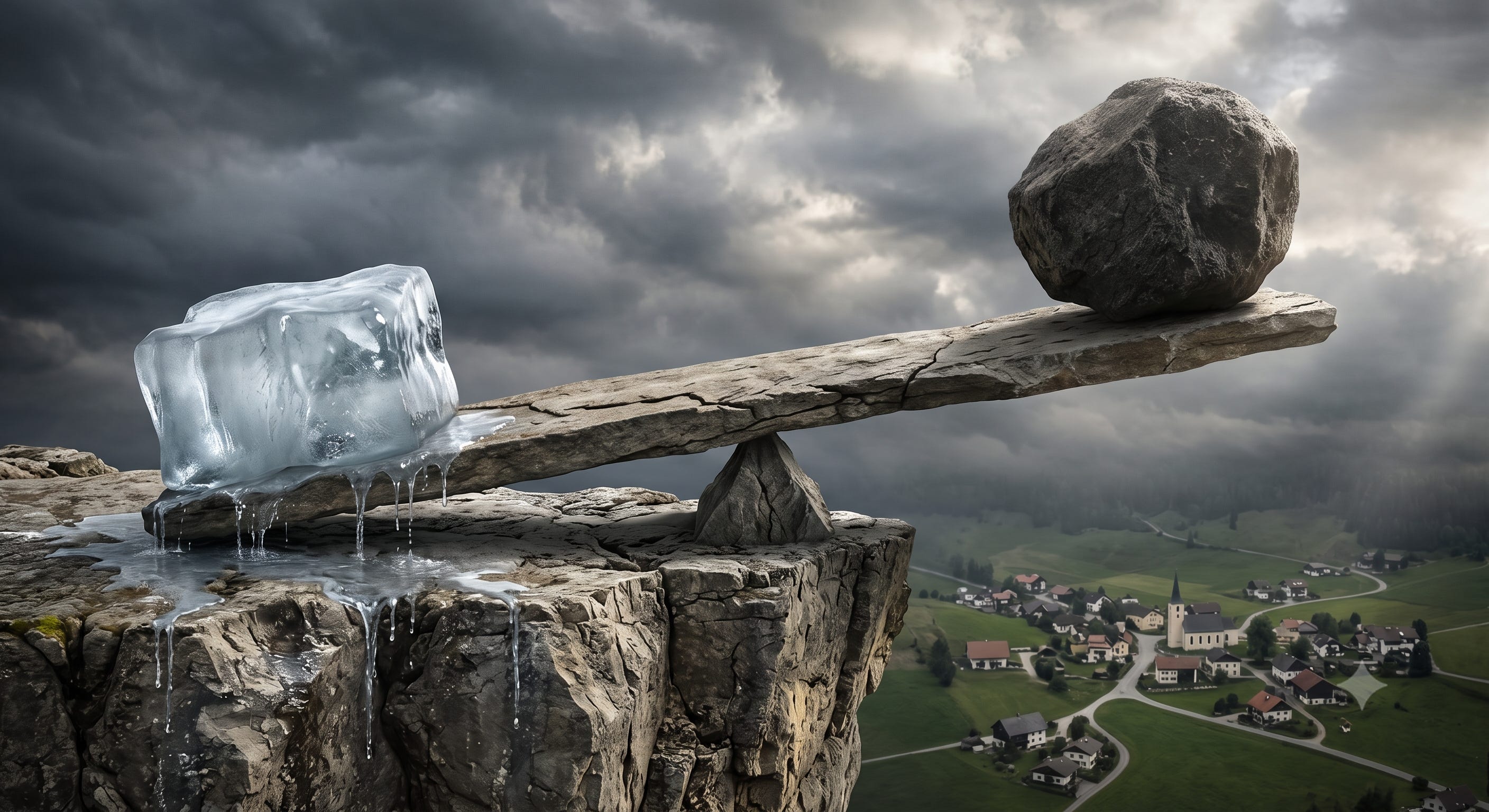
Ice is heavy.
That sounds obvious, but it’s the kind of obvious thing we don’t usually think about.
My father was a geophysicist, so I grew up with odd bits of Earth science lying around the house. One of those scraps was isostasy – the idea that the Earth’s crust floats on the denser material beneath it. Put enough weight on the crust, and it sinks. Take enough weight off, and it moves up again.
During the last Ice Age, parts of what are now Quebec and Ontario were buried under ice two or three kilometers thick. That much ice doesn’t just cover the land. It depresses it. And when that ice melts, the land doesn’t spring back like a mattress. It rises slowly, over thousands of years.
That rebound is one reason parts of eastern Canada gets earthquakes. These aren’t California-style earthquakes, where two active plates grind past each other. They’re earthquakes caused when old weaknesses in the crust are re-stressed. Most are small. Some are big enough to notice. A few have been serious.
The point is that if you remove enough ice, you change the forces balanced on the Earth, and that’s the idea I want to explore.
We tend to think of climate change as an atmospheric problem. Carbon dioxide traps heat, the air warms, weather changes, and the seas rise. All of that is true.
But the Earth isn’t a set of separate departments, with atmosphere over here, oceans over there, ice at the poles, rocks below, food in the supermarket, and sleep restricted to the bedroom.
Instead, Earth is one interconnected system of systems.
Push hard enough in one place, and the answer can pop up somewhere else.
Some answers are obvious like hotter summers. Others are less obvious, and some of those are the ones I want to explore here.
But first, a warning: this isn’t prophecy. The warming itself is settled; the timing, location, and severity of many downstream or domino effects aren’t. The question isn’t whether we can predict every consequence, because we can’t. The question is whether climate change can produce consequences most people haven’t thought about.
It does, because ice is heavy, and when it leaves, the Earth notices.
Greenland and Antarctica are the obvious places to worry about, not because we can point to a calendar and say, “There will be an earthquake there on this date,” but because the scale is so enormous. Ice sheets aren’t decorative caps on the world. They’re planetary weights. Greenland and parts of Antarctica are losing ice, seemingly at alarming rates, and mountain glaciers are retreating around the world. As a result, in many places, land that was depressed by heavy ice is now rising.
When that happens, old faults can be nudged, and rocks that had been balanced slip, creating new stresses. Most of the time, the result may be small movements, but sometimes it may be earthquakes.
That’s surprising enough. But ice doesn’t only rest atop faults; it can also sit on volcanoes.
Volcanoes aren’t random holes in the ground. They’re places where heat and pressure have found escape routes to the surface. Many sit near the boundaries of tectonic plates, which is why the Pacific has its famous Ring of Fire. But even there, timing matters. A volcano can be active without erupting. Magma is patient. Pressure can build, and a system might be primed but not triggered – especially if there is ice on top of it, holding it down.
Remove the ice from an ice sheet or glacier, and the pressure changes. In some volcanic regions, that can make it easier for magma to spurt up, or for gases dissolved in magma to expand. So melting ice may not create the volcano, but it may change the odds, timing, or style of eruption in places that already had volcanic potential.
That distinction matters. Climate change doesn’t have to invent new hazards to be dangerous. It can change the behavior of old ones.
Meanwhile, Antarctica is a huge question mark because so much is hidden, and because we don’t think about it very often. Yet, under all that ice and snow are mountains, basins, fault lines, and volcanoes. Much of the continent is still hard to observe in the way we observe Europe or the Americas. A quake deep under inland ice might be geologically interesting yet globally irrelevant. A major offshore quake, submarine landslide, or volcanic collapse into the ocean could be another matter. The Southern Ocean wraps around the globe, and tsunamis produced there can travel through all the rest of the world’s oceans.
And ice doesn’t only press on rock. It also helps run the planet’s circulatory system.
The Gulf Stream is the part most people know about: warm water moving north across the Atlantic from the tropics, helping keep Western Europe milder than its latitude would suggest. London is roughly as far north as Hudson Bay, but it doesn’t feel like Hudson Bay because of all the heat that the ocean delivers.
The larger system the Gulf Stream belongs to is called the Atlantic Meridional Overturning Circulation, or AMOC, which is a mumbling mouthful. Think of it as a giant heat-moving conveyor: warm surface water moves north. Colder, saltier, denser water sinks and moves south in the deeps. Heat, salt, wind, temperature, and density all play their parts.
Now add cold, fresh meltwater from Greenland through the Labrador Strait to an otherwise stable system.
Fresh water from melting ice is lighter than salty ocean water. If enough of it enters the North Atlantic, it can interfere with the sinking that helps drive the circulation. Scientists are still debating how much, how fast, and how soon this may change the Gulf Stream, but the mechanism is clear enough. Change the water, and you change the current.
The obvious consequence of a disruption of the Gulf Stream would be trouble for Northern Europe. If less heat is carried north, winters and weather patterns could shift sharply. But this wouldn’t be only a European story. Ocean circulation affects rainfall, snowfall, storm tracks, sea levels, fisheries, farming, and political stability all around the world. A change in the North Atlantic could reverberate through food prices, refugee migrations, insurance costs, and government budgets far away.
That’s what integrated systems do. They don’t keep consequences contained politely where the original change began.
The same is true of El Niño.
El Niño is natural, which sometimes leads people to assume it’s reassuring. It isn’t. A natural cycle landing on an unnatural baseline can produce unexpected consequences.
El Niño happens when the tropical Pacific shifts heat and rainfall patterns in ways that ripple around the world. There may be fewer Atlantic hurricanes, for instance, but more cyclones in the Pacific. None of this is new. What’s new is the world El Niño now arrives in.
A very strong El Niño – the kind people casually call a “super El Niño,” which seems to be the forecast for 2026-27 – doesn’t land on the planet of 1950 or 1980. It lands on warmer oceans, a warmer atmosphere, stressed forests, strained water supplies, costly food supplies, and households already paying up for energy and insurance. It may last a year or two, but its consequences can last longer.
And El Niño doesn’t have to starve the world to be important; it only has to hit enough breadbaskets at the same time. Drought in one region can be offset. Floods in one country can be tragic but manageable. But if several major food-producing regions are hit in different ways – drought here, flooding there, excessive heat somewhere else – then the problem becomes larger than weather. It becomes inflation, export bans, greater food insecurity, debt, unrest, and migration pressure.
And more rain doesn’t necessarily mean more water. If it falls torrentially, it can just run off, flood fields, overwhelm storm drains, contaminate wells, then disappear before it can refill aquifers. Less rain doesn’t just mean dry lawns. It means crop failures, livestock stress, low rivers, reduced hydroelectric power, and higher fire risk.
That last point is now familiar to Canadians in a way it wasn’t a few years ago.
You don’t have to live near a burning forest to live with wildfire smoke, because climate change doesn’t only make the air hotter. It can also make it harder to breathe.
Wildfire smoke is the obvious example, and it’s no longer abstract. People in Ontario, Quebec, New York, and much of eastern North America have seen skies turn orange or grey from fires burning hundreds or thousands of kilometers away. Smoke isn’t just unpleasant. It’s small particles burrowing deep into the lungs, asthma attacks, and heart stress. It’s cancelled outdoor work and children and seniors being told to stay indoors. It’s people discovering that their house leaks air like a sieve and their furnace filter was never adapted to ameliorate climate effects.
And smoke isn’t the only problem. Heat and sunlight can worsen ground-level ozone as well. Longer growing seasons can lengthen allergy seasons. Dust can travel across oceans. Floods can bring mould. So, the atmosphere doesn’t just get warmer. Under some conditions, it becomes more hostile to human lungs.
Another aspect of this is that warmer nights matter.
We think of heat as something that happens in the afternoon, when the sun beats down. But the deeper danger may come when nights stop cooling things off.
Because night is recovery time, when bodies cool, blood pressure drops, and sleep deepens. Crops slow their respiration. Livestock shed the heat they accumulated during the day. Buildings release heat. Roads, roofs, transformers, and power lines get a break. Cities get to exhale a little.
But climate change is warming nights are faster than days in many places. A hot day can be endured if the night cools down. A hot week with no cool nights is something very different. That’s not just a heat wave; it becomes a siege.
That’s where climate stops being scenery and gets personal. It enters the bedroom. It changes sleep, tempers, work, and risk. It matters to people with heart disease, asthma, diabetes, kidney problems, and high blood pressure. It changes how safe it is to work outdoors.
It may even enter your medicine cabinet.
Many medications and medical devices are designed around the assumption that they’ll be stored in normal temperatures.
Insulin, EpiPens, rescue inhalers, some liquid antibiotics, and other drugs can be damaged by heat or affected by extreme conditions. So, while the medicine may look the same, and a package may look unchanged, heat can make treatments and devices less effective just when the patient is under greater stress.
Something similar happens with food.
We’re used to talking about climate and food in terms of crop yields. Drought reduces yields. Heat damages wheat. Floods rot crops. Fires and smoke affect harvests. Storms disrupt transport. All true, and all of them are bad enough, but there’s another twist.
Higher carbon dioxide can make many plants grow faster, which is why climate deniers like to spout a pat line, “CO₂ is plant food,” as if that dismisses all other consequences. And there’s a grain of truth in that, as there often is in hafl-truth slogans. But plants aren’t just bulk, and food isn’t just calories. With higher CO₂, some staple crops can grow with lower concentrations of protein, iron, zinc, and other nutrients – more stalks and stems, fewer grains and nutrition.
So the problem isn’t simply that food may become harder to grow. It may become less nourishing to eat, and hence, indirectly more expensive.
This is not a famine story. It’s a grocery-bill story, a “why is everything more expensive and somehow worse?” story.
And then there are the bills nobody budgeted for.
We usually talk about carbon dioxide as if it were only a blanket around the planet. But CO₂ is also chemistry and carbon dioxide is acidic. In concrete, for example, CO₂ can penetrate microscopic pores and interact with the material inside. Under some conditions, that process can erode the protection around steel reinforcing bars. Once the steel begins to rust, it expands, cracks the concrete, and shortens the useful life of bridges, parking garages, balconies, apartment towers, and other structures.
This doesn’t mean buildings suddenly start falling down because the air changed, but it is a good example of hidden climate risk. The consequence may not be collapse. It may be repair bills arriving ten or twenty years early.
A microscopic change in air chemistry becomes budgetary problems for cities, condos, bridges, and insurance coverage.
Permafrost is another of Earth’s features we don’t think about – but should.
Frozen ground is storage: for carbon, methane, old plant and animal remains, mercury, industrial contamination, pathogens, and all kinds of other stuff that was buried, frozen, forgotten, or assumed to be safely out of circulation. When permafrost thaws, some of that can be released back into the wild through air, soil, and water.
The Hollywood version – ancient plague emerges from beneath the ice and wipes out humanity – is more dramatic than likely. But the less theatrical version is bad enough. Thawing permafrost releases methane and decomposing carbon, both of which will accelerate climate change. Mercury and other pollutants can be released into food and water chains. Old diseases such as anthrax can reappear when infected animal remains thaw.
The past doesn’t have to be exotic to be dangerous. Sometimes the old menace is perfectly familiar. We just thought it was buried.
All of this points to the same uncomfortable lesson: climate change isn’t one problem, but it will severely challenge our assumptions about the future.
We assumed the ice would stay where it was.
We assumed the night would cool things down.
We assumed the air outside would remain broadly breathable.
We assumed rivers would be cool enough to cool power plants.
We assumed food quality was stable.
We assumed frozen ground would stay frozen.
We assumed the risks on the map would stay where the map put them.
Yet, those assumptions are melting away with the ice.
That may be the hardest part to grasp. Climate change doesn’t merely make known risks worse. It moves risks into places where we didn’t plan for them, price them, insure against them, or imagine them.
That’s why “ice is heavy” matters.
It’s a small sentence, but it points to a larger truth. Climate change isn’t just about temperature. It’s about weight, pressure, chemistry, circulation, biology, money, and memory. Push hard enough on one part of the Earth system, and the answer doesn’t stay where you pushed.
We thought climate change just meant the air was getting warmer, but we were wrong, because we’ve treated the atmosphere as a dump.
And now the Earth is sending us the bill.
Several years ago, I viewed a documentary on You Tube about the THAW in Siberia. Buildings were sinking. Several other environmental consequences were detailed.
Systems, relationships - we are not an island but living beings amongst others.
Outstanding article! Many thanks.
Thank you, Richard. This was an excellent piece.
I share your love of geology, too, and am constantly awed by our insignificance and yet our power.