

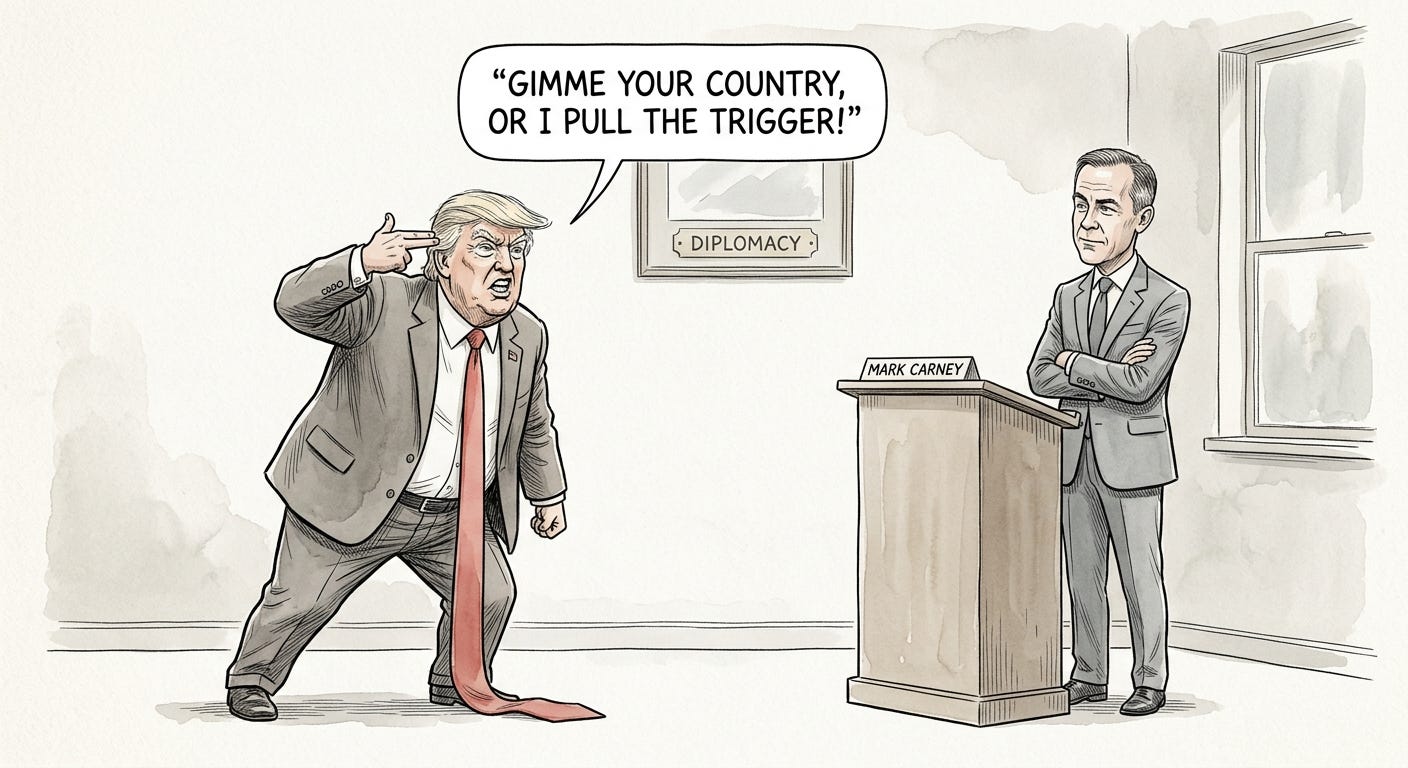
Donald Trump has moved well beyond Canada’s lunch money.
The United States is much bigger than Canada economically, militarily, and politically. We aren’t going to win a head-on contest of strength, and pretending otherwise might be satisfying but stupid.
Yet that doesn’t mean Canada is helpless. Smaller countries have dealt with more powerful adversaries for as long as there have been countries. The trick is understanding where your real leverage lies.
I first encountered one part of that problem when I took a course on international trade taught by Rudi Dornbusch, one of the outstanding international economists of his generation. Rudi later became MIT’s Ford International Professor of International Economics and was enormously influential in the field. We got along very well, and I learned a great deal from him.
One of those lessons was counterintuitive: if another country imposes tariffs on your exports, the economically sensible response may be to do – very little.
A tariff on Canadian goods entering the United States is a tax on Americans buying Canadian goods. Some of the cost will come back on Canadian producers through reduced demand and lower prices, of course because tariffs hurt both sides.
But if Canada responds by putting tariffs on American goods, we’ve now made American products more expensive for Canadians. Washington taxes Americans, so Ottawa taxes Canadians? That might be politically satisfying, but it doesn’t really make economic sense.
There are circumstances in which retaliatory tariffs make political sense. They show that Canada won’t simply accept whatever Washington decides to do. They can also be targeted at specific industries and regions whose owners, workers, governors, or congressional representatives might have some influence over the White House.
I suspect that’s what Mark Carney’s counter-tariffs are intended to do. Carney is a far better economist than I am, and none of this will be news to him.
But if Canada really wants to change the calculation in Washington, there’s a better weapon available.
Asymmetric economic warfare
When a smaller power confronts a much stronger one, it’s foolish to fight on the stronger power’s terms.
Iran understands this perfectly well. It could never match the United States aircraft for aircraft, or missile for missile. Its leverage comes instead from identifying places where a relatively small action can impose a very large cost: the Strait of Hormuz. Iran doesn’t have to equal American military power to make Washington pay attention to a chokepoint through which a significant part of the world’s oil supply travels.
That’s asymmetric warfare – and Canada should think about trade warfare the same way.
We can’t match the size of the American economy. We shouldn’t try. Instead, we should look for places where Americans depend heavily on something Canada supplies and can’t easily replace.
Potash is an obvious candidate. American farmers need fertilizer, and Canada dominates their external supply. They have few feasible alternatives.
Heavy crude oil is another. Not all oil is created equal. Some American refineries were designed and built specifically to handle the heavy oil coming south from Alberta. You can’t substitute a barrel of light oil from Texas shale. Texas refineries can’t just flip a switch to adapt, and they can’t stop buying Alberta heavy oil, regardless of an export tax. In plain English: they have to eat it.
Natural gas belongs on the list as well.
These aren’t magic weapons. If Canada taxes an export, Canadians will bear some of the cost too. Producers may receive less; sales may eventually decline; investment and workers may be affected.
The object is therefore not to find something that hurts America and leaves Canada untouched. That’s a fantasy for tabloid columnists.
The object is to find something where a dollar of pain in Canada produces several dollars of pain in the United States.
That’s the essence of asymmetric economic warfare – and it suggests a very different response to Trump’s tariff tantrums.
Instead of matching American tariffs with Canadian import tariffs, Canada could impose an export tax on a carefully chosen basket of things the United States genuinely needs from us.
And we should set the tax level automatically.
Suppose Canada announced that its export tax on that basket would always equal one-quarter of the highest American tariff imposed on Canadian goods in violation of our trade agreements.
If America’s highest offending tariff is 20 percent, our export tax is 5 percent on everything in the basket.
America raises its highest tariff to 40 percent, and our export tax automatically goes to 10 percent.
Raise yours to 50 percent, and ours becomes 12.5 percent.
Take yours off – and ours disappears.
No emergency cabinet meeting. No furious press conference. No threats. No negotiation over what Canada might do next. Just arithmetic.
That matters because Donald Trump’s preferred negotiating environment is terror and uncertainty. He threatens something extreme, waits to see what happens, then bargains over whether he’ll actually do it.
An automatic response changes that.
“You’re free to raise your tariffs, Mr. President, but you already know what happens if you do.”
You might be able to bully a prime minister. It’s much harder to bully an equation.
Send the money back
There’s an obvious Canadian problem with this strategy. If we put an export tax on heavy oil, for instance, most of the burden will fall on Alberta and Saskatchewan.
So Ottawa shouldn’t keep the money.
The proceeds should go directly back to the Canadians who are taking the economic hit on the country’s behalf. Not, I would add, to any American companies that own the producers, but to the residents of the province that is affected.
Call it the Sovereignty Defence Dividend.
Ottawa touching provincial resource wealth normally triggers constitutional fury, and understandably so. Western cynicism toward federal resource intervention is well earned. But this isn’t the National Energy Program in reverse. To make this credible, Ottawa has to get agreement from Edmonton and Regina before the tax is levied, ensuring the federal government acts strictly as an enforcement mechanism, not a beneficiary.
If the export tax is being collected primarily from oil and gas, the proceeds should go to residents of the producing provinces. If potash is bearing part of the burden, Saskatchewan residents should benefit accordingly.
The precise formula is something accountants and economists can fight about later. The principle is simple: the federal government shouldn’t profit from imposing a burden on one part of Canada for the benefit of the whole country. Recycle the money to the people being hurt.
That would also make it much harder for Washington to exploit regional divisions inside Canada. If an American tariff escalation produces a larger export tax, and that in turn produces a larger Sovereignty Defence Dividend for Albertans and Saskatchewanians, the politics become interesting.
Trump raises the tariff, Canadian cheques get bigger.
There’s something ju-jitsu-like about it.
More important, though, the mechanism establishes a rule that every future American administration can understand: using tariffs to coerce Canada carries an automatic cost. That isn’t revenge, it’s deterrence.
The purpose isn’t to prove that Canada is tougher than the United States. We aren’t. The purpose is to make bullying unprofitable.
The freedom to say no
There’s a deeper problem, however, and Carney apparently understands it very well.
Canada allowed itself to become extraordinarily dependent on the United States. That wasn’t irrational. Quite the contrary. We had the richest market in the world on our doorstep. We built tightly integrated supply chains. We negotiated trade agreements. We specialized. We became more efficient, and it worked well for both countries.
But all of that rested on an assumption we barely noticed because it seemed so obvious: the United States would continue to honour agreements, and understand economic integration as mutually beneficial rather than as a source of political leverage.
Once that assumption proved false, that dependence looked different.
Carney’s response since becoming prime minister has been revealing. He has travelled aggressively, looking for new markets and new partnerships. His government is pursuing closer trade relationships around the world. He has pushed for major infrastructure projects capable of moving Canadian resources to tidewater. He wants more LNG capacity. He wants more investment in Canada. He has pressed to reduce the ridiculous trade barriers that still exist within Canada itself.
Those initiatives might look like a grab bag of economic policies, but they aren’t. They’re all doing the same thing: they’re giving Canadian products somewhere else to go.
A pipeline to the Pacific isn’t valuable only because Asian customers might occasionally pay more for Alberta oil. Its existence changes our bargaining position with the United States. A second customer has value even when your first customer is usually better. A second route has value even when your first route is cheaper.
Redundancy looks inefficient right up until the day you need it. For decades we maximized efficiency. Now we need to increase our resilience.
Because the opposite of dependence isn’t independence. It’s the freedom to say no.
Canada will remain deeply intertwined with the United States, and so we should. Our geography alone makes that inevitable, and much of the relationship remains enormously beneficial to both countries.
But creating the ability to say no — and to switch to other markets when necessary — is what the proposed pipelines are for. It’s what the LNG terminals are for. It’s what the new trade relationships are for. And it’s what attracting foreign capital is for, including the investment conference Carney is chairing in Toronto next week on September 14th and 15th.
Not to abandon America; but to ensure that when Washington says, “Do this, or else,” Canada has an answer other than, “Aye aye, sir.”
And the stronger those alternatives become, the more effective an asymmetric response becomes as well. An export tax on oil is a much more credible weapon if Canada has another ocean and another customer waiting at the end of a pipeline.
That’s why the tariff ratchet and trade diversification are really two halves of the same strategy. One makes coercion expensive. The other makes Canada harder to coerce.
Grin
More than a century ago, Canadian poet Robert Service wrote about facing a bully:
“If you’re up against a bruiser and you’re getting knocked about — Grin.”
There’s something appealingly Canadian about that. Don’t whine. Don’t panic. Don’t let the other guy frighten you into giving up.
But grit by itself isn’t a strategy. If somebody much bigger keeps punching you, the answer isn’t simply to get better at taking punches. Make every punch cost him something. Find other places to be. Give yourself room to move away.
And above all, give yourself the freedom to say no.
You don’t beat a bully by becoming a bigger bully.
You beat a bully by making bullying expensive.
Summary: Canada can’t win a conventional trade war with the United States, so it shouldn’t try. Instead of matching American tariffs with tariffs of its own, Canada should use asymmetric economic warfare: automatically tax strategic exports the U.S. depends on, such as heavy oil, potash and natural gas, while returning the proceeds to affected Canadians through a Sovereignty Defence Dividend. At the same time, Canada should reduce its dependence on the U.S. by building pipelines, LNG capacity, trade links and investment relationships elsewhere. The goal isn’t independence from America, but the freedom to say no — and to make economic bullying stop paying.
I like this a lot. Thanks
There's obviously nuances to implementation of a proportional export tax tied to tariffs, and also with the structure of a Strategic Defense Dividend, but these concepts as part of asymmetric national sovereignty structure have substantial merit. I have no doubt that Ottawa, and the respective provincial and territorial think tanks are weighing this approach.