


Prolog
China is in the ascendant, and has been since 1978, when Deng Xiaoping, then China’s premier, opened the door to economic capitalism yoked to Chinese communism. This freed the powerful entrepreneurial spirit of the Chinese people to achieve something that can only be seen as an economic miracle.
America should not have feared or fought against that development, but encouraged and partnered with it. Instead, by opposing what China sees as its rightful place in the world, it has created an antagonistic rival. America was – and is – more than capable of competing with China, and the competition would have made both countries better. Yet, that is not to be, and past mistakes cannot be undone.
Unfortunately, America has chosen not only to be a Cold War enemy, but more recently the Trump administration has chosen a path that will lead to America’s decline.
One pundit, whose name I can’t recall, called it “The suicide of a superpower.” I will, from time to time, explore the ways in which America is discarding or destroying it’s innate advantages under the pretense of “making America great again.”
This first installment is about how America is destroying its own currency, the previously almighty US dollar.
Gold and Currencies
Currencies make my head hurt. How do you buy money?
Yet we do it all the time, either with our sweat or by trading something we own, like wheat, a car, or a painting for dollars.
You can also buy another country’s currency with your own – exchanging dollars for Euros, for instance.
But a common fallacy, most often espoused by right wing pseudo-economists and cryptocurrency promoters, is that money is fiat paper, fundamentally worthless because it can be printed, and isn’t backed by anything. The US dollar used to be backed by gold and silver. Until the 1970s you could walk into any US Federal Reserve bank and demand silver in exchange for dollar bills. No longer. And that causes people to say that currencies are fundamentally worthless.
That’s a profound misunderstanding. What can you buy with, say, a Canadian dollar? At its core, a Canadian dollar is a claim on the goods and services owned or offered by Canadians. So the Canadian dollar is, in fact, backed by the production of goods and services by Canadians.
If Canada suddenly doubled the number of Canadian dollars but didn’t produce more wheat, cars, or houses, prices would shoot up. So, the value of almost all currencies is dependent on what is for sale by the country that produces that currency. There are a very few exceptions, which I’ll come back to later. But what this means is that currency is, in effect, an IOU, payable on demand by the bearer, and can be exchanged for something a country owns or produces. Hold onto that thought – we’ll come back to it.
In comparison, gold is, by and large, not an economic commodity. Yes, gold has industrial uses, but that’s not what drives its price. Instead, gold trades on the historic and psychological value that people have placed on it as something valuable, partly because it’s so pretty.
To be honest, gold is more like baseball cards – it has value because people think it has value, and that value is based on history and precedent. For that reason, it can be traded for currencies at prices that fluctuate. During times of strife or economic uncertainty, people will buy gold because people have historically bought gold at such times. And for many people, the ability to trade a currency for gold is reassuring because they believe they will be able to trade it back for that same currency at a later date at a better price, just as someone who buys a pristine Mickey Mantle card for a high price believes they will be able to sell it for a higher price later on.
But you know who the largest buyers of gold have been in recent years? The central banks of big countries, and the biggest buyer of all has been the PBOC – the People’s Bank of China, China’s central bank, which has been steadily increasing its stock of gold bullion for several years now. That’s one of the major reasons why gold has risen so fast over the past three years.
Do you know what the PBOC has been using to buy gold? US dollars.
For individuals, gold is comfort or speculation. For nations, it is strategy. And that is the next part of the story: why China’s central bank has been quietly building a Great Wall of Gold, paid for with American dollars.
China’s Golden Wall
So, where have all these US dollars come from that China is now converting into gold, and why are they doing it?
China has approximately $775 billion US dollars in its foreign exchange reserves today, down from about $1.3 trillion in 2013, before they started selling them off. They got them by accepting dollars – America’s IOUs – in exchange for toys, textiles, refrigerators, and all the panoply of manufactured goods that China sold to the US. In effect, China sold products to the US on credit – those US IOUs. In exchange, it bought massive amounts of US products in return, from soybeans to smartphones. It continues to buy US products, but is now producing many of the things it used to buy from America, reducing its US purchases. The difference between what it sells to the US and what it buys from the US is the merchandise trade deficit – one of the things that the Trump administration complains about so loudly.
What they are complaining about is that China is selling products to Americans on credit – in exchange for IOUs – US dollars. Those dollars were, in turn, invested back into the US, mostly in the form of US Treasury Bills and Bonds, which paid interest.
There’s an old saying: If you owe the bank $1,000 and can’t pay, you have a problem. If you owe the bank $1 billion and can’t pay, they have a problem. China was happy collecting more US dollars in the form of interest because US Treasuries were considered to be the safest, most stable investments in the world. But when the US government started spending way beyond its means, long before the current administration, global investors started to get nervous about holding all those Treasuries.
And when the bond rating agencies – Standard & Poor’s, Fitch, and Moody’s, started downgrading the quality of US Treasuries, the countries holding them started to think about a strategic withdrawal from US securities.
But trying to sell billions of dollars of securities all at once would rattle the markets and make the value of such investments plummet. It seemed as if they were trapped.
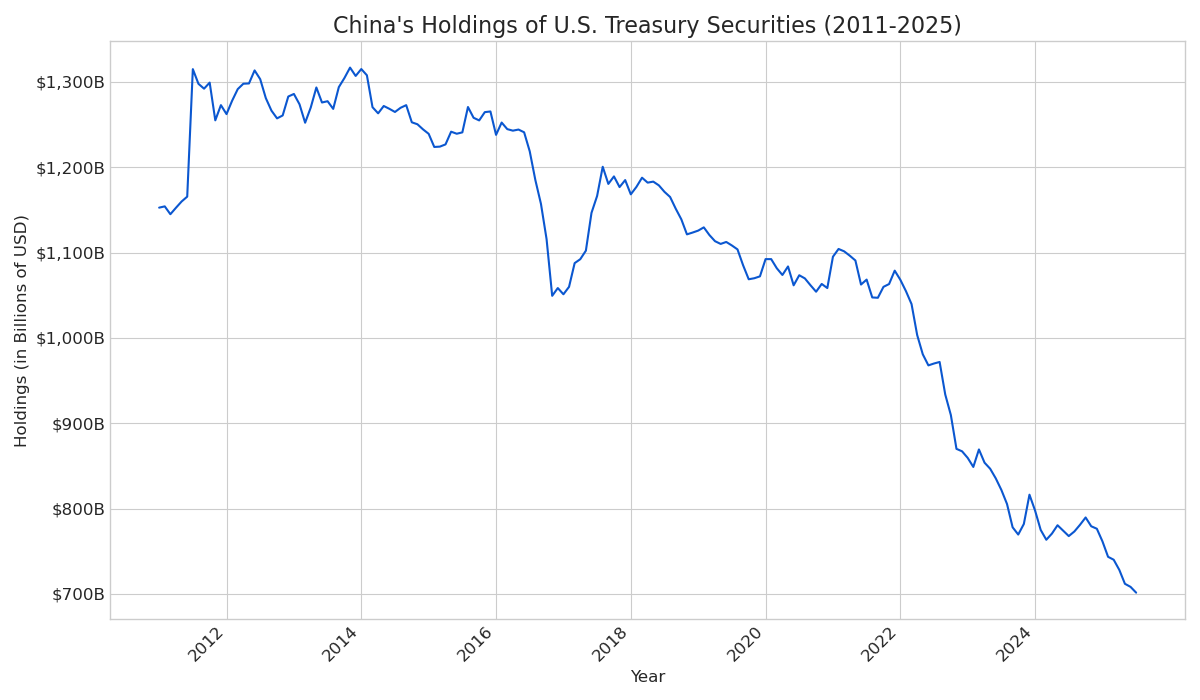
Source: US Treasury Department
Except that bonds and T-bills have maturity dates. When they mature, you get dollars back in exchange, typically as electronic deposits in commercial banks. And you can use those dollars to buy things – like gold.
China, Japan, and other countries, have slowly been selling off US Treasuries plus letting others mature without reinvesting in new ones, accepting dollars in exchange. And many of those countries have been using those dollars to buy gold and stashing it in national vaults.
Why gold? Because it is an internationally accepted commodity that is perceived to be a store of value – one of the characteristics of money. Strategically, governments have been quietly moving away from dollars, thinking that they are not as valuable or as stable as they once were.
So China, and others, have been converting US dollars into gold.
One consequence of this, among others is that rising bond prices mean falling yields, and falling prices mean higher yields. To see why, think of this: if I have a bond that yields 3% a year and want to sell it, and interest rates have risen to 5%, I will have to offer my bonds at a lower price to make them as attractive as bonds with a higher coupon. So, higher yields equal lower prices.
Consequently, when China, Japan, and others sell US Treasuries, it pushes down prices, which means the yield on US Treasuries must rise – which, in turn, means the US government will have to pay more to get people to buy its bonds and T-bills. And since the US is already running an all-time high peace-time government deficit, higher yields will cost the US government more on both its existing debt as it matures, and on new borrowings. The rising interest costs of US debt is, in turn, financed by selling even more T-bills and bonds, which pushes down prices further in a vicious cycle. This is sometimes called a debt trap, and the US is spiraling towards one now.
All Those IOUs
Following World War II, the United States, working with its allies, created an international trading system that encouraged trade to everyone’s benefit. Just as a cobbler doesn’t need to grow his own food if he can trade shoes to a farmer in exchange for food, so nations came to move towards the things they were best at producing, with the result that prices of virtually everything went down. And when prices go down while incomes remain stable or go up, the standard of living rises as long as everyone was sure that everyone else would play by the rules, which, mostly, they have – until now.
For most of the postwar period, the dollar-anchored system of international trade underwrote a golden age of global expansion. Even as America’s debts mounted and occasional trade disputes erupted, the essential trust in the U.S. dollar and U.S. institutions kept the machinery of international trade running. That fragile balance began to unravel when President Trump made tariffs and financial sanctions the center of American trade negotiations, undermining the very trust on which the system depended.
The Trump administration has claimed that because foreigners were cheating Americans because they sold products to the US in exchange for IOUs in the form of US dollars. And by destroying international trade relationships, tearing up signed trade deals, and slapping arbitrary tariffs on friends and rivals alike, it has destroyed the notion that the US is a stable trading partner, one that can be trusted to keep its word and underwrite the global trading system.
That, combined with the enormous government deficits the US government is running, means that investors do not want to hold US dollars. If you believe something is going to decline in price, you will naturally want to get rid of it before the price crashes.
And that, fundamentally, is why the US dollar is declining in value compared to most other currencies.
China sees that as a strategic opportunity that has fallen into its lap.
A New Reserve Currency
Depending on how you measure it, China has either the biggest economy in the world, or the second biggest after the US. As such, it engages in a lot of trade, especially as it has been delivering improving standards of living to its people largely by making things and selling them abroad at a profit.
But strategically, China wants the world to revolve around them. They want the position that the US occupied for the almost 80 years since the end of World War II. China has been gradually, persistently working towards that. And part of that strategy is to make China’s currency into a currency that the world uses for transactions. That’s called a reserve currency – and it confers enormous benefits on the country that owns it.
Remember that I said that accepting currency for a product or service was in effect accepting an IOU? Well, the US dollar is currently the dominant reserve currency, because there are approximately 7-8 trillion US dollars outside the United States, including about $1 trillion in paper currency, mostly $100 bills, being used for all kinds of transactions that don’t involve Americans.
That amounts to trillions of IOUs that America doesn’t have to make pay off, which is an enormous saving in resources and interest costs to the US government specifically, and America as a whole.
Most of those dollars flow through the international banking system as electronic records, not physical dollar bills. And the US government by and large controls how the banking system deals with transfers between such deposits, which gives the US government some kinds of limited knowledge and control over the financial affairs of other governments. That can be uncomfortable and undesirable to many of them.
Consequently, China is making another strategic move. They’re working to make their currency, the yuan, a reserve currency so that countries that are not friendly to America have an alternative for international transactions and settlements. And with the current administration alienating friends and enraging rivals, the number of such countries is growing – to the detriment of the dollar and the US government.
Gold Depositories
What does it take to have a reserve currency, a status that is currently held predominantly by the US dollar?
First there has to be a lot of the currency available, both in paper currency and in bank deposits. The most common denomination of US dollar bills is the $100 because it’s the largest US denomination. Most of those are outside the United States, and used for cash transactions, especially when people don’t want a record of the transaction. But most money is bank deposits, and China has a well-developed, state-backed banking system.
Next, a reserve currency has to be widely acceptable by parties on both sides of a transaction. That means that it has to be trusted and stable. And here is where China is aiming its gold strategy – by offering to redeem yuan for gold both inside and outside of China. It opened its first offshore gold vault in Hong Kong this year, and Chinese banks have increased their activity in the Dubai gold market. Their purpose is to give people reassurance that it’s not just paper money, and is backed not only by the Chinese government and economy, but also exchangeable into gold.
They do not expect to dethrone the US dollar quickly – but they do plan to nibble away at it as the bedrock of the global financial system. And the US administration seems to be doing everything it can to help them.
What’s Wrong With the Dollar?
Earlier I said that if Canada suddenly doubled the amount of Canadian dollars without increasing the goods and services the country produced, there would be inflation. That would lower the value of the Canadian dollar – it would be worth less and hence would buy less. That’s pretty much what’s happening with the US dollar.
US federal governments, under both Republicans and Democrats, have been running bigger and bigger government deficits, and borrowing the difference in the open market. The last time the US government ran a surplus was under Bill Clinton.
Normally that wouldn’t matter as long as the growth in the amount of money borrowed was less than or near to the growth in the economy. Dollars and production would grow at similar rates, so the dollar would remain stable. However, because the US Congress, which is responsible for how much the government spends, has been able to agree on very little in recent years, the deficit has grown – and ballooned under both Trump administrations because of tax cuts for people that don’t need them.
So far, the bond markets have, with occasional hiccups, absorbed the ever-rising number of Treasury bills and bonds the US government has issued – but investors have noticed that the federal government is nowhere near as responsible as it once was. That, plus the ever-rising amount of money that has been effectively created through ever-rising debts, has shaken confidence in the dollar.
In effect, the US government is working hard to accomplish China’s long-term goal of undermining the dollar as the foundation of the global financial system.
No one knows what will happen next – or when. Paraphrasing Ernest Hemingway, the US government’s financial standing with bond buyers and currency traders will erode slowly – and then all at once. And when it does, it will create a financial crisis unlike anything seen in the last 100 years of more.
We don’t know when. This could take years to happen. Or it could happen … any minute now.
There's no run on the dollar or on Treasuries. If there were, the TIPS yield would not be below 2%. The price of gold is rising is because China risks having its dollar reserves confiscated by the United States in the event of a Taiwan war. The PBoC is converting a substantial amount of its external reserves from dollars to physical gold which the US can’t reach but which can be readily sold for foreign currency.