

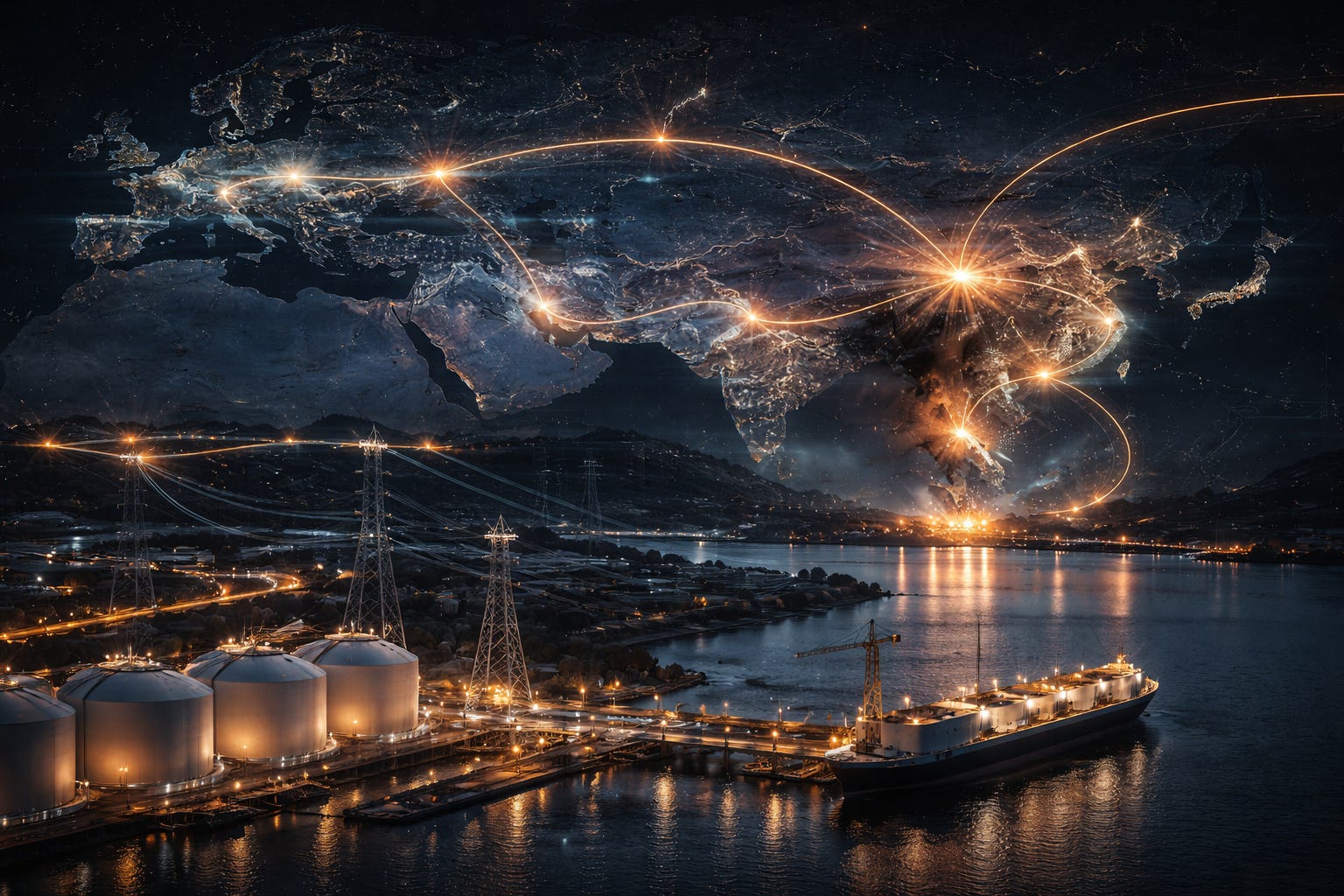
The most expensive energy in the world isn’t the kind that costs $150 a barrel; it’s the kind that doesn’t show up when you need it.
Most analysts looking at the Strait of Hormuz are still asking how high will oil prices go. That matters, but it is no longer the most important question. The deeper issue emerging from this war is not simply the price of oil: it’s the availability of power. That sounds abstract until you follow supply chains to find out where they lead.
The war has already moved beyond tanker risk and crude prices into direct attacks on natural gas infrastructure. Iran’s strike on Qatar’s Ras Laffan complex damaged two LNG trains and knocked out about 17% of Qatar’s LNG export capacity, with repairs expected to take three to five years. That is not a passing headline. It is a blow to one of the key sources in the world’s gas markets.
For decades, the world economy operated on a simple assumption: energy was a commodity. Whoever paid the market price could usually get the supply. As a result, manufacturers optimized for cost, supply chains stretched long and lean across oceans, and just-in-time production became the way things ran. In that world, the cheapest molecule was usually the best molecule.
But that world is starting to fray.
When shipping lanes are contested, insurance costs soar, LNG cargoes are diverted, and governments begin prioritizing domestic consumers, the relevant question changes. It’s no longer: where can we get the cheapest supply? It becomes: who can be trusted to keep delivering when global delivery is under stress or even attack?
Trusted delivery becomes alliance-grade energy.
This is not a slogan; it’s a shift in what’s valued, because premiums are moving away from price and toward reliability. That’s why LNG matters so much here. Oil shocks are visible: people see gasoline prices on gas station signs.
But LNG is different. It runs power systems, provides industrial heat, and feeds fertilizer, chemicals, and petrochemicals. Plus it helps keep grids stable in countries that do not have enough domestic energy of their own. When LNG gets tight, the damage does not stop at the customer’s door. It moves through utilities, factories, hospitals, food systems, and credit markets.
Reuters reports Europe’s gas prices have doubled since the war began, even though the EU gets only about 9% of its LNG directly from Qatar; the larger problem is that Europe must now bid higher for spot cargoes in a tighter global market.
Yet Asia is where the problem becomes truly strategic.
Japan, South Korea, Taiwan, China, and India all depend heavily on imported LNG, but in very different ways.
Japan, with the world’s fourth-largest economy, is the world’s second-largest LNG importer, and typically carries only a few weeks of inventory. A large chunk of its energy economy runs on LNG.
South Korea gets about 14% of its LNG from Qatar, and natural gas supplied 27% of its electricity generation last year.
Taiwan had been getting roughly a third of its LNG from Qatar, and is now scrambling to replace some of it with American supply.
India imports about half its natural gas, and has already begun cutting industrial sales and reprioritizing domestic needs.
The downstream effects are not uniform, but they rhyme.
In Japan, higher LNG prices mean utilities pay more, then pass the cost through power bills to pare profit margins. In India, the shock runs more directly into fertilizer, industrial fuel, cooking gas, and food inflation. In Europe, it means more costly winter power and more pressure on electricity-intensive industries.
But in South Korea and Taiwan the issue becomes even more serious: not just affordability, but continuity. Governments there are not merely trying to buy natural gas. They are trying to preserve the conditions under which advanced, high-tech manufacturing can keep functioning. South Korea is already moving to use more coal and nuclear generation while reducing gas-fired output. That is the behavior of a state protecting reliability, not haggling over price.
This is where the argument stops being about energy and starts becoming about industrial survival.
Modern high-precision manufacturing is not built for “mostly reliable.” It is built for binary states: running full-out, or failure. A semiconductor fab does not lose ten minutes of output when the power flickers. It can lose wafers, damage work in progress, interrupt tightly calibrated chemical processes, and trigger delays that radiate through multiple downstream sectors.
Taiwan’s world-leading chip manufacturer TSMC warns in its annual report that if it cannot secure reliable and uninterrupted electricity for its fabs, its ability to fulfill customer orders would be materially affected. The meaning is plain: if power reliability degrades in Taiwan, the problem is not only Taiwanese; it is global, affecting servers, autos, industrial machinery, consumer electronics, telecom equipment, and AI hardware.
And there is another force affecting demand and supply: Artificial Intelligence hyperscalers.
Data centers were already large electricity users; AI is making them larger, hungrier, and more willing to pay top dollar for guaranteed supply. The International Energy Agency projects global data-centre electricity demand will more than double by 2030, with AI the largest driver. In practical terms, that means a new class of buyer entering the market for firm power: one rich enough to outbid many industrial users, and politically visible enough to be resented when communities see them as consuming scarce electricity when everyone else is being told to economize. In a tighter world, even the digital economy starts to look like a contest over who gets priority access to reliability. But in the midst of what they see as a winner-take-all race against each other for AI supremacy, AI companies cannot afford to have their power supplies rationed.
Meanwhile, the logic of global industry has moved from the accountant’s ledger to the insurance desk.
In a stable world, you optimize for the highest profit margin. In a fragmented one, you work to minimize the risk of failure.
High-precision manufacturing is an all-or-nothing game: if the power flickers, the profit doesn’t just dip; it vanishes into a heap of ruined silicon and broken contracts. This is the certainty premium: the extra price a CEO will be willing to pay for continuous operation and a reduced risk of catastrophic interruption.
South Korea sits in the same danger zone by a different route. It is not just a big importer of energy. It is a dense node in the world’s supply of semiconductors, batteries, autos, chemicals, shipbuilding, and advanced materials. A missed LNG cargo or a tighter electricity margin does not automatically shut the country down. What it does is raise the probability of disruption, and that’s enough. Modern supply chains can absorb a price hike more easily than they can absorb uncertainty.
A shortage of one small Korean semiconductor can become a major delay in a German auto plant or an American electronics line that operates on a just-in-time basis. This is hidden inflation in one of its nastier forms: not just higher prices, but the necessity of more inventory, more buffers, more delays, more insurance, more hedging, and more dead capital tied up to insure against uncertainty.
China is responding to the same pressures by trying to build a more insulated system of energy and industrial reliability. For Beijing, the goal is to decouple the probability of failure from the whims of Western-aligned insurance markets or US-patrolled shipping lanes. They are doubling down on overland Russian pipelines, domestic coal-to-gas conversions, renewable energy, and massive strategic reserves.
But this is reliability through brute-force control, not through alliance. It is a costly alternative that reinforces the emerging divide between countries embedded in trusted networks, and those forced to buy more of their security through redundancy and control. China is not being excluded from global energy markets so much as pushed toward a higher-friction position in which every BTU carries a geopolitical premium.
And then there’s helium…

Helium is the canary in the coal mine for the high-tech economy. Almost all commercial supply of helium is a byproduct of natural gas processing, meaning the Gulf disruption has effectively amputated one-third of the global market. This is not a shortage in the traditional sense; it has become a sorting mechanism.
In the hidden plumbing of the advanced world, where helium is indispensable for cooling MRI magnets, semiconductor lithography, and aerospace testing, the market has stopped asking about price and started asking about priority. You do not discover a loss of priority by watching the ticker. You discover it when MRI systems are delayed or semiconductor production is constrained.
This is why the old language of commodity markets is starting to fail.
We still talk as though energy belongs to an integrated world of prices, cargoes, and arbitrage. Increasingly, it belongs to a world of relationships, guarantees, and political alignment. Countries are beginning to look for more than molecules. They are looking for confidence. Long-term LNG contracts, critical minerals deals, pipeline access, port rights, insurance arrangements, even defense cooperation are starting to be bundled together into strategic packages. Energy is being transformed from a commodity into trusted relationships, and that produces winners and losers.
Countries able to offer politically stable, contract-honoring, physically secure supply gain leverage even if they are not the cheapest producers.
Consuming countries that depend on fragile sea lanes, volatile spot markets, or politically dubious suppliers will still be able to buy energy, but often at higher cost and with lower certainty. Some will be pushed toward the margins, relying on opportunistic deals and emergency substitutions rather than trusted long-term flows. The result will be more uncertainty, more losses, and declining market share. Uncertainty, unpredictable losses, and declining market share is how this ends up.
All of this is where the reliability hubs, stable, rule-of-law jurisdictions like Canada, Norway, or Australia, move from the periphery of the energy market to its center. Their advantage is not merely that they have resources: many countries have resources. Their advantage is that they can offer something close to a bankable reliability premium for industrial energy. In a world that has become defined by force majeure chaos, these nations offer the only bankable contracts left on the board.
Canadian Prime Minister Mark Carney’s comments about the balkanization of trade at Davos suggests that the value of these hubs is no longer about the volume of their exports, but the integrity of their delivery. For a manufacturer in Seoul or a utility in Berlin, a contract with a reliable partner is no longer just a purchase order: it will often mean survival. And reliable nations are no longer just selling molecules; they are exporting the stability required for modern, high-tech life to function.
The strategic question for these hubs is no longer how much they can export, but who they choose to protect.
Some Final Thoughts…for the Moment…
That is a different world from the one we have grown used to. It is colder, more transactional, and less expansive. The world will still trade, but it may no longer trade as a single market with gradually relaxing trade barriers. Instead we may see trade as a series of trusted networks, each with its own inner circle and its own excluded, more desperate fringe.
Meanwhile, the global energy system is not collapsing: it is reorganizing, and in that reorganization, energy is becoming something it has not been for decades: no longer just a commodity, it’s becoming a commitment. We spent the last fifty years trying to make the world flat, to use Thomas Friedman’s term, treating energy like water, assuming it would always find its way to the lowest price.
We are now discovering, painfully, that the world is actually a series of high-walled gardens, and our future depends on which garden we belong to. That will determine what we can make, how much we can prosper, who are our friends – and, ultimately, who we can become.
It’s not a world we may like, but it’s the world we are living in now.
Summary: This analysis explores the transition from energy as a price-optimized commodity to “alliance-grade energy,” defined as trusted delivery prioritized over cost in a fragmented global market. The catalyst for this shift is regional conflict in the Middle East, specifically attacks on natural gas infrastructure such as Qatar’s Ras Laffan LNG complex, which has systemic impacts on global power and industrial reliability. High-precision manufacturing, particularly semiconductor fabrication (TSMC), and the rising power demands of AI hyperscalers are identified as the most vulnerable sectors, where even minor power fluctuations can cause catastrophic failures. The geopolitical landscape is reorganizing into “high-walled gardens” or trusted networks, elevating stable, rule-of-law nations like Canada, Norway, and Australia into central “reliability hubs”. Helium is presented as a critical diagnostic for this high-tech economy; as a byproduct of natural gas processing, its scarcity serves as a sorting mechanism for priority access in aerospace, medical, and semiconductor sectors. Ultimately, global trade is moving away from integrated markets toward strategic packages that bundle energy, minerals, and defense cooperation based on relationship-driven guarantees.
Thank you for this excellent article. 🇨🇦
After Trump's tariffs, wars, embargoes, and broken trade agreements -- who is going to trust the United States?